August 4, 2026
What are Eligible Investment Funds (EIFs)? What is an Offshore Fund?
Why in News?
The government has proposed a major easing of eligibility norms for Eligible Investment Funds (EIFs) managed from India, as part of its ongoing efforts to establish the country as a global fund management hub.
-
Context: Under the Taxation and Other Laws (Amendment) Bill, 2026, offshore funds seeking tax exemptions on their global income will no longer be required to comply with several stringent historical conditions.
Key Points:
-
Removal of Strict Conditions: According to the new bill, offshore funds seeking tax exemptions on their global income are exempt from the following requirements:
-
Maintaining a minimum of 25 investors.
-
Limiting any single investor’s participation to a maximum of 10%.
-
Restricting investments of more than 25% of the corpus in a single entity.
-
Avoiding investments in associate entities.
-
Maintaining a minimum average monthly corpus of Rs 100 crore.
-
-
Level Playing Field: This amendment removes the discrepancies between International Financial Services Centre (IFSC) and non-IFSC offshore funds, establishing a uniform eligibility framework.
What is an Offshore Fund?
-
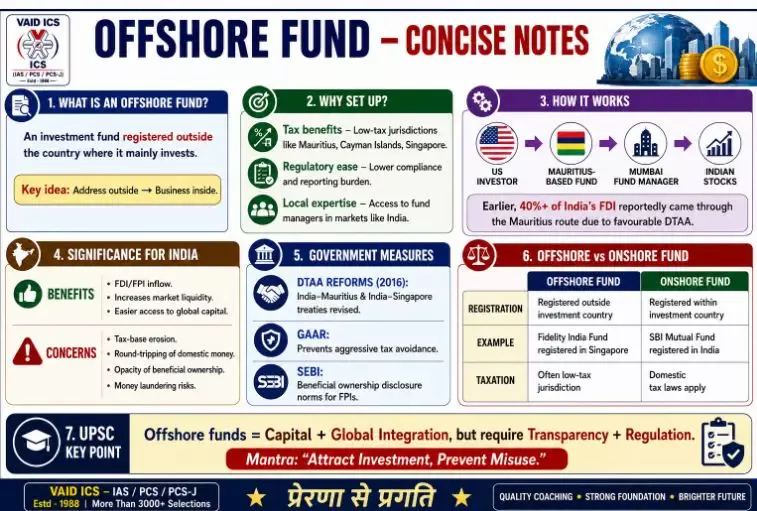
Definition: An offshore fund is an investment fund that is registered/incorporated in one country but invests primarily in another country. The fund management and investment decisions are often handled from the country where the investments are made, but the legal registration is in a different jurisdiction.
-
Key Idea: Address is outside, Business is inside.
Why Are They Set Up? – 3 Main Reasons:
-
Tax Benefits: Registered in low-tax jurisdictions like Mauritius, the Cayman Islands, Singapore, and Luxembourg. This helps reduce capital gains tax and withholding tax.
-
Regulatory Ease: Fewer compliance, disclosure, and reporting requirements compared to onshore funds.
-
Access to Expertise: Foreign investors can leverage local fund managers’ expertise in emerging markets like India without setting up a full office here.
How It Works ?
-
US Investor → Invests money in a Mauritius-based Fund → Fund Manager in Mumbai invests that money in Indian stocks like Reliance, HDFC.
-
Earlier, over 40% of FDI into India came through the Mauritius route due to favorable DTAA.
Significance for India:
-
Positives:
-
Brings FDI/FPI: Increases liquidity in stock markets and capital for companies.
-
Easier Capital Inflow: Fewer bureaucratic hurdles for foreign investors.
-
-
Negatives/Concerns:
-
Tax Base Erosion: India loses potential tax revenue.
-
Round Tripping: Domestic black money can be sent out and brought back as “foreign investment”.
-
Opacity: Difficult to identify the “Beneficial Owner” of the fund. Often used for money laundering.
-
Government Measures:
To curb misuse, India has implemented:
-
Revised DTAA: India-Mauritius and India-Singapore DTAA amended in 2016. Capital gains tax is now applicable.
-
GAAR: General Anti-Avoidance Rules to check tax avoidance through such structures.
-
SEBI Regulations: Mandatory disclosure of Beneficial Ownership for FPIs.
Offshore vs Onshore Fund:
| Basis | Offshore Fund | Onshore Fund |
| Registration | Outside the country of investment | Inside the country of investment |
| Example | Fidelity India Fund registered in Singapore | SBI Mutual Fund registered in India |
| Taxation | Low-tax jurisdiction | As per domestic tax laws |
Conclusion:
Offshore funds are a critical channel for foreign investment in India. While they provide capital and global integration, India must ensure proper regulatory oversight through treaties and transparency norms to prevent abuse. The overarching aim is “Attract Investment, Prevent Misuse”.
क्यों चर्चा में है? (Why in News?)
-
सरकार ने भारत को एक वैश्विक फंड प्रबंधन केंद्र (Global Fund Management Hub) के रूप में स्थापित करने के अपने चल रहे प्रयासों के तहत, भारत से प्रबंधित होने वाले पात्र निवेश फंडों (EIFs) के लिए पात्रता मानदंडों में बड़ी ढील देने का प्रस्ताव दिया है।
-
संदर्भ: कराधान और अन्य कानून (संशोधन) विधेयक, 2026 के तहत, अपनी वैश्विक आय पर कर छूट चाहने वाले अपतटीय फंडों (Offshore Funds) को अब कई कड़े ऐतिहासिक नियमों का पालन करने की आवश्यकता नहीं होगी।
मुख्य बिंदु:
-
कड़े नियमों को हटाना: नए विधेयक के अनुसार, वैश्विक आय पर कर छूट चाहने वाले अपतटीय फंडों को अब निम्नलिखित शर्तों से छूट दी गई है:
-
कम से कम 25 निवेशकों को बनाए रखना।
-
किसी एक निवेशक की हिस्सेदारी को अधिकतम 10% तक सीमित करना।
-
एक ही इकाई में अपने कोष के 25% से अधिक का निवेश करने पर प्रतिबंध।
-
सहयोगी संस्थाओं में निवेश से बचना।
-
100 करोड़ रुपये का न्यूनतम औसत मासिक कोष (Corpus) बनाए रखना।
-
-
समान अवसर (Level Playing Field): यह संशोधन अंतर्राष्ट्रीय वित्तीय सेवा केंद्र (IFSC) और गैर-IFSC अपतटीय फंडों के बीच की असमानताओं को दूर करता है, जिससे एक समान पात्रता ढांचा स्थापित होता है।
अपतटीय फंड क्या है? (What is an Offshore Fund?)
-
परिभाषा: अपतटीय फंड एक ऐसा निवेश फंड है जो किसी एक देश में पंजीकृत/निगम (Registered/Incorporated) होता है लेकिन मुख्य रूप से किसी अन्य देश में निवेश करता है। फंड प्रबंधन और निवेश के निर्णय अक्सर उस देश से किए जाते हैं जहाँ निवेश किया जाता है, लेकिन कानूनी पंजीकरण एक अलग क्षेत्राधिकार में होता है।
-
मुख्य विचार: पता बाहर, व्यवसाय अंदर (Address is outside, Business is inside)।
इन्हें क्यों स्थापित किया जाता है? – 3 मुख्य कारण:
-
कर लाभ (Tax Benefits): मॉरीशस, केमैन आइलैंड्स, सिंगापुर और लक्समबर्ग जैसे कम कर वाले क्षेत्रों में पंजीकृत। इससे कैपिटल गेन्स टैक्स और विदहोल्डिंग टैक्स को कम करने में मदद मिलती है।
-
नियामक सुगमता (Regulatory Ease): ऑनशोर फंड्स की तुलना में अनुपालन, प्रकटीकरण और रिपोर्टिंग की आवश्यकताएं कम होती हैं।
-
विशेषज्ञता तक पहुंच (Access to Expertise): विदेशी निवेशक यहाँ पूर्ण कार्यालय स्थापित किए बिना भारत जैसे उभरते बाजारों में स्थानीय फंड मैनेजरों की विशेषज्ञता का लाभ उठा सकते हैं।
यह कैसे काम करता है – उदाहरण के साथ:
-
अमेरिकी निवेशक → मॉरीशस स्थित फंड में निवेश करता है → मुंबई में फंड मैनेजर उस पैसे को रिलायंस, एचडीएफसी जैसे भारतीय शेयरों में निवेश करता है।
-
पहले, अनुकूल DTAA के कारण भारत में आने वाला 40% से अधिक FDI मॉरीशस के रास्ते आता था।
भारत के लिए महत्व:
-
सकारात्मक पहलू:
-
FDI/FPI लाना: शेयर बाजार में तरलता और कंपनियों के लिए पूंजी बढ़ाता है।
-
आसान पूंजी प्रवाह: विदेशी निवेशकों के लिए कम नौकरशाही बाधाएं।
-
-
नकारात्मक पहलू/चिंताएं:
-
कर आधार का क्षरण (Tax Base Erosion): भारत संभावित कर राजस्व खो देता है।
-
राउंड ट्रिपिंग (Round Tripping): घरेलू काले धन को बाहर भेजा जा सकता है और “विदेशी निवेश” के रूप में वापस लाया जा सकता है।
-
अस्पष्टता (Opacity): फंड के “लाभार्थी स्वामी” (Beneficial Owner) की पहचान करना मुश्किल है। अक्सर मनी लॉन्ड्रिंग के लिए उपयोग किया जाता है।
-
सरकारी उपाय:
दुरूपयोग रोकने के लिए भारत ने निम्नलिखित कदम उठाए हैं:
-
संशोधित DTAA: 2016 में भारत-मॉरीशस और भारत-सिंगापुर DTAA में संशोधन किया गया। अब कैपिटल गेन्स टैक्स लागू है।
-
GAAR: ऐसे स्ट्रक्चर्स के माध्यम से कर से बचने की जांच के लिए जनरल एंटी-अवॉइडेंस रूल्स।
-
SEBI के नियम: FPIs के लिए बेनिफिशियल ओनरशिप का अनिवार्य खुलासा।
अपतटीय (Offshore) बनाम ऑनशोर (Onshore) फंड:
| आधार (Basis) | अपतटीय फंड (Offshore Fund) | ऑनशोर फंड (Onshore Fund) |
| पंजीकरण | निवेश के देश के बाहर | निवेश के देश के अंदर |
| उदाहरण | सिंगापुर में पंजीकृत फिडेलिटी इंडिया फंड | भारत में पंजीकृत एसबीआई म्यूचुअल फंड |
| कराधान | कम कर क्षेत्राधिकार | घरेलू कर कानूनों के अनुसार |
निष्कर्ष:
अपतटीय फंड भारत में विदेशी निवेश का एक महत्वपूर्ण जरिया हैं। हालांकि वे पूंजी और वैश्विक एकीकरण प्रदान करते हैं, लेकिन भारत को दुरुपयोग को रोकने के लिए संधियों और पारदर्शिता मानदंडों के माध्यम से उचित नियामक निगरानी सुनिश्चित करनी चाहिए। इसका सर्वोपरि उद्देश्य “निवेश आकर्षित करना, दुरुपयोग रोकना” है।

May 19, 2026
October 17, 2025
October 16, 2025
October 6, 2025

