July 30, 2026
What is Gig Economy?
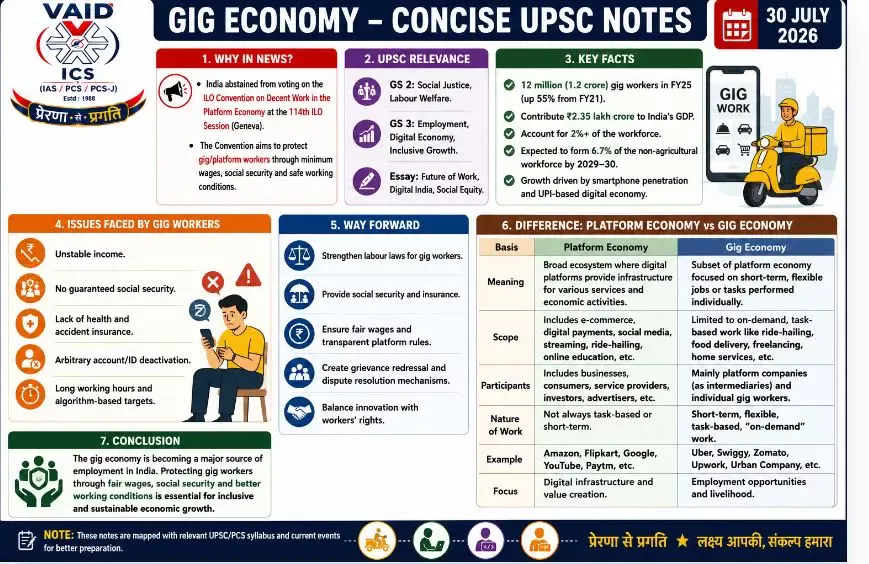
Why in news? Congress MP Shashi Tharoor criticized the Indian government for abstaining from the vote on the International Labour Organization (ILO) Convention concerning “Decent Work in the Platform Economy” at its 114th session in Geneva.
-
ILO Convention: It is the first international standard of its kind aimed at protecting gig workers by setting binding rules on minimum wages, occupational safety, and social security. While 406 delegates voted in favour and 8 against, 36 countries—including India—abstained.
UPSC Syllabus Relevance:
-
GS Paper Two (Governance & Social Justice): Welfare schemes for vulnerable sections, labor rights, and inclusive policy-making.
-
GS Paper Three (Indian Economy): Employment, growth, contribution of the gig economy to GDP, and structural economic transformation.
-
Essay: Digitalization, changing nature of work, youth aspirations, and social equity in modern India.
Key Data and Metrics on India’s Gig Economy:
-
Workforce Scale: Grown by 55% from 77 lakh workers in FY21 to 120 lakh (12 million) workers in FY25 (Economic Survey 2025-26 data).
-
Workforce Share: Gig workers comprise over 2% of India’s total workforce. Non-agricultural gig jobs are projected to constitute 6.7% of the workforce by 2029-30.
-
Economic Contribution: Contributes ₹2.35 lakh crore to India’s GDP.
-
Enablers of Growth: Driven by smartphone penetration among over 80 crore users and 15 billion UPI transactions per month.
Key Arguments and Concerns:
-
Government Stance & Criticisms: * India abstained despite domestic employers and workers supporting the framework. Critics argue this shows a disconnect with the realities of young digital workers.
-
Proponents of the convention advocate for adopting global minimum standards into domestic legislation.
-
-
Core Vulnerabilities of Gig Workers in India:
-
Unstable and unpredictable earnings.
-
Arbitrary ID deactivations by platform companies.
-
Absence of mandatory medical, accidental, or life insurance coverage.
-
Unreasonable algorithmic targets and difficult working conditions (e.g., lack of basic amenities like washrooms).
-
Way Forward:
-
Harmonizing Domestic Laws: Aligning domestic policies with progressive international standards while safeguarding the operational flexibility of platforms.
-
Strengthening Social Safety Nets: Expanding welfare funds, mandatory insurance coverage, and social security portability as envisioned in the national Labour Codes.
-
Regulating Algorithmic Management: Ensuring fair dispute resolution mechanisms, transparent deactivation policies, and fair-wage guarantees for platform workers.
Conclusion:
-
As India’s gig economy rapidly scales to become a major pillar of employment and GDP contribution, balancing platform innovation with worker welfare is crucial for sustainable and inclusive economic growth.
समाचार संदर्भ:
-
मुद्दा: कांग्रेस सांसद शशि थरूर ने जिनेवा में आयोजित अंतर्राष्ट्रीय श्रम संगठन (ILO) के सत्र के दौरान “प्लेटफॉर्म अर्थव्यवस्था में उचित कार्य” (Decent Work in the Platform Economy) पर ILO कन्वेंशन के मतदान से भारत के दूर रहने (abstain) की आलोचना की है:
-
ILO कन्वेंशन: यह गिग श्रमिकों की रक्षा के लिए अपनी तरह का पहला अंतरराष्ट्रीय मानक है, जो न्यूनतम मजदूरी, व्यावसायिक सुरक्षा और सामाजिक सुरक्षा पर बाध्यकारी नियम तय करता है: इस कन्वेंशन के पक्ष में 406 और विरोध में 8 वोट पड़े, जबकि भारत सहित 36 देशों ने मतदान में हिस्सा नहीं लिया (अध्यक्षता/मतदान से परहेज किया):
यूपीएससी परीक्षा के लिए प्रासंगिकता:
-
जीएस पेपर टू (शासन और सामाजिक न्याय): कमजोर वर्गों के लिए कल्याणकारी योजनाएं, श्रम अधिकार और समावेशी नीति-निर्माण:
-
जीएस पेपर थ्री (भारतीय अर्थव्यवस्था): रोजगार, विकास, सकल घरेलू उत्पाद (GDP) में गिग अर्थव्यवस्था का योगदान और संरचनात्मक आर्थिक परिवर्तन:
-
निबंध: डिजिटलीकरण, काम की बदलती प्रकृति, युवाओं की आकांक्षाएं और आधुनिक भारत में सामाजिक समानता:
भारत की गिग अर्थव्यवस्था से जुड़े मुख्य आंकड़े:
-
कार्यबल का पैमाना: वित्त वर्ष २०२१ के 77 लाख श्रमिकों से बढ़कर वित्त वर्ष २०२५ में 120 लाख (1.2 करोड़) श्रमिक हो गए हैं, जो 55% की वृद्धि को दर्शाता है (आर्थिक सर्वेक्षण आंकड़े):
-
कार्यबल में हिस्सेदारी: गिग श्रमिक भारत के कुल कार्यबल का 2% से अधिक हिस्सा हैं: गैर-कृषि गिग नौकरियां 2029-30 तक कार्यबल का 6.7% होने का अनुमान है:
-
आर्थिक योगदान: यह क्षेत्र भारत के सकल घरेलू उत्पाद (GDP) में ₹2.35 लाख करोड़ का योगदान देता है:
-
विकास के प्रेरक: 80 करोड़ से अधिक उपयोगकर्ताओं के बीच स्मार्टफोन की पहुंच और प्रति माह 15 अरब UPI लेनदेन इसके मुख्य चालक हैं:
मुख्य तर्क और चिंताएं:
-
सरकार का रुख और आलोचना: घरेलू नियोक्ताओं और श्रमिकों द्वारा समर्थन किए जाने के बावजूद भारत ने मतदान से परहेज किया: आलोचकों का मानना है कि यह युवा डिजिटल श्रमिकों की वास्तविकताओं से सरकार की दूरी को दर्शाता है:
-
भारत में गिग श्रमिकों की मुख्य समस्याएं:
-
अनिश्चित और अस्थिर कमाई:
-
प्लेटफॉर्म कंपनियों द्वारा मनमाने ढंग से आईडी बंद करना (ID deactivations):
-
अनिवार्य चिकित्सा, दुर्घटना या जीवन बीमा कवरेज का अभाव:
-
अनुचित एल्गोरिथम लक्ष्य और कठिन कार्य परिस्थितियां (जैसे बुनियादी सुविधाओं का अभाव):
-
आगे की राह (Way Forward):
-
घरेलू कानूनों का सामंजस्य: प्लेटफॉर्म्स की परिचालन लचीलापन सुरक्षा करते हुए घरेलू नीतियों को अंतरराष्ट्रीय मानकों के साथ संरेखित करना:
-
सामाजिक सुरक्षा का विस्तार: राष्ट्रीय श्रम संहिताओं के अनुरूप कल्याणकारी कोष, अनिवार्य बीमा कवरेज और सामाजिक सुरक्षा पोर्टेबिलिटी का विस्तार करना:
-
एल्गोरिथम प्रबंधन का नियमन: प्लेटफॉर्म श्रमिकों के लिए निष्पक्ष विवाद समाधान तंत्र, पारदर्शी आईडी-निष्क्रियता नीतियां और उचित मजदूरी की गारंटी सुनिश्चित करना:
निष्कर्ष:
-
जैसे-जैसे भारत की गिग अर्थव्यवस्था रोजगार और जीडीपी योगदान का एक प्रमुख स्तंभ बन रही है, वैसे-वैसे सतत और समावेशी आर्थिक विकास के लिए प्लेटफॉर्म नवाचार और श्रमिक कल्याण के बीच संतुलन बनाना अत्यंत आवश्यक है:

May 19, 2026
October 17, 2025
October 16, 2025
October 6, 2025

