July 28, 2026
Gist of Daily Articles: 28 July 2026/Daily Mains Qn/Model Answer/Mains Concise Note The Hindu/Indian Express
Anti Paper Leak Bill 2026:
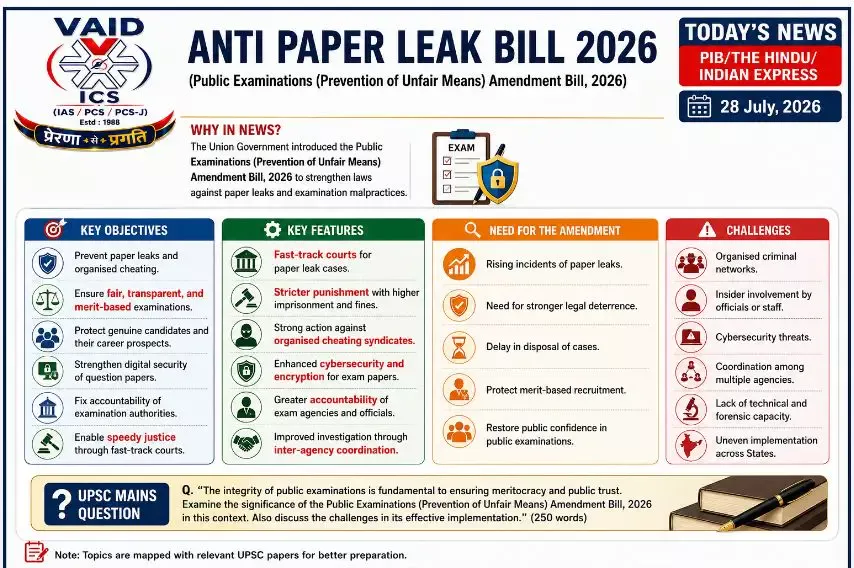
The Public Examinations (Prevention of Unfair Means) Amendment Bill, 2026, is a vital legislative measure designed to fortify the legal framework against question paper leaks, organised cheating, and diverse unfair practices in public examinations. By proposing amendments to the Public Examinations (Prevention of Unfair Means) Act, 2024, this bill introduces stringent penalties, fast-track judicial mechanisms, and elevated institutional accountability to safeguard the fairness and transparency of public examinations.
Objectives of the Anti Paper Leak Bill 2026:
The primary mission of the proposed legislation is to establish a secure, merit-based, and transparent examination ecosystem nationwide through the following goals:
-
Eradicating question paper leaks and curbing examination malpractices.
-
Deterring organised cheating rings with robust legal provisions.
-
Ensuring merit-based recruitment and equitable opportunities.
-
Safeguarding the career interests and hard work of honest candidates.
-
Advancing transparency and integrity across all public examinations.
-
Strengthening digital security protocols and the confidentiality of examination papers.
-
Holding examination agencies and officials strictly accountable.
-
Enabling swift justice delivery via dedicated fast-track courts.
-
Restoring absolute public confidence in recruitment and entrance examinations.
Key Features of the Anti Paper Leak Bill 2026:
The bill reinforces the existing legal architecture by incorporating several critical enhancements:
-
Fast-Track Courts: Establishes special judicial tribunals for the accelerated trial and resolution of paper leak and examination malpractice cases.
-
Stricter Punishments: Imposes enhanced terms of imprisonment and significantly higher monetary fines for individuals and organised syndicates involved in fraud.
-
Action Against Organised Syndicates: Focuses heavily on dismantling criminal networks through rigorous investigation and targeted prosecution.
-
Enhanced Digital Security: Mandates secure handling, storage, and transmission of question papers leveraging advanced cybersecurity frameworks and encryption.
-
Institutional Accountability: Fixes direct responsibility on administrative authorities and private service providers for maintaining end-to-end examination integrity.
-
Protection of Genuine Candidates: Secures fair competitive environments by shielding the evaluation process from corruption.
-
Improved Investigation Mechanism: Streamlines multi-agency coordination to detect and prosecute violations effectively.
Need for the Amendment:
The introduction of the 2026 amendment is a direct response to escalating challenges that threaten the credibility of national examination structures:
-
Rising Paper Leak Incidents: Frequent breaches have routinely compromised high-stakes recruitment and entrance tests.
-
Demand for Stronger Legal Deterrence: Existing frameworks necessitate tougher penalties to genuinely discourage organised perpetrators.
-
Need for Speedy Justice: Lengthy litigation cycles require dedicated fast-track processing to deliver timely verdicts.
-
Preservation of Merit: Ensures that deserving aspirants secure positions based purely on capability rather than illicit shortcuts.
-
Neutralisation of Organised Crime: Directly addresses the sophisticated methods used by criminal syndicates.
-
Restoration of Public Trust: Rebuilds faith among students and parents regarding examination transparency.
Challenges in Implementation:
Despite its robust legal design, successful execution of the bill faces several practical hurdles:
-
Sophisticated Criminal Networks: Syndicates frequently adapt to new security measures, complicating detection and evidence gathering.
-
Insider Vulnerabilities: Potential collusion by administrative staff, printing personnel, or exam center operators poses a persistent risk.
-
Advanced Cybersecurity Threats: Digital testing infrastructure remains susceptible to sophisticated cyberattacks and data breaches.
-
Multi-Agency Coordination: Ensuring synchronized cooperation between central bodies, state police forces, and examining authorities can be complex.
-
Administrative and Capacity Constraints: Investigating digital fraud requires specialised forensic experts and modern technological equipment.
-
Uniform State Enforcement: Disparities in regional administrative capabilities may result in uneven implementation across different states.
एंटी पेपर लीक बिल 2026 :
पब्लिक एग्जामिनेशंस (प्रिवेंशन ऑफ अनफेयर मीन्स) अमेंडमेंट बिल, 2026 एक महत्वपूर्ण विधाई उपाय है जिसे सार्वजनिक परीक्षाओं में प्रश्न पत्र लीक, संगठित नकल और विभिन्न अनुचित प्रथाओं के खिलाफ कानूनी ढांचे को मजबूत करने के लिए तैयार किया गया है। पब्लिक एग्जामिनेशंस (प्रिवेंशन ऑफ अनफेयर मीन्स) एक्ट, 2024 में संशोधन करके यह विधेयक सार्वजनिक परीक्षाओं की निष्पक्षता और पारदर्शिता की रक्षा के लिए कड़े दंड, फास्ट-ट्रैक न्यायिक तंत्र और बेहतर संस्थागत जवाबदेही पेश करता है।
एंटी पेपर लीक बिल 2026 के उद्देश्य:
प्रस्तावित कानून का मुख्य मिशन निम्नलिखित लक्ष्यों के माध्यम से देश भर में एक सुरक्षित, मेधा-आधारित और पारदर्शी परीक्षा पारिस्थितिकी तंत्र स्थापित करना है:
-
प्रश्न पत्र लीक को समाप्त करना और परीक्षा में होने वाली गड़बड़ियों पर लगाम लगाना।
-
मजबूत कानूनी प्रावधानों के साथ संगठित नकल गिरोहों को हतोत्साहित करना।
-
मेधा-आधारित भर्ती और समान अवसरों को सुनिश्चित करना।
-
ईमानदार उम्मीदवारों के करियर हितों और कड़ी मेहनत की रक्षा करना।
-
सभी सार्वजनिक परीक्षाओं में पारदर्शिता और अखंडता को आगे बढ़ाना।
-
डिजिटल सुरक्षा प्रोटोकॉल और परीक्षा पत्रों की गोपनीयता को मजबूत करना।
-
परीक्षा एजेंसियों और अधिकारियों को सख्त रूप से जवाबदेह बनाना।
-
समर्पित फास्ट-ट्रैक अदालतों के माध्यम से त्वरित न्याय वितरण को सक्षम करना।
-
भर्ती और प्रवेश परीक्षाओं में पूर्ण जन विश्वास को बहाल करना।
एंटी पेपर लीक बिल 2026 की मुख्य विशेषताएं:
यह विधेयक कई महत्वपूर्ण संवर्धनों को शामिल करके मौजूदा कानूनी ढांचे को मजबूत करता है:
-
फास्ट-ट्रैक अदालतें (Fast-Track Courts): पेपर लीक और परीक्षा धोखाधड़ी के मामलों की त्वरित सुनवाई और समाधान के लिए विशेष न्यायिक न्यायाधिकरण स्थापित करती हैं।
-
सख्त दंड (Stricter Punishments): धोखाधड़ी में शामिल व्यक्तियों और संगठित सिंडिकेट्स के लिए कारावास की बढ़ी हुई अवधि और काफी अधिक मौद्रिक जुर्माने का प्रावधान करती है।
-
संगठित सिंडिकेट के खिलाफ कार्रवाई (Action Against Organised Syndicates): कठोर जांच और लक्षित अभियोजन के माध्यम से आपराधिक नेटवर्क को खत्म करने पर भारी जोर देती है।
-
उन्नत डिजिटल सुरक्षा (Enhanced Digital Security): उन्नत साइबर सुरक्षा फ्रेमवर्क और एन्क्रिप्शन का लाभ उठाते हुए प्रश्न पत्रों के सुरक्षित संचालन, भंडारण और प्रसारण को अनिवार्य बनाती है।
-
संस्थागत जवाबदेही (Institutional Accountability): अंत-से-अंत तक परीक्षा की अखंडता बनाए रखने के लिए प्रशासनिक अधिकारियों और निजी सेवा प्रदाताओं पर सीधी जिम्मेदारी तय करती है।
-
वास्तविक उम्मीदवारों की सुरक्षा (Protection of Genuine Candidates): मूल्यांकन प्रक्रिया को भ्रष्टाचार से बचाकर निष्पक्ष प्रतिस्पर्धात्मक वातावरण सुरक्षित करती है।
-
बेहतर जांच तंत्र (Improved Investigation Mechanism): उल्लंघनों का प्रभावी ढंग से पता लगाने और मुकदमा चलाने के लिए बहु-एजेंसी समन्वय को सुव्यवस्थित करता है।
संशोधन की आवश्यकता:
2026 के संशोधन की शुरुआत उन बढ़ती चुनौतियों का सीधा जवाब है जो राष्ट्रीय परीक्षा संरचनाओं की विश्वसनीयता को खतरे में डालती हैं:
-
बढ़ती पेपर लीक की घटनाएं: बार-बार होने वाले सुरक्षा उल्लंघनों ने उच्च-दांव वाली भर्ती और प्रवेश परीक्षाओं को नियमित रूप से प्रभावित किया है।
-
मजबूत कानूनी रोक की मांग: मौजूदा ढांचे के तहत संगठित अपराधियों को वास्तव में हतोत्साहित करने के लिए सख्त दंड की आवश्यकता है।
-
शीघ्र न्याय की आवश्यकता: लंबी मुकदमेबाजी के चक्रों को समय पर फैसले देने के लिए समर्पित फास्ट-ट्रैक प्रोसेसिंग की आवश्यकता होती है।
-
योग्यता का संरक्षण: यह सुनिश्चित करता है कि योग्य उम्मीदवारों को अनुचित शॉर्टकट के बजाय पूरी तरह से क्षमता के आधार पर पद मिलें।
-
संगठित अपराध का बेअसर होना: आपराधिक सिंडिकेट्स द्वारा उपयोग की जाने वाली परिष्कृत विधियों को सीधे संबोधित करता है।
-
जनता के विश्वास की बहाली: परीक्षा पारदर्शिता के संबंध में छात्रों और अभिभावकों के बीच विश्वास का पुनर्निर्माण करता है।
कार्यान्वयन में चुनौतियां:
इसके मजबूत कानूनी डिजाइन के बावजूद, इस विधेयक के सफल निष्पादन को कई व्यावहारिक बाधाओं का सामना करना पड़ता है:
-
परिष्कृत आपराधिक नेटवर्क: सिंडिकेट अक्सर नए सुरक्षा उपायों के अनुकूल ढल जाते हैं, जिससे पहचान और सबूत जुटाना चुनौतीपूर्ण हो जाता है।
-
अंदरूनी सूत्र की कमजोरियां (Insider Vulnerabilities): प्रशासनिक कर्मचारियों, मुद्रण कर्मियों या परीक्षा केंद्र संचालकों की संभावित मिलीभगत एक लगातार जोखिम पैदा करती है।
-
उन्नत साइबर सुरक्षा खतरे (Advanced Cybersecurity Threats): डिजिटल परीक्षण बुनियादी ढांचा परिष्कृत साइबर हमलों और डेटा उल्लंघनों के प्रति संवेदनशील बना हुआ है।
-
बहु-एजेंसी समन्वय (Multi-Agency Coordination): केंद्रीय निकायों, राज्य पुलिस बलों और परीक्षा अधिकारियों के बीच सिंक्रनाइज्ड सहयोग सुनिश्चित करना जटिल हो सकता है।
-
प्रशासनिक और क्षमता बाधाएं (Administrative and Capacity Constraints): डिजिटल धोखाधड़ी की जांच के लिए विशेष फोरेंसिक विशेषज्ञों और आधुनिक तकनीकी उपकरणों की आवश्यकता होती है।
-
समान राज्य प्रवर्तन (Uniform State Enforcement): क्षेत्रीय प्रशासनिक क्षमताओं में असमानताओं के परिणामस्वरूप विभिन्न राज्यों में असमान कार्यान्वयन हो सकता है।

May 19, 2026
October 17, 2025
October 16, 2025
October 6, 2025

