July 16, 2026
The 2nd Indian Wildlife Ecology Conference (IWEC)
Why in news ?
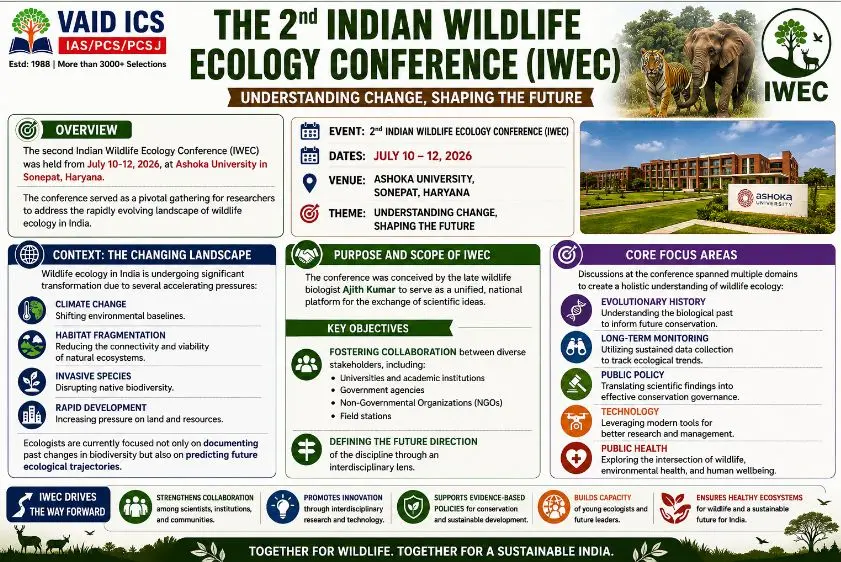
The second Indian Wildlife Ecology Conference (IWEC) was held from July 10-12, 2026, at Ashoka University in Sonepat, Haryana. The conference served as a pivotal gathering for researchers to address the rapidly evolving landscape of wildlife ecology in India.
Context: The Changing Landscape:
Wildlife ecology in India is undergoing significant transformation due to several accelerating pressures:
-
Climate Change: Shifting environmental baselines.
-
Habitat Fragmentation: Reducing the connectivity and viability of natural ecosystems.
-
Invasive Species: Disrupting native biodiversity.
-
Rapid Development: Increasing pressure on land and resources.
Ecologists are currently focused not only on documenting past changes in biodiversity but also on predicting future ecological trajectories.
Purpose and Scope of IWEC:
The conference was conceived by the late wildlife biologist Ajith Kumar to serve as a unified, national platform for the exchange of scientific ideas.
Key objectives included:
-
Fostering collaboration between diverse stakeholders, including:
-
Universities and academic institutions.
-
Government agencies.
-
Non-Governmental Organizations (NGOs).
-
Field stations.
-
-
Defining the future direction of the discipline through an interdisciplinary lens.
Core Focus Areas:
Discussions at the conference spanned multiple domains to create a holistic understanding of wildlife ecology:
-
Evolutionary History: Understanding the biological past to inform future conservation.
-
Long-term Monitoring: Utilizing sustained data collection to track ecological trends.
-
Public Policy: Translating scientific findings into effective conservation governance.
-
Technology: Leveraging modern tools for better research and management.
-
Public Health: Exploring the intersection of wildlife, environmental health, and human wellbeing.
दूसरी भारतीय वन्यजीव पारिस्थितिकी सम्मेलन (IWEC)
अवलोकन
दूसरा भारतीय वन्यजीव पारिस्थितिकी सम्मेलन (IWEC) 10-12 जुलाई, 2026 को अशोक विश्वविद्यालय, सोनीपत (हरियाणा) में आयोजित किया गया था। यह सम्मेलन भारत में वन्यजीव पारिस्थितिकी (wildlife ecology) के तेजी से बदलते परिदृश्य पर चर्चा करने के लिए शोधकर्ताओं का एक महत्वपूर्ण मिलन स्थल रहा।
संदर्भ: बदलता परिदृश्य
भारत में वन्यजीव पारिस्थितिकी कई दबावों के कारण महत्वपूर्ण परिवर्तन से गुजर रही है:
-
जलवायु परिवर्तन: पर्यावरणीय आधारों (environmental baselines) का बदलना।
-
आवास विखंडन (Habitat Fragmentation): प्राकृतिक पारिस्थितिकी तंत्र की कनेक्टिविटी और जीवनक्षमता में कमी।
-
आक्रामक प्रजातियां (Invasive Species): मूल जैव विविधता में बाधा डालना।
-
तेजी से विकास: भूमि और संसाधनों पर बढ़ता दबाव।
पारिस्थितिकीविद (ecologists) अब न केवल जैव विविधता में आए बदलावों को दर्ज करने पर ध्यान केंद्रित कर रहे हैं, बल्कि भविष्य के पारिस्थितिक प्रक्षेपवक्र (ecological trajectories) की भविष्यवाणी करने में भी रुचि रखते हैं।
IWEC का उद्देश्य और दायरा:
इस सम्मेलन की परिकल्पना दिवंगत वन्यजीव जीवविज्ञानी अजीत कुमार द्वारा की गई थी, ताकि यह भारतीय वन्यजीव पारिस्थितिकीविदों के लिए वैज्ञानिक विचारों के आदान-प्रदान का एक राष्ट्रीय मंच बन सके।
मुख्य उद्देश्यों में शामिल हैं:
-
विभिन्न हितधारकों के बीच सहयोग को बढ़ावा देना, जैसे:
-
विश्वविद्यालय और शैक्षणिक संस्थान।
-
सरकारी एजेंसियां।
-
गैर-सरकारी संगठन (NGOs)।
-
फील्ड स्टेशन।
-
-
अंतःविषय (interdisciplinary) दृष्टिकोण के माध्यम से अनुशासन की भविष्य की दिशा निर्धारित करना।
चर्चा के मुख्य विषय
सम्मेलन में वन्यजीव पारिस्थितिकी की व्यापक समझ विकसित करने के लिए कई क्षेत्रों पर चर्चा की गई:
-
विकासवादी इतिहास (Evolutionary History): भविष्य के संरक्षण के लिए जैविक अतीत को समझना।
-
दीर्घकालिक निगरानी (Long-term Monitoring): पारिस्थितिक रुझानों को ट्रैक करने के लिए निरंतर डेटा संग्रह का उपयोग करना।
-
सार्वजनिक नीति (Public Policy): वैज्ञानिक निष्कर्षों को प्रभावी संरक्षण शासन (governance) में बदलना।
-
प्रौद्योगिकी (Technology): बेहतर अनुसंधान और प्रबंधन के लिए आधुनिक उपकरणों का लाभ उठाना।
-
सार्वजनिक स्वास्थ्य (Public Health): वन्यजीवों, पर्यावरणीय स्वास्थ्य और मानव कल्याण के बीच के संबंधों का पता लगाना।

May 19, 2026
October 17, 2025
October 16, 2025
October 6, 2025

