July 1, 2026
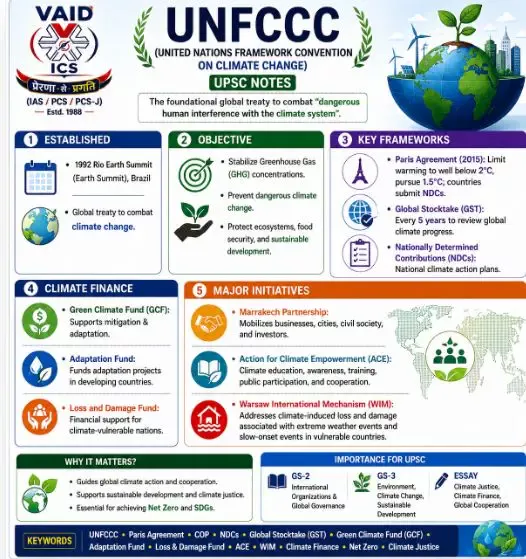
The 64th meeting of the UNFCCC :”Trade-Climate Interface.”
Why in the news?
- Bonn Climate Dialogue: The UNFCCC session concluded on June 18, 2026, marking the first of three scheduled dialogues on the trade-climate nexus, mandated by the COP30 agreement in Belém (November 2025).
- Policy Integration: International organizations, including the WTO, ITC, and UNCTAD, presented frameworks on how global trade rules can align with climate mitigation goals.
Relevance of the Trade-Climate Interface:
- Market Rules: Article 3.5 of the UNFCCC emphasizes that climate-related trade measures should not act as “arbitrary or unjustifiable discrimination” or disguised restrictions on international trade.
- Universal Implementation: For climate mitigation strategies to succeed, they must be universal. Without global standards, industrial production merely shifts, negating environmental progress.
Key Issues and Challenges:
- Carbon Leakage: When strict climate regulations are imposed in one region (e.g., the EU), industrial producers may relocate to countries with lax regulations, leading to no net reduction in global emissions.
- Competitiveness Disparities: Producers in countries with strict carbon-internalization costs are at a disadvantage compared to those in nations that do not account for emission externality costs.
- Developmental Concerns: Developing nations argue that measures like the CBAM act as barriers to their exports, restrict market access, and place an unfair compliance burden on their economies.
Understanding CBAM (Carbon Border Adjustment Mechanism):
- Objective: Introduced by the EU to ensure a “level playing field.” It adjusts the price of imported goods (e.g., steel, cement) to reflect the carbon costs that would have been incurred if produced domestically within the EU.
- Protectionism vs. Climate Action: While intended to stop carbon leakage, many developing countries view it as a discriminatory trade barrier that violates the principles of equity.
- Global Adoption: While the EU is currently the primary implementer, nations like the UK, USA, Australia, and Canada are actively exploring similar border tax adjustments.
IMF Proposal: The Alternative:
- Differential Carbon Tax: To move away from the complexities and conflicts of border taxes, the IMF has proposed a tiered carbon tax based on income levels:
- Low-Income Countries: $25 per tonne of $CO_2$.
- Middle-Income Countries: $50 per tonne of $CO_2$.
- Developed Countries: $75 per tonne of $CO_2$.
- This model aims to create a more equitable and predictable global framework.
Conclusion:
The Bonn dialogue underscores that survival in a warming world requires a “fair and justly differentiated response.” As runaway climate change continues, the global community must urgently shift from unilateral trade measures toward a cooperative, practicable solution that balances climate mitigation with sustainable development for all nations.

Citizenship (Amendment) Rules, 2026
May 19, 2026
Gist of daily Article /The Hindu 17oct 2025
October 17, 2025
Daily Gist of the Hindu/Indian Express : 16 Oct 2025
October 16, 2025
Daily Gist of The Hindu/Indian Express: 6 Oct 2025
October 6, 2025

