July 1, 2026
India’s AI Revolution: A New Blueprint for Growth: REFORM 3.0/ Hindu Rate of Grwoth !
Introduction:
For four decades post-Independence, India’s economic growth was constrained, famously termed the “Hindu rate of growth.” The 1991 economic reforms shattered these barriers, placing the nation on a higher growth trajectory. Today, Artificial Intelligence (AI) stands as the next critical catalyst. By leveraging its robust digital public infrastructure, India is uniquely positioned to trigger a “Bharat rate of growth” of 8% or more, fueled by accelerated productivity and innovation.
The Transformational Power of AI:
-
The 1991 Precedent: Much like the 1991 crisis necessitated liberalization, the modern global landscape makes AI adoption a strategic imperative rather than a luxury.
-
Leapfrogging Potential: India has a proven track record of skipping developmental stages through mass-scale digital adoption.
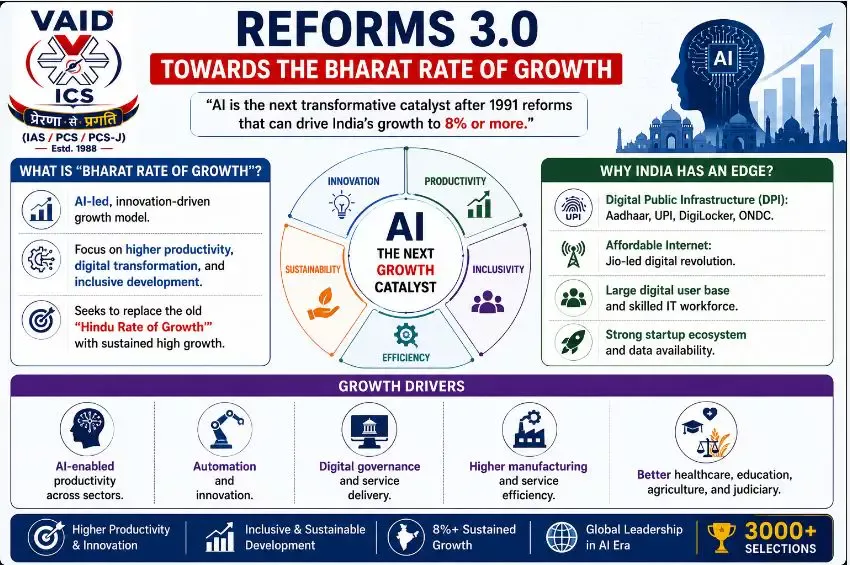
The Digital Foundation:
-
-
[Aadhaar Redacted]: Created the world’s largest biometric identity framework, serving as the bedrock for modern digital services.
-
UPI: Revolutionized payments by handling nearly 50% of global real-time digital transactions, proving India’s capability in systemic engineering.
-
Jio: Democratized the internet, making mobile data accessible and affordable to millions overnight.
-
-
Future Outlook: These successes serve as a blueprint for building an indigenous AI ecosystem that serves the masses.
The Case for Strategic Investment:
-
Bridging the R&D Gap: India’s current R&D spend (0.65% of GDP) lags significantly behind global leaders like the US and China.
-
Affordability: Integrating AI across top universities, research institutions, and 5,000 high schools is estimated to cost only 0.06% of GDP—a negligible fraction compared to existing annual subsidies for food, fertilizer, and fuel.
-
Reallocation over Expansion: The capital required for an AI revolution exists within the current budget; it is a matter of shifting priorities from legacy subsidies toward high-growth, high-productivity assets.
-
Compounding Returns: Unlike traditional welfare spending, AI investment offers long-term, scalable benefits in innovation and knowledge capital.
Challenges and Sovereign Requirements:
-
Technological Sovereignty: Relying exclusively on foreign APIs limits India’s control. There is an urgent need to host frontier models locally.
-
Operational Complexity: Mastering high-availability, low-latency computing, and robust cybersecurity (including data residency and prompt defense) is essential.
-
Diversifying Hardware: With the current dependence on specific global hardware providers, India must foster a more resilient, cost-effective computing ecosystem to avoid vendor lock-in.
The Way Forward:
-
National AI Token Policy: Implement a structured, 24-month phased rollout starting with academic and research institutions.
-
Public-Private Synergies: Collaborate with global cloud providers to build a multi-vendor sovereign compute framework, trading infrastructure support for secure, free inference capacity.
-
Market-Led Growth: Mirror the mobile data revolution by fostering competition through smart regulation, driving costs down naturally rather than relying solely on subsidies.
-
Indic-Centric Innovation: Focus on building benchmarks for Indian languages, ensuring AI is fine-tuned for local needs in healthcare, agriculture, and the judiciary.
-
Ecosystem Scaling: Target the creation of 10,000+ AI-native startups and solidify India’s position as a top-five global consumer of AI tokens.
Conclusion:
Artificial Intelligence represents the most significant structural reform opportunity since 1991. By prioritizing sovereign infrastructure, diversifying compute hardware, and ensuring widespread access, India can transcend its traditional growth ceilings. Through decisive, forward-thinking policy, AI can catalyze the “Bharat rate of growth,” securing India’s place as a global leader in the digital age.
भारत की AI क्रांति: विकास के लिए एक नई रूपरेखा:
परिचय:
आजादी के बाद लगभग चार दशकों तक, भारत की आर्थिक वृद्धि दर सीमित रही, जिसे प्रसिद्ध रूप से “हिंदू विकास दर” (Hindu rate of growth) कहा जाता था। 1991 के आर्थिक सुधारों ने इन बाधाओं को तोड़कर देश को एक उच्च विकास पथ पर अग्रसर किया। आज, आर्टिफिशियल इंटेलिजेंस (AI) अगला महत्वपूर्ण उत्प्रेरक (catalyst) बनकर उभरा है। अपने मजबूत डिजिटल सार्वजनिक बुनियादी ढांचे का लाभ उठाकर, भारत उत्पादकता और नवाचार को गति देकर 8% या उससे अधिक की “भारत विकास दर” प्राप्त करने की अद्वितीय स्थिति में है।
AI की परिवर्तनकारी शक्ति:
-
1991 का उदाहरण: जिस तरह 1991 के संकट ने उदारीकरण को अनिवार्य बना दिया था, उसी तरह आज का वैश्विक परिदृश्य AI को एक विकल्प के बजाय रणनीतिक आवश्यकता बनाता है।
-
विकास में छलांग लगाने की क्षमता: भारत ने बड़े पैमाने पर डिजिटल अपनाकर विकास के कई चरणों को लांघने का रिकॉर्ड कायम किया है।
-
डिजिटल आधार:
-
आधार: इसने दुनिया का सबसे बड़ा बायोमेट्रिक पहचान ढांचा बनाया, जो आधुनिक डिजिटल सेवाओं की नींव है।
-
UPI: इसने वैश्विक वास्तविक समय डिजिटल लेनदेन का लगभग 50% संभालकर भुगतान क्षेत्र में क्रांति ला दी है, जो प्रणालीगत इंजीनियरिंग में भारत की क्षमता को सिद्ध करता है।
-
जियो: इसने इंटरनेट का लोकतंत्रीकरण किया, जिससे लाखों लोगों के लिए मोबाइल डेटा सुलभ और सस्ता हो गया।
-
-
भविष्य की संभावनाएं: ये सफलताएं एक ऐसे स्वदेशी AI इकोसिस्टम के निर्माण के लिए खाका (blueprint) प्रदान करती हैं जो राष्ट्रीय स्तर पर आम जनता की सेवा कर सके।
रणनीतिक निवेश की आवश्यकता:
-
R&D में अंतर को पाटना: भारत का वर्तमान R&D व्यय (GDP का 0.65%) अमेरिका और चीन जैसे वैश्विक नेताओं से काफी पीछे है।
-
वित्तीय सामर्थ्य: शीर्ष विश्वविद्यालयों, अनुसंधान संस्थानों और 5,000 हाई स्कूलों में AI को एकीकृत करने की लागत GDP का केवल 0.06% है—जो भोजन, उर्वरक और ईंधन पर दी जाने वाली मौजूदा सब्सिडी की तुलना में नगण्य है।
-
विस्तार के बजाय पुन: आवंटन: AI क्रांति के लिए आवश्यक पूंजी वर्तमान बजट में ही मौजूद है; यह प्राथमिकता को पुरानी सब्सिडी से हटाकर उच्च-विकास वाली उत्पादक संपत्तियों की ओर ले जाने का विषय है।
-
दीर्घकालिक लाभ: पारंपरिक कल्याणकारी खर्च के विपरीत, AI में निवेश नवाचार और ज्ञान पूंजी में दीर्घकालिक और स्केलेबल लाभ प्रदान करता है।
चुनौतियां और संप्रभु आवश्यकताएं:
-
तकनीकी संप्रभुता: विदेशी API पर विशेष रूप से निर्भर रहने से भारत की पहुंच सीमित हो जाती है। स्थानीय स्तर पर फ्रंटियर मॉडल को होस्ट करना अनिवार्य है।
-
परिचालन जटिलता: उच्च उपलब्धता, कम विलंबता (low latency) और मजबूत साइबर सुरक्षा (डेटा रेजिडेंसी और प्रॉम्प्ट डिफेंस सहित) में महारत हासिल करना आवश्यक है।
-
हार्डवेयर में विविधता: वैश्विक हार्डवेयर प्रदाताओं पर वर्तमान निर्भरता को देखते हुए, भारत को वेंडर लॉक-इन से बचने के लिए अधिक लचीला और लागत प्रभावी कंप्यूटिंग इकोसिस्टम विकसित करना होगा।
आगे की राह:
-
राष्ट्रीय AI टोकन नीति: अगले 24 महीनों में एक संरचित, चरणबद्ध रोलआउट लागू करना, जिसकी शुरुआत शैक्षणिक और अनुसंधान संस्थानों से हो।
-
सार्वजनिक-निजी तालमेल: सुरक्षित और मुफ्त इंफरेंस क्षमता के बदले डेटा सेंटर के लिए भूमि और बिजली सहायता प्रदान करके एक मल्टी-वेंडर संप्रभु कंप्यूटिंग ढांचा बनाने के लिए वैश्विक क्लाउड प्रदाताओं के साथ साझेदारी करना।
-
बाजार-आधारित विकास: मोबाइल डेटा क्रांति का अनुसरण करते हुए, स्मार्ट विनियमन के माध्यम से प्रतिस्पर्धा को बढ़ावा देना, ताकि सब्सिडी के बजाय स्वाभाविक रूप से लागत कम हो।
-
इंडिक-केंद्रित नवाचार: भारतीय भाषाओं के लिए बेंचमार्क बनाने पर ध्यान केंद्रित करना, ताकि AI स्वास्थ्य सेवा, कृषि और न्यायपालिका की स्थानीय जरूरतों के लिए अनुकूलित हो।
-
इकोसिस्टम का विस्तार: 10,000 से अधिक AI-नेटिव स्टार्टअप बनाने का लक्ष्य रखना और AI टोकन खपत में भारत को शीर्ष पांच देशों में शामिल करना।
निष्कर्ष:
आर्टिफिशियल इंटेलिजेंस 1991 के आर्थिक उदारीकरण के बाद का सबसे महत्वपूर्ण संरचनात्मक सुधार अवसर है। संप्रभु बुनियादी ढांचे को मजबूत करके, सस्ती AI पहुंच का विस्तार करके, ओपन-सोर्स मॉडल को बढ़ावा देकर और कंप्यूटिंग हार्डवेयर में विविधता लाकर, भारत अपनी पारंपरिक विकास सीमाओं को पार कर सकता है। निर्णायक नेतृत्व के साथ, AI “भारत विकास दर” को गति दे सकता है और देश को वैश्विक AI लीडर के रूप में स्थापित कर सकता है।

May 19, 2026
October 17, 2025
October 16, 2025
October 6, 2025

