June 18, 2026
UNICEF Children’s Climate Risk Report 2026
Introduction:
-
Nature of Report: A comprehensive global assessment evaluating the exposure and vulnerability of children to climate and environmental hazards.
-
Core Focus: It measures the impact of overlapping climate risks (heat, drought, floods, etc.) on child health, education, nutrition, and survival.
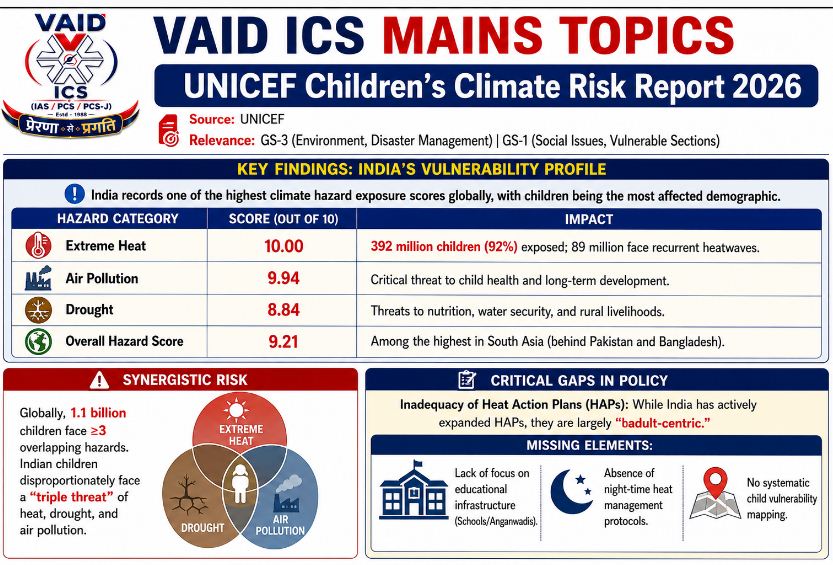
Key Findings: India’s Vulnerability Profile:
India records one of the highest climate hazard exposure scores globally, with children being the most affected demographic.
| Hazard Category | Score (out of 10) | Impact |
| Extreme Heat | 10.00 | 392 million children (92%) exposed; 89 million face recurrent heatwaves. |
| Air Pollution | 9.94 | Critical threat to child health and long-term development. |
| Drought | 8.84 | Threats to nutrition, water security, and rural livelihoods. |
| Overall Hazard Score | 9.21 | Among the highest in South Asia (behind Pakistan and Bangladesh). |
-
Synergistic Risk: Globally, 1.1 billion children face ≥3 overlapping hazards. Indian children disproportionately face a “triple threat” of heat, drought, and air pollution.
Critical Gaps in Policy:
-
Inadequacy of Heat Action Plans (HAPs): While India has actively expanded HAPs, they are largely “adult-centric.”
-
Missing Elements:
-
Lack of focus on educational infrastructure (Schools/Anganwadis).
-
Absence of night-time heat management protocols.
-
No systematic child vulnerability mapping.
-
Lack of age-specific adaptation strategies (children have different physiological responses to heat than adults).
-
Broad Implications
-
Health: Increased disease burden (vector-borne, heat-related illnesses) and malnutrition.
-
Education: Reduced school attendance, diminished cognitive development, and lowered learning outcomes.
-
Systemic Need: Transition from general climate adaptation to child-centric resilience (resilient schools, specialized healthcare, and targeted social protection).
UPSC Syllabus Mapping
GS Paper III (Environment & Climate Change)
-
Understanding the intersectionality of climate hazards.
-
Need for adaptation strategies beyond generic infrastructure.
GS Paper II (Social Justice & Governance)
-
Vulnerable Groups: Children as a high-priority group in the climate justice framework.
-
Public Health: Impact of air pollution and heat on long-term human capital formation.
-
Policy Gap: Need for mainstreaming “child-sensitive” climate action in government schemes (e.g., ICDS/Anganwadis).
Essay & Ethics:
-
Climate Justice: Are children paying the price for adult-driven climate change?
-
Sustainable Development: Goal 3 (Good Health), Goal 4 (Quality Education), and Goal 13 (Climate Action).
-
Intergenerational Equity: Protecting the future generation from environmental degradation.
The Way Forward :
-
Child-Specific Data: Developing a database to map heat vulnerability specifically for schools and Anganwadi centers.
-
Infrastructure Retrofitting: Making educational and healthcare buildings climate-resilient through passive cooling.
-
HAP 2.0: Redesigning state-level Heat Action Plans to include “Children” as a special category for alerts, relief, and adaptation measures.
-
Integration: Linking climate adaptation policies with existing nutrition and social protection frameworks.
यूनिसेफ चिल्ड्रेन क्लाइमेट रिस्क रिपोर्ट 2026:
GS पेपर III (पर्यावरण और जलवायु परिवर्तन)
-
जलवायु खतरों की जटिलता को समझना।
-
सामान्य बुनियादी ढांचे से आगे बढ़कर अनुकूलन रणनीतियों की आवश्यकता।
GS पेपर II (सामाजिक न्याय और शासन)
-
कमजोर समूह (Vulnerable Groups): जलवायु न्याय ढांचे में बच्चों को प्राथमिकता।
-
सार्वजनिक स्वास्थ्य: बच्चों के दीर्घकालिक विकास पर वायु प्रदूषण और गर्मी का प्रभाव।
-
नीतिगत अंतर: सरकारी योजनाओं (जैसे ICDS/आंगनवाड़ी) में ‘बाल-संवेदनशील’ जलवायु कार्रवाई को शामिल करना।
निबंध और नैतिकता
-
जलवायु न्याय (Climate Justice): क्या बच्चे वयस्कों द्वारा पैदा किए गए जलवायु परिवर्तन की कीमत चुका रहे हैं?
-
सतत विकास (Sustainable Development): SDG 3 (अच्छा स्वास्थ्य), SDG 4 (गुणवत्तापूर्ण शिक्षा) और SDG 13 (जलवायु कार्रवाई)।
परिचय:
-
रिपोर्ट की प्रकृति: यह एक वैश्विक मूल्यांकन (global assessment) है जो जलवायु और पर्यावरणीय खतरों के प्रति बच्चों के जोखिम (exposure) और संवेदनशीलता का आकलन करता है।
-
मुख्य उद्देश्य: यह मापना कि अत्यधिक गर्मी, सूखा, बाढ़, तूफान और वायु प्रदूषण जैसे जलवायु जोखिम बच्चों के स्वास्थ्य, शिक्षा, पोषण और अस्तित्व को कैसे प्रभावित करते हैं।
मुख्य निष्कर्ष: भारत की स्थिति:
भारत में बच्चों पर जलवायु खतरों का जोखिम वैश्विक स्तर पर सबसे अधिक है।
| खतरा (Hazard) | स्कोर (10 में से) | प्रभाव |
| अत्यधिक गर्मी | 10.00 | 39.2 करोड़ बच्चे (92%) अत्यधिक गर्मी के संपर्क में; 8.9 करोड़ बच्चे बार-बार हीटवेव का सामना करते हैं। |
| वायु प्रदूषण | 9.94 | बच्चों के स्वास्थ्य और दीर्घकालिक विकास के लिए एक गंभीर खतरा। |
| सूखा | 8.84 | पोषण, जल सुरक्षा और ग्रामीण आजीविका पर संकट। |
| कुल जोखिम स्कोर | 9.21 | दक्षिण एशिया में पाकिस्तान और बांग्लादेश के बाद भारत का स्कोर सबसे अधिक है। |
-
बहु-खतरा प्रभाव: विश्व स्तर पर, 1.1 अरब बच्चे कम से कम तीन जलवायु खतरों के संपर्क में हैं। भारतीय बच्चे अक्सर ‘गर्मी, सूखा और वायु प्रदूषण’ के “तिहरे खतरे” का सामना करते हैं।
नीतिगत कमियाँ (Policy Gaps):
-
हीट एक्शन प्लान (HAPs) में बच्चों की अनदेखी: भारत में हीट एक्शन प्लान का विस्तार तो हुआ है, लेकिन वे ज्यादातर ‘वयस्क-केंद्रित’ हैं।
-
प्रमुख कमियाँ:
-
स्कूलों और आंगनवाड़ियों में गर्मी से निपटने के उपाय नहीं हैं।
-
रात के समय गर्मी के प्रबंधन की रणनीति का अभाव है।
-
बच्चों की भेद्यता (vulnerability) का कोई सटीक मानचित्रण (mapping) नहीं है।
-
उम्र के अनुसार विशिष्ट अनुकूलन उपायों की कमी है।
-
व्यापक निहितार्थ (Implications):
-
स्वास्थ्य: हीट-स्ट्रैस, संक्रामक रोगों का बोझ और कुपोषण में वृद्धि।
-
शिक्षा: स्कूल जाने में कमी, सीखने की क्षमता में गिरावट और शैक्षिक परिणामों पर नकारात्मक प्रभाव।
-
सिस्टम की आवश्यकता: सामान्य जलवायु अनुकूलन (climate adaptation) से हटकर ‘बाल-केंद्रित लचीलेपन’ (जैसे लचीले स्कूल, स्वास्थ्य प्रणालियाँ) की ओर बढ़ने की आवश्यकता है।
आगे की राह (Way Forward):
-
बाल-विशिष्ट डेटा: स्कूलों और आंगनवाड़ी केंद्रों के लिए विशेष रूप से हीट-भेद्यता डेटाबेस तैयार करना।
-
बुनियादी ढांचे का नवीनीकरण: स्कूलों और स्वास्थ्य केंद्रों को पैसिव कूलिंग के माध्यम से जलवायु-अनुकूल बनाना।
-
हीट एक्शन प्लान 2.0: राज्य-स्तरीय हीट एक्शन प्लान को फिर से डिजाइन करना, जिसमें बच्चों को अलर्ट, राहत और अनुकूलन उपायों के लिए एक ‘विशेष श्रेणी’ माना जाए।
-
एकीकरण: जलवायु अनुकूलन नीतियों को मौजूदा पोषण और सामाजिक सुरक्षा ढांचे (social protection frameworks) के साथ जोड़ना।

May 19, 2026
October 17, 2025
October 16, 2025
October 6, 2025

