June 13, 2026
Capital Gains Tax/पूंजीगत लाभ कर
Why in news?
The Chief Economic Adviser (CEA) V. Anantha Nageswaran recently stated that there is less urgency for the government to further adjust the capital gains tax regime for stocks, as the justification for such changes is currently stronger for bonds than for equities. This comes in the wake of the government recently exempting Foreign Institutional Investors (FIIs) from capital gains tax on government securities to attract more foreign investment.
Key points:
-
Tax Exemption Strategy: The government’s decision to remove capital gains tax on government securities for foreign investors is aimed at drawing more capital into India amid challenges like foreign equity outflows and currency pressure.
-
CEA’s Stance: The CEA clarified that the government sees a greater need to incentivize bond investments compared to stocks, suggesting the current tax structure for equities may not require immediate major revisions.
-
Economic Outlook: Despite global headwinds—such as the West Asia conflict and rising oil prices—the Reserve Bank of India (RBI) has projected an economic growth rate of 6.6% for FY27.
-
Risk Factors: The economy faces potential risks from:
-
High Oil Prices: As the world’s third-largest oil importer, sustained high prices hinder economic growth and government finances.
-
El Niño: There are concerns regarding weather-related disruptions, which often lead to drought conditions.
-
-
Inflation & Fuel: The CEA noted that fuel retailers might not need to pass on the full impact of higher oil prices to consumers if global oil prices stabilize as expected by financial markets.
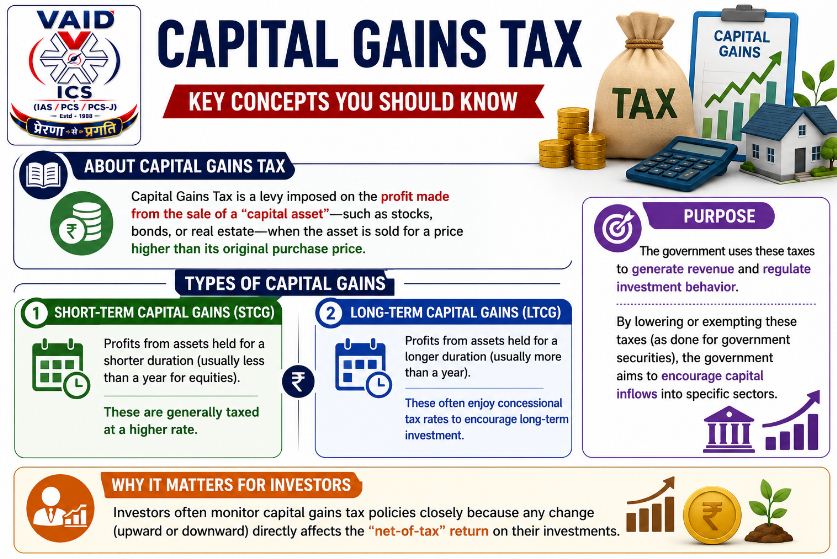
About Capital Gains Tax:
Capital Gains Tax is a levy imposed on the profit made from the sale of a “capital asset”—such as stocks, bonds, or real estate—when the asset is sold for a price higher than its original purchase price.
-
Types of Capital Gains:
-
Short-Term Capital Gains (STCG): Profits from assets held for a shorter duration (usually less than a year for equities). These are generally taxed at a higher rate.
-
Long-Term Capital Gains (LTCG): Profits from assets held for a longer duration (usually more than a year). These often enjoy concessional tax rates to encourage long-term investment.
-
-
Purpose: The government uses these taxes to generate revenue and regulate investment behavior. By lowering or exempting these taxes (as done for government securities), the government aims to encourage capital inflows into specific sectors.
सुर्खियों में क्यों है:
मुख्य आर्थिक सलाहकार (CEA) वी. अनंत नागेश्वरन ने हाल ही में कहा है कि सरकार के लिए इक्विटी (शेयरों) पर पूंजीगत लाभ कर (Capital Gains Tax) के ढांचे में और बदलाव करने की कोई तत्काल आवश्यकता नहीं है। यह बयान सरकार द्वारा विदेशी निवेशकों को सरकारी बॉन्ड (सिक्योरिटीज) पर पूंजीगत लाभ कर से छूट देने के कुछ ही दिन बाद आया है, जिसका उद्देश्य देश में अधिक विदेशी निवेश आकर्षित करना है।
मुख्य बिंदु:
-
निवेश आकर्षित करने की रणनीति: सरकार ने विदेशी संस्थागत निवेशकों (FIIs) को सरकारी बॉन्ड पर टैक्स से छूट दी है ताकि विदेशी इक्विटी से पैसा बाहर जाने और कमजोर मुद्रा के दबाव के बीच अधिक निवेश आकर्षित किया जा सके।
-
CEA का रुख: CEA ने स्पष्ट किया कि सरकार का मानना है कि बॉन्ड की तुलना में इक्विटी (शेयर) के लिए टैक्स नियमों में बदलाव की उतनी तात्कालिक जरूरत नहीं है।
-
आर्थिक दृष्टिकोण: पश्चिम एशिया में संघर्ष और तेल की बढ़ती कीमतों जैसी वैश्विक चुनौतियों के बावजूद, भारतीय रिजर्व बैंक (RBI) ने चालू वित्त वर्ष 2027 (FY27) के लिए 6.6% आर्थिक विकास दर का अनुमान लगाया है।
-
जोखिम कारक: भारतीय अर्थव्यवस्था के लिए कुछ जोखिम बने हुए हैं:
- उच्च तेल कीमतें: भारत दुनिया का तीसरा सबसे बड़ा तेल आयातक है, इसलिए तेल की ऊंची कीमतें आर्थिक विकास और सरकारी खजाने पर असर डाल सकती हैं।
- अल नीनो: सूखे की स्थिति पैदा करने वाली अल नीनो की घटना से भी अर्थव्यवस्था प्रभावित हो सकती है।
-
मुद्रास्फीति और ईंधन: CEA ने कहा कि अगर वैश्विक तेल की कीमतें बाजार के अनुमान के अनुसार कम रहती हैं, तो तेल खुदरा विक्रेताओं को उपभोक्ताओं पर बोझ डालने की जरूरत नहीं पड़ेगी।
पूंजीगत लाभ कर (Capital Gains Tax) क्या है:
पूंजीगत लाभ कर वह कर है जो किसी “पूंजीगत संपत्ति” (जैसे शेयर, बॉन्ड या रियल एस्टेट) को खरीदने की तुलना में ऊंची कीमत पर बेचने से होने वाले लाभ (मुनाफे) पर लगाया जाता है।
-
पूंजीगत लाभ के प्रकार:
- अल्पकालिक पूंजीगत लाभ (STCG): कम अवधि के लिए रखी गई संपत्ति (इक्विटी के लिए आमतौर पर 1 वर्ष से कम) को बेचने पर होने वाला लाभ। इस पर कर की दर आमतौर पर अधिक होती है।
- दीर्घकालिक पूंजीगत लाभ (LTCG): लंबी अवधि के लिए रखी गई संपत्ति (आमतौर पर 1 वर्ष से अधिक) को बेचने पर होने वाला लाभ। निवेश को बढ़ावा देने के लिए इस पर अक्सर कम कर लगाया जाता है।
-
उद्देश्य: सरकार इसका उपयोग राजस्व जुटाने और निवेश के व्यवहार को विनियमित करने के लिए करती है। टैक्स में छूट देकर सरकार विशिष्ट क्षेत्रों में निवेश को प्रोत्साहित करती है।

May 19, 2026
October 17, 2025
October 16, 2025
October 6, 2025

