June 13, 2026
National Biodiversity Authority (NBA)
Why in news?
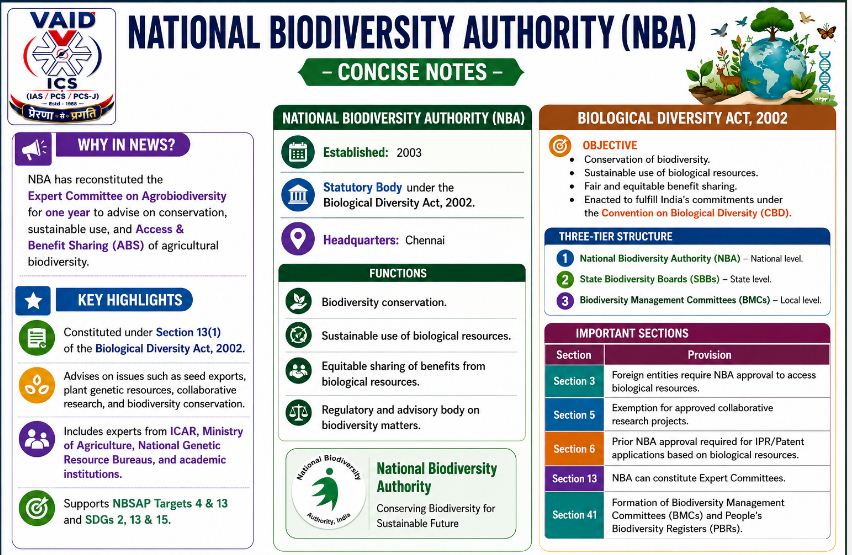
The National Biodiversity Authority (NBA) has reconstituted the Expert Committee on Agrobiodiversity for a one-year term. This initiative is designed to provide expert guidance on the conservation, sustainable use, and access and benefit-sharing (ABS) of India’s agricultural biodiversity.
Key points:
- Leadership: The committee is chaired by Padma Shri Dr. P. L. Gautam, a renowned agricultural scientist and former Chairperson of the NBA and the Protection of Plant Varieties and Farmers’ Rights Authority (PPVFRA). The Chairperson of the PPVFRA will serve as the Co-Chair.
- Legal Basis: The committee is established under Section 13(1) of the Biological Diversity Act, 2002.
- Advisory Role: Since 2005, this body has provided recommendations on critical issues, including the International Treaty on Plant Genetic Resources for Food and Agriculture (ITPGRFA), seed exports, and collaborative research projects involving biological resources.
- Collaboration: The reconstituted committee consists of experts from the Ministry of Agriculture and Farmers Welfare, Indian Council of Agricultural Research (ICAR), National Bureaus of Plant, Animal and Fish Genetic Resources, and various legal and academic institutions like NALSAR.
- Strategic Goals: The committee will assist in meeting India’s NBSAP Targets 4 and 13 and support the realization of Sustainable Development Goals (SDG) 2 (Zero Hunger), SDG 13 (Climate Action), and SDG 15 (Life on Land).
About NBA:
- Establishment: The National Biodiversity Authority is a statutory body set up in 2003 to implement the provisions of the Biological Diversity Act, 2002.
- Function: It acts as the primary regulatory and advisory body for the Government of India regarding the conservation of biodiversity and the equitable sharing of benefits derived from biological resources.
- Agrobiodiversity Focus: The authority plays a crucial role in balancing agricultural innovation and research with the mandatory biodiversity conservation objectives required by national law.
About Biological Diversity Act, 2002:
The Biological Diversity Act, 2002 is the primary legislation in India aimed at conserving biological diversity, ensuring the sustainable use of its components, and providing for the equitable sharing of benefits arising from the utilization of genetic resources. It was enacted to fulfill India’s commitments under the Convention on Biological Diversity (CBD). The Act established a three-tier structure: the National Biodiversity Authority (NBA) at the national level, State Biodiversity Boards (SBBs) at the state level, and Biodiversity Management Committees (BMCs) at the local level.
Key Sections of the Act:
- Section 3 (Regulation of Access): Restricts foreigners, foreign companies, or non-resident Indians from accessing biological resources or associated knowledge for research or commercial purposes without the prior approval of the NBA.
- Section 5 (Exemption for Collaborative Research): Provides provisions for collaborative research projects between Indian and foreign institutions, ensuring these projects conform to the policy guidelines of the Central Government and are approved by the relevant ministry.
- Section 6 (Intellectual Property Rights): Mandates that anyone seeking an Intellectual Property Right (such as a patent) for an invention based on biological resources or associated knowledge must obtain prior approval from the NBA.
- Section 13 (Expert Committees): Empowers the NBA to constitute specialized committees to provide expert technical guidance on diverse matters related to biodiversity, including agrobiodiversity, conservation, and sustainable use.
- Section 41 (Constitution of BMCs): Requires local bodies (Gram Panchayats/Municipalities) to constitute Biodiversity Management Committees (BMCs) to promote conservation, sustainable use, and documentation of biodiversity through People’s Biodiversity Registers (PBRs).

May 19, 2026
October 17, 2025
October 16, 2025
October 6, 2025

