June 12, 2026
Gist of Daily Articles: Daily Mains Qn/Model Answer/Mains Concise Note The Hindu/Indian Express:12 June 2026
Population Dynamics & Policy Reorientation
Syllabus Relevance: GS Paper I (Social Issues: Population and associated issues) | GS Paper II (Social Justice: Health/Development)
1. Context: The Demographic Transition:
-
Declining TFR: India’s Total Fertility Rate (TFR) has dropped to 1.9, falling below the replacement level of 2.1 (the rate needed to maintain a stable population).
-
Regional Disparity: There is a sharp contrast between states. Some southern states (e.g., Andhra Pradesh with a TFR of 1.4–1.5) are experiencing rapid fertility decline and ageing, while some northern states (BIMARU region) still maintain higher fertility rates.
-
The Shift: Policymakers are moving away from the fear of a “population explosion” toward addressing the challenges of a future “ageing society” and a potential contraction in the working-age population.
2. Arguments for Incentivising Larger Families:
-
Mitigating Future Ageing: Encouraging higher birth rates is seen as a way to ensure a sufficient future workforce to support an increasing elderly population.
-
Economic Sustainability: Proponents argue that a shrinking youth base could lead to lower productivity, reduced tax revenues, and increased pressure on pension and healthcare systems (similar to the “demographic traps” faced by Japan, South Korea, and China).
-
Localised Needs: States like Andhra Pradesh argue that population policy must be evidence-based and localized. If a state’s TFR is well below replacement, policy incentives are intended to prevent long-term demographic collapse.
3. Critical Perspective: Challenges and Concerns
-
Resource Stress: India continues to face immense pressure on land, water, food, and energy. A large population remains a significant challenge to sustainable development.
-
Ineffectiveness of Cash Incentives: Economists note that financial incentives (cash for a 3rd/4th child) rarely reverse fertility trends, which are driven by structural factors like the high cost of education, housing, and childcare, and changing aspirations.
-
Social & Gender Impacts:
-
Workforce Participation: Policies that encourage larger families may inadvertently discourage female labour force participation, as childcare responsibilities often fall disproportionately on women.
-
Communal Narratives: There is concern that the debate is sometimes hijacked by political narratives surrounding religious fertility differentials, which obscures the broader economic and structural realities.
-
-
Quality over Quantity: The focus should remain on human capital development (health, education, skills) rather than numerical targets. A large population is not an asset if it lacks employment and productivity.
4. Way Forward: From “Control” to “Care”
-
Demographic Dividend Management: India is currently at a “demographic window of opportunity.” The focus must be on upskilling, creating quality employment, and improving health outcomes to fully leverage the existing youth population.
-
Rights-Based Approach: Population policy should move toward a “people-centred” approach that prioritizes reproductive health, women’s agency, and elderly welfare.
-
Integrated Social Security: Instead of just incentivising births, governments should invest in robust pension systems, universal healthcare, and geriatric care to prepare for the inevitable shift toward an older society.
-
Evidence-Based Federalism: Recognize that India is not a monolith. Policies should be flexible, allowing states to design responses that reflect their specific demographic transition (e.g., skill development in high-fertility states; elderly care in low-fertility states).
Conclusion for Mains Answer Writing:
-
India must avoid the extremes of “coercive control” and “forced pronatalism.”
-
The policy discourse must shift from the number of citizens to the quality of human capital. Development remains the most effective “contraceptive” for stabilization, while quality education and health infrastructure are the best investments for a maturing demographic.
Mains qn: India’s population policy focus should now shift from ‘population control’ to ‘demographic stability’ and the challenges posed by an ‘ageing population’.” In light of this statement, analyze the changing nature of India’s demographic transition and the policy shifts required to address it. (250 words, 15 marks).
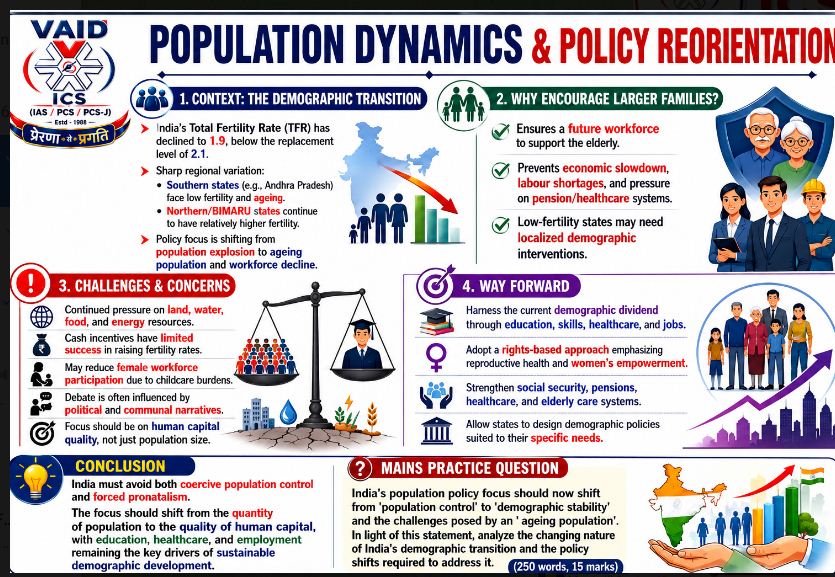
जनसंख्या गतिकी और नीति पुनर्रचना (Population Dynamics & Policy Reorientation):
पाठ्यक्रम: जीएस पेपर I (सामाजिक मुद्दे: जनसंख्या और उससे संबंधित मुद्दे) | जीएस पेपर II (सामाजिक न्याय: स्वास्थ्य/विकास)
1. संदर्भ: जनसांख्यिकीय संक्रमण (Demographic Transition):
-
घटती TFR: भारत की कुल प्रजनन दर (TFR) गिरकर 1.9 हो गई है, जो प्रतिस्थापन स्तर (replacement level) 2.1 से नीचे है।
-
क्षेत्रीय असमानता: दक्षिणी राज्यों (जैसे आंध्र प्रदेश, TFR 1.4–1.5) में तेजी से प्रजनन दर में गिरावट और बुजुर्गों की संख्या बढ़ रही है, जबकि कुछ उत्तरी राज्यों में प्रजनन दर अभी भी अधिक है।
-
बदलाव: नीति निर्माता अब “जनसंख्या विस्फोट” के डर के बजाय “वृद्ध समाज” और कार्यबल में संभावित कमी से निपटने पर ध्यान केंद्रित कर रहे हैं।
2. बड़े परिवारों को प्रोत्साहित करने के तर्क:
-
भविष्य की उम्रदराज आबादी: उच्च जन्म दर को भविष्य के कार्यबल को सुनिश्चित करने के उपाय के रूप में देखा जा रहा है ताकि वृद्ध आबादी का भरण-पोषण हो सके।
-
आर्थिक स्थिरता: समर्थकों का तर्क है कि युवा आबादी कम होने से उत्पादकता कम हो सकती है, कर राजस्व घट सकता है और पेंशन एवं स्वास्थ्य प्रणालियों पर दबाव बढ़ सकता है।
-
स्थानीय आवश्यकताएं: आंध्र प्रदेश जैसे राज्य तर्क देते हैं कि जनसंख्या नीति साक्ष्य-आधारित (evidence-based) और स्थानीय होनी चाहिए। यदि किसी राज्य की TFR प्रतिस्थापन स्तर से नीचे है, तो वहां प्रोत्साहन का उद्देश्य दीर्घकालिक जनसांख्यिकीय पतन को रोकना है।
3. आलोचनात्मक दृष्टिकोण: चुनौतियां और चिंताएं
-
संसाधनों पर दबाव: भारत अभी भी भूमि, जल, भोजन और ऊर्जा पर भारी दबाव का सामना कर रहा है। एक बड़ी जनसंख्या अभी भी सतत विकास के लिए चुनौती है।
-
नकद प्रोत्साहन की अप्रभावीता: अर्थशास्त्रियों का कहना है कि नकद प्रोत्साहन (तीसरे/चौथे बच्चे के लिए पैसा) प्रजनन रुझानों को नहीं बदल पाते, क्योंकि ये शिक्षा, आवास और बच्चों की परवरिश की लागत जैसे संरचनात्मक कारकों पर निर्भर होते हैं।
-
सामाजिक और लैंगिक प्रभाव:
-
कार्यबल में भागीदारी: बड़े परिवारों को प्रोत्साहित करने वाली नीतियां अनजाने में महिलाओं की श्रम बल में भागीदारी को हतोत्साहित कर सकती हैं।
-
सांप्रदायिक विमर्श: चिंता है कि यह बहस कभी-कभी धार्मिक प्रजनन अंतर जैसे राजनीतिक विमर्शों में उलझ जाती है, जो वास्तविक आर्थिक और संरचनात्मक वास्तविकताओं को धुंधला कर देती है।
-
-
गुणवत्ता बनाम संख्या: ध्यान केवल संख्या बढ़ाने पर नहीं, बल्कि मानव पूंजी विकास (स्वास्थ्य, शिक्षा, कौशल) पर होना चाहिए।
4. आगे की राह: “नियंत्रण” से “देखभाल” की ओर:
-
जनसांख्यिकीय लाभांश का प्रबंधन: भारत के पास अभी “जनसांख्यिकीय अवसर” (demographic window) है। ध्यान कौशल विकास, गुणवत्तापूर्ण रोजगार सृजन और स्वास्थ्य परिणामों में सुधार पर होना चाहिए।
-
अधिकार-आधारित दृष्टिकोण: जनसंख्या नीति को ‘जन-केंद्रित’ होना चाहिए जो प्रजनन स्वास्थ्य, महिलाओं की स्वायत्तता और बुजुर्गों के कल्याण को प्राथमिकता दे।
-
एकीकृत सामाजिक सुरक्षा: केवल जन्म को प्रोत्साहित करने के बजाय, सरकारों को एक मजबूत पेंशन प्रणाली, सार्वभौमिक स्वास्थ्य सेवा और वृद्धावस्था देखभाल में निवेश करना चाहिए।
-
साक्ष्य-आधारित संघवाद (Federalism): राज्यों को उनकी विशिष्ट जनसांख्यिकीय स्थिति के अनुसार नीति बनाने की छूट मिलनी चाहिए (जैसे: उच्च प्रजनन वाले राज्यों में कौशल विकास; कम प्रजनन वाले राज्यों में बुजुर्गों की देखभाल)।
मेन्स उत्तर लेखन के लिए निष्कर्ष:
-
भारत को “जबरन नियंत्रण” और “जबरन प्रोत्साहन” दोनों के चरम से बचना चाहिए।
-
नीतिगत चर्चा का ध्यान नागरिकों की संख्या से हटकर मानव पूंजी की गुणवत्ता पर होना चाहिए। विकास ही जनसंख्या स्थिरीकरण के लिए सबसे प्रभावी ‘गर्भनिरोधक’ है, और गुणवत्तापूर्ण शिक्षा व स्वास्थ्य बुनियादी ढांचा एक परिपक्व होती जनसांख्यिकी के लिए सबसे अच्छा निवेश है।

May 19, 2026
October 17, 2025
October 16, 2025
October 6, 2025

