June 5, 2026
Daily UPSC Current Affairs/ 18 ‘Namo Oxygen Parks’
Notes: World Environment Day 2026 – Delhi Green Initiatives
Why is it in the News?
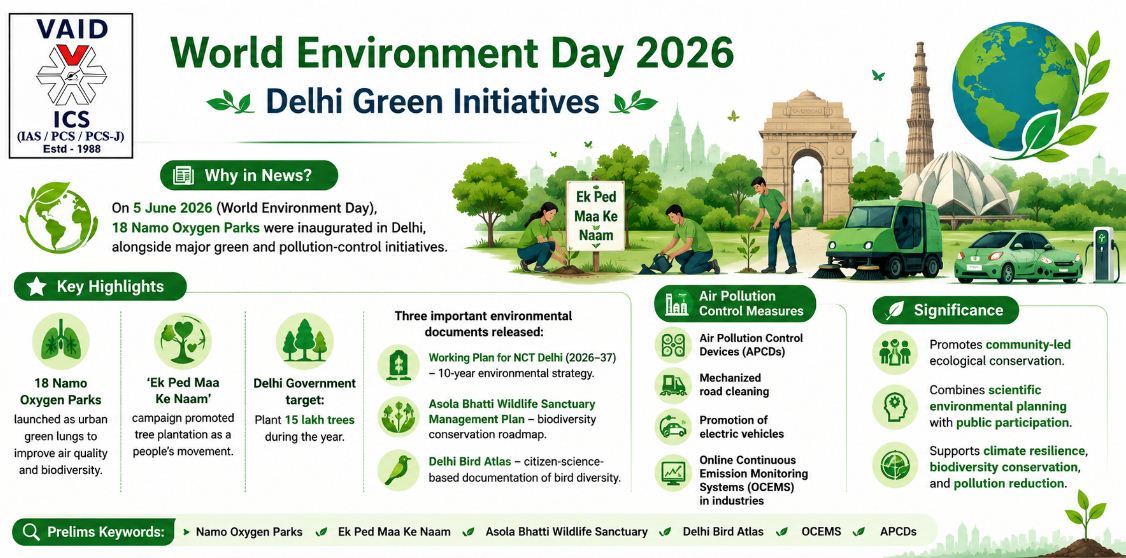
On World Environment Day (June 5, 2026), the Union Minister for Environment, Forest and Climate Change and the Chief Minister of Delhi inaugurated 18 ‘Namo Oxygen Parks’ across the city. The event served as a launchpad for major ecological projects aimed at combating urban pollution and promoting sustainable environmental governance.
Key Points:
- 18 Namo Oxygen Parks: Inaugurated across Delhi to act as “urban green lungs.” These spaces are designed to improve air quality, boost local biodiversity, and provide recreational green spaces for citizens.
- ‘Ek Ped Maa Ke Naam’ Campaign: A nationwide initiative promoted as a people’s movement. It emphasizes that tree plantation should be rooted in gratitude and personal responsibility, encouraging citizens to nurture trees long-term.
- Green Targets: The Delhi Government announced an ambitious target to plant 15 lakh trees within the current year, highlighting the need for active community participation in safeguarding the newly planted cover.
- Scientific Governance Publications: To ensure data-driven environmental management, three critical documents were released:
- Working Plan for NCT Delhi (2026–27 to 2036–37): A 10-year strategy for sustainable development and environmental governance.
- Asola Bhatti Wildlife Sanctuary Management Plan: A blueprint for the next decade focusing on the restoration and protection of this key biodiversity reserve.
- Delhi Bird Atlas: A landmark scientific compilation of Delhi’s bird species, created through an extensive “citizen science” project involving birdwatchers and volunteers.
- Pollution Mitigation Strategies: The Union Minister highlighted ongoing efforts to tackle air pollution through:
- Deployment of Air Pollution Control Devices (APCDs).
- Mechanized deep cleaning of roads to reduce dust.
- Accelerated transition to electric mobility.
- Installation of Online Continuous Emission Monitoring Systems (OCEMS) in industries.
Strategic Importance:
The event underscores a shift toward “Community-Led Ecological Conservation.” By combining scientific planning (the three new management documents) with public movements (like ‘Ek Ped Maa Ke Naam’), the government aims to build long-term ecological resilience against climate change, biodiversity loss, and land degradation.
OCEMS (Online Continuous Emission Monitoring Systems)
OCEMS is a digital surveillance system that allows authorities to monitor industrial pollution in real-time.
- What it does: It consists of sensors and analyzers installed directly on the chimneys (stacks) or at the outlets of industrial units. These devices continuously measure the concentration of pollutants being released into the atmosphere.
- Key Functions:
- Real-time Data: It transmits emission data directly to the servers of the Central Pollution Control Board (CPCB) or State Pollution Control Boards (SPCBs) without human intervention.
- Transparency: Because the data is transmitted electronically, it prevents industries from manipulating manual reports.
- Accountability: If emission levels exceed the legally permitted standards (norms), the system triggers an automatic alert, allowing authorities to take immediate action against the polluting industry.
APCDs (Air Pollution Control Devices):
APCDs are the physical machinery or equipment installed within an industrial facility to capture or treat pollutants before they are released into the air.
- What it does: They act as a “filter” or “cleaner” for industrial smoke and emissions.
- Common Examples of APCDs:
- Bag Filters (Fabric Filters): Similar to a giant vacuum cleaner bag, these capture fine dust particles from industrial gas streams.
- Electrostatic Precipitators (ESPs): These use high-voltage electric charges to attract and remove dust and smoke particles from exhaust gases.
- Scrubbers (Wet Scrubbers): These use liquid (usually water or chemicals) to “wash” the pollutants out of the gas stream. This is highly effective for gaseous pollutants like sulfur dioxide.
- Cyclonic Separators: These use centrifugal force to spin the air, causing heavier dust particles to drop out of the gas stream into a collection hopper.
Why are they important for Delhi?
In the context of the recent initiatives in Delhi:
- OCEMS provides the “Watch” (surveillance and data).
- APCDs provide the “Fix” (physical reduction of pollution).
विश्व पर्यावरण दिवस 2026 – दिल्ली हरित पहल:
यह चर्चा में क्यों है?: विश्व पर्यावरण दिवस (5 जून, 2026) पर, केंद्रीय पर्यावरण, वन और जलवायु परिवर्तन मंत्री और दिल्ली की मुख्यमंत्री ने शहर भर में 18 ‘नमो ऑक्सीजन पार्क’ का उद्घाटन किया। यह आयोजन शहरी प्रदूषण से निपटने और सतत पर्यावरणीय शासन को बढ़ावा देने के उद्देश्य से शुरू की गई प्रमुख पारिस्थितिक परियोजनाओं के लिए एक लॉन्चपैड के रूप में कार्य करता है।
मुख्य बिंदु:
-
18 नमो ऑक्सीजन पार्क: इन्हें “शहरी ग्रीन लंग्स” (फेफड़ों) के रूप में कार्य करने के लिए दिल्ली भर में स्थापित किया गया है। ये स्थान वायु गुणवत्ता में सुधार, स्थानीय जैव विविधता को बढ़ावा देने और नागरिकों के लिए मनोरंजक हरित स्थान प्रदान करने के लिए डिज़ाइन किए गए हैं।
-
‘एक पेड़ माँ के नाम’ अभियान: एक राष्ट्रव्यापी पहल जिसे जन-आंदोलन के रूप में बढ़ावा दिया जा रहा है। यह इस बात पर जोर देता है कि वृक्षारोपण कृतज्ञता और व्यक्तिगत जिम्मेदारी में निहित होना चाहिए, जो नागरिकों को लंबे समय तक पेड़ों का पोषण करने के लिए प्रोत्साहित करता है।
-
हरित लक्ष्य: दिल्ली सरकार ने चालू वर्ष के भीतर 15 लाख पेड़ लगाने का महत्वाकांक्षी लक्ष्य घोषित किया है, जो नए लगाए गए कवर की सुरक्षा में सक्रिय सामुदायिक भागीदारी की आवश्यकता पर प्रकाश डालता है।
-
वैज्ञानिक शासन प्रकाशन: डेटा-संचालित पर्यावरणीय प्रबंधन सुनिश्चित करने के लिए तीन महत्वपूर्ण दस्तावेज जारी किए गए:
-
कार्य योजना (Working Plan) NCT दिल्ली (2026–27 से 2036–37): सतत विकास और पर्यावरणीय शासन के लिए 10 साल की रणनीति।
-
असोला भट्टी वन्यजीव अभयारण्य प्रबंधन योजना: इस महत्वपूर्ण जैव विविधता भंडार की बहाली और सुरक्षा पर ध्यान केंद्रित करते हुए अगले दशक के लिए एक ब्लूप्रिंट।
-
दिल्ली बर्ड एटलस: दिल्ली की पक्षी प्रजातियों का एक ऐतिहासिक वैज्ञानिक संकलन, जिसे पक्षी प्रेमियों और स्वयंसेवकों को शामिल करके एक व्यापक “नागरिक विज्ञान” (citizen science) परियोजना के माध्यम से तैयार किया गया है।
-
-
प्रदूषण शमन रणनीतियाँ: केंद्रीय मंत्री ने वायु प्रदूषण से निपटने के चल रहे प्रयासों पर प्रकाश डाला:
-
वायु प्रदूषण नियंत्रण उपकरणों (APCDs) की तैनाती।
-
धूल कम करने के लिए सड़कों की मशीनीकृत गहरी सफाई।
-
इलेक्ट्रिक मोबिलिटी की ओर त्वरित बदलाव।
-
उद्योगों में ऑनलाइन निरंतर उत्सर्जन निगरानी प्रणाली (OCEMS) की स्थापना।
-
रणनीतिक महत्व: यह आयोजन “सामुदायिक-नेतृत्व वाले पारिस्थितिक संरक्षण” (Community-Led Ecological Conservation) की दिशा में बदलाव को रेखांकित करता है। वैज्ञानिक योजना और जन आंदोलनों को जोड़कर, सरकार का लक्ष्य जलवायु परिवर्तन, जैव विविधता के नुकसान और भूमि क्षरण के खिलाफ दीर्घकालिक पारिस्थितिक लचीलापन बनाना है।
OCEMS (ऑनलाइन निरंतर उत्सर्जन निगरानी प्रणाली): OCEMS एक डिजिटल निगरानी प्रणाली है जो अधिकारियों को वास्तविक समय में औद्योगिक प्रदूषण पर नजर रखने की अनुमति देती है।
-
यह क्या करती है: इसमें सीधे चिमनियों या औद्योगिक इकाइयों के आउटलेट पर स्थापित सेंसर और विश्लेषक होते हैं। ये उपकरण वायुमंडल में छोड़े जा रहे प्रदूषकों की सांद्रता को लगातार मापते हैं।
-
मुख्य कार्य:
-
रियल-टाइम डेटा: यह उत्सर्जन डेटा को बिना मानवीय हस्तक्षेप के सीधे केंद्रीय प्रदूषण नियंत्रण बोर्ड (CPCB) या राज्य प्रदूषण नियंत्रण बोर्ड (SPCBs) के सर्वर पर प्रसारित करता है।
-
पारदर्शिता: चूँकि डेटा इलेक्ट्रॉनिक रूप से प्रसारित होता है, यह उद्योगों को मैन्युअल रिपोर्ट में हेरफेर करने से रोकता है।
-
जवाबदेही: यदि उत्सर्जन का स्तर कानूनी रूप से अनुमत मानकों (norms) से अधिक हो जाता है, तो सिस्टम एक स्वचालित अलर्ट भेजता है, जिससे अधिकारी प्रदूषण फैलाने वाले उद्योग के खिलाफ तत्काल कार्रवाई कर सकते हैं।
-
APCDs (वायु प्रदूषण नियंत्रण उपकरण): APCDs औद्योगिक सुविधा के भीतर स्थापित भौतिक मशीनरी या उपकरण हैं जो प्रदूषकों को हवा में छोड़े जाने से पहले पकड़ते या उपचारित करते हैं।
-
यह क्या करते हैं: ये औद्योगिक धुएं और उत्सर्जन के लिए “फिल्टर” या “क्लीनर” के रूप में कार्य करते हैं।
-
APCDs के सामान्य उदाहरण:
-
बैग फिल्टर (फैब्रिक फिल्टर): एक विशाल वैक्यूम क्लीनर बैग के समान, ये औद्योगिक गैस धाराओं से सूक्ष्म धूल के कणों को पकड़ते हैं।
-
इलेक्ट्रोस्टैटिक प्रेसिपिटेटर (ESPs): ये निकास गैसों से धूल और धुएं के कणों को आकर्षित करने और हटाने के लिए उच्च-वोल्टेज विद्युत आवेशों का उपयोग करते हैं।
-
स्क्रबर्स (वेट स्क्रबर्स): ये प्रदूषकों को गैस स्ट्रीम से बाहर निकालने के लिए तरल (पानी या रसायन) का उपयोग करते हैं। यह सल्फर डाइऑक्साइड जैसे गैसीय प्रदूषकों के लिए अत्यधिक प्रभावी है।
-
साइक्लोनिक सेपरेटर: ये हवा को घुमाने के लिए केन्द्रापसारक बल (centrifugal force) का उपयोग करते हैं, जिससे भारी धूल के कण गैस स्ट्रीम से अलग होकर कलेक्शन हॉपर में गिर जाते हैं।
-
ये दिल्ली के लिए क्यों महत्वपूर्ण हैं?: दिल्ली में हाल की पहलों के संदर्भ में:
-
OCEMS “वॉच” (निगरानी और डेटा) प्रदान करता है।
-
APCDs “फिक्स” (प्रदूषण में भौतिक कमी) प्रदान करते हैं।

May 19, 2026
October 17, 2025
October 16, 2025
October 6, 2025

