June 4, 2026
What is a Flex-Fuel Vehicle (FFV)?
Topic: Energy Security, Sustainable Development, and Economic Transformation
GS Paper Reference: GS III (Economy, Infrastructure, Environment)
Launch of India’s first mass-market flex-fuel motorcycles (Splendor+ and HF Deluxe) by Hero MotoCorp.
- Flex Fuel Definition: Vehicles equipped with internal combustion engines (ICE) and upgraded fuel systems capable of running on any blend of petrol and ethanol (ranging from E20 to E85).
- Strategic Vision: Shift from Annadatas (food providers) to Urjadatas (energy providers) for farmers.
Rationale: Why Flex-Fuel?
- Energy Security: India currently imports ~88.5% of its crude oil, making it vulnerable to geopolitical price shocks.
- Economic Benefit: Reduces foreign exchange outflow; funds that would go to oil imports are diverted to Indian farmers.
- Environmental Impact: Lower carbon footprint compared to traditional ICE vehicles; avoids upstream emissions associated with EV battery production.
- Scalability: Requires minimal infrastructure CAPEX compared to EVs; rollout is estimated to be 10–15 times faster than EV charging networks.
Data & Performance Metrics (Since ESY 2014-15):
| Metric | Impact/Savings |
| Foreign Exchange Saved | ₹1.84 lakh crore |
| Crude Oil Substitution | 302 lakh metric tonnes |
| CO₂ Emission Reduction | 909 lakh metric tonnes |
| Earnings for Farmers | ₹1.58 lakh crore |
- Projection for 1% adoption in ESY 2026-27:
- Demand for 4 crore litres of ethanol.
- 195 crore savings in foreign exchange.
- 160 crore direct income transfer to farmers.
Advantages Over EVs:
- Indigenous Sourcing: Biofuels are “homegrown,” whereas EVs are currently highly import-dependent for battery components (lithium, cobalt, etc.).
- Cost Effectiveness: Lower manufacturing costs. Consumers can potentially recover the cost of the vehicle through fuel price savings within 3 years (if E85 is priced competitively).
Challenges & Road Ahead;
- Policy Support: Need for targeted incentives and supportive fuel pricing to make E85 economically viable for the common consumer.
- Standardization: Adoption follows rigorous testing (SIAM, ARAI, IOCL).
- Diversified Energy Mix: Future mobility in India will not be “one-size-fits-all” but a combination of EVs, Biofuels, Hydrogen, and Renewables tailored to Indian realities.
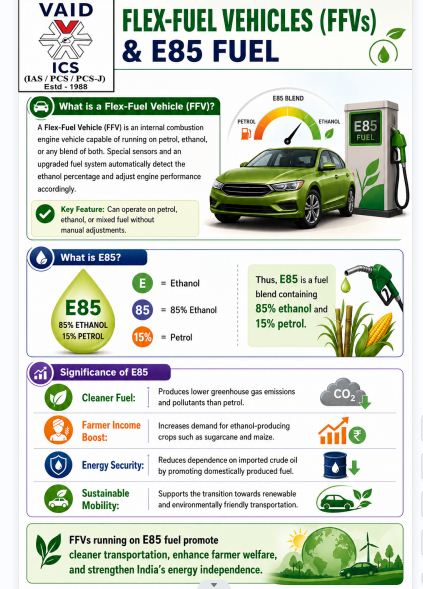
What is a Flex-Fuel Vehicle (FFV)?
A Flex-Fuel Vehicle (FFV) is a vehicle with an internal combustion engine (ICE) designed to run on more than one type of fuel, or a mixture of those fuels.
In the Indian context, this typically refers to Petrol-Ethanol blends. Unlike a regular car or motorcycle that is calibrated to run only on petrol or a very specific low-level blend (like E10 or E20), an FFV is engineered with a special sensor and an upgraded fuel system that can automatically detect the percentage of ethanol in the tank and adjust the engine’s fuel injection and ignition timing accordingly.
- The “Flex” advantage: You can fill your tank with pure petrol, pure ethanol, or any combination of the two.
Understanding E85:
The term “E85” is a specific fuel designation that tells you exactly how much ethanol is in the mix.
- The Breakdown: * E stands for Ethanol.
- 85 stands for the percentage of ethanol in the fuel.
- Therefore, E85 is a fuel blend consisting of 85% ethanol and 15% petrol.
Why is E85 significant?
- High Ethanol Content: It represents a major step toward replacing petrol with a renewable, plant-based fuel (produced from sugarcane, corn, or grains).
- Environmental Impact: Ethanol burns cleaner than petrol, meaning it releases fewer greenhouse gases and pollutants, helping to reduce the overall carbon footprint of the vehicle.
- Economic Shift: By moving from E20 (20% ethanol) to E85, the demand for ethanol increases significantly. This directly translates into higher income for farmers, as the demand for ethanol feedstock (crops) rises.
- Energy Independence: Because ethanol is produced domestically, increasing the use of E85 reduces India’s reliance on expensive imported crude oil, strengthening the nation’s energy security.
मुख्य अवधारणा
-
फ्लेक्स-फ्यूल वाहन (FFV) क्या हैं? ये ऐसे वाहन हैं जिनमें इंटरनल कंबशन इंजन (ICE) होता है और ये पेट्रोल तथा एथेनॉल के किसी भी मिश्रण (E20 से E85 तक) पर चलने में सक्षम होते हैं।
-
हालिया घटनाक्रम: हीरो मोटोकॉर्प द्वारा भारत की पहली मास-मार्केट फ्लेक्स-फ्यूल मोटरसाइकिल (Splendor+ और HF Deluxe) का लॉन्च।
-
रणनीतिक दृष्टिकोण: किसानों को ‘अन्नदाता’ से ‘ऊर्जादाता’ (Energy Providers) बनाना।
2. तर्क: फ्लेक्स-फ्यूल क्यों?
-
ऊर्जा सुरक्षा: भारत अपनी कच्चे तेल की जरूरतों का ~88.5% आयात करता है, जिससे देश वैश्विक भू-राजनीतिक झटकों के प्रति संवेदनशील बना रहता है।
-
आर्थिक लाभ: विदेशी मुद्रा (Forex) की निकासी कम होती है; जो पैसा तेल आयात में जाता है, वह भारतीय किसानों की आय के रूप में देश में ही रहता है।
-
पर्यावरण: पारंपरिक ICE वाहनों की तुलना में कार्बन फुटप्रिंट कम है; साथ ही EV बैटरी निर्माण से होने वाले उत्सर्जन से भी बचाव होता है।
-
स्केलेबिलिटी: EVs की तुलना में इसमें बहुत कम इंफ्रास्ट्रक्चर लागत (CAPEX) लगती है; इसे EV चार्जिंग नेटवर्क की तुलना में 10-15 गुना तेजी से रोलआउट किया जा सकता है।
3. आंकड़े और प्रदर्शन (ESY 2014-15 से अब तक)
| मीट्रिक (Metric) | प्रभाव/बचत |
| विदेशी मुद्रा बचत | ₹1.84 लाख करोड़ |
| कच्चे तेल का प्रतिस्थापन | 302 लाख मीट्रिक टन |
| CO₂ उत्सर्जन में कमी | 909 लाख मीट्रिक टन |
| किसानों की कमाई में वृद्धि | ₹1.58 लाख करोड़ |
-
ESY 2026-27 में 1% अपनाने का अनुमान:
-
4 करोड़ लीटर एथेनॉल की मांग।
-
₹195 करोड़ की विदेशी मुद्रा बचत।
-
₹160 करोड़ का सीधा किसानों को आय हस्तांतरण।
-
4. इलेक्ट्रिक वाहनों (EVs) के मुकाबले लाभ
-
स्वदेशी स्रोत: जैव-ईंधन (Biofuels) “घरेलू” हैं, जबकि EV बैटरी के लिए लिथियम/कोबाल्ट जैसे आयातित घटकों पर निर्भर रहना पड़ता है।
-
लागत-प्रभावशीलता: विनिर्माण लागत कम है। उपभोक्ता ईंधन की बचत के माध्यम से लगभग 3 वर्षों में वाहन की लागत वसूल सकते हैं।
5. चुनौतियां और भविष्य की राह
-
नीतिगत समर्थन: E85 को आम उपभोक्ता के लिए किफायती बनाने हेतु लक्षित प्रोत्साहन (incentives) और सहायक ईंधन मूल्य निर्धारण की आवश्यकता है।
-
मानकीकरण: इंजन की विश्वसनीयता सुनिश्चित करने के लिए SIAM, ARAI और IOCL द्वारा कठोर परीक्षण।
-
विविध ऊर्जा मिश्रण: भारत का भविष्य “एक-आकार-सभी-के-लिए” नहीं है, बल्कि EVs, जैव-ईंधन, हाइड्रोजन और नवीकरणीय ऊर्जा का एक संतुलित मिश्रण है।
6. तकनीकी जानकारी: E85 क्या है?
-
E85 का मतलब: ‘E’ का अर्थ है एथेनॉल और ’85’ का अर्थ है ईंधन मिश्रण में 85% एथेनॉल और 15% पेट्रोल।
-
E85 का महत्व:
-
उच्च एथेनॉल सामग्री: पेट्रोल को नवीकरणीय, पौधे-आधारित ईंधन (गन्ना, मक्का, अनाज) से बदलने की दिशा में एक बड़ा कदम।
-
पर्यावरण: एथेनॉल पेट्रोल की तुलना में अधिक स्वच्छ जलता है, जिससे ग्रीनहाउस गैसें कम होती हैं।
-
आर्थिक परिवर्तन: एथेनॉल की मांग बढ़ने से किसानों के लिए आय का एक अतिरिक्त स्रोत तैयार होता है।
-
ऊर्जा स्वतंत्रता: घरेलू स्तर पर एथेनॉल उत्पादन से कच्चे तेल के आयात पर निर्भरता कम होती है, जिससे भारत की ऊर्जा सुरक्षा मजबूत होती है।
-
.

May 19, 2026
October 17, 2025
October 16, 2025
October 6, 2025

