June 3, 2026
Mission Muga Silk ‘Senehjori’:
Mission Objective:
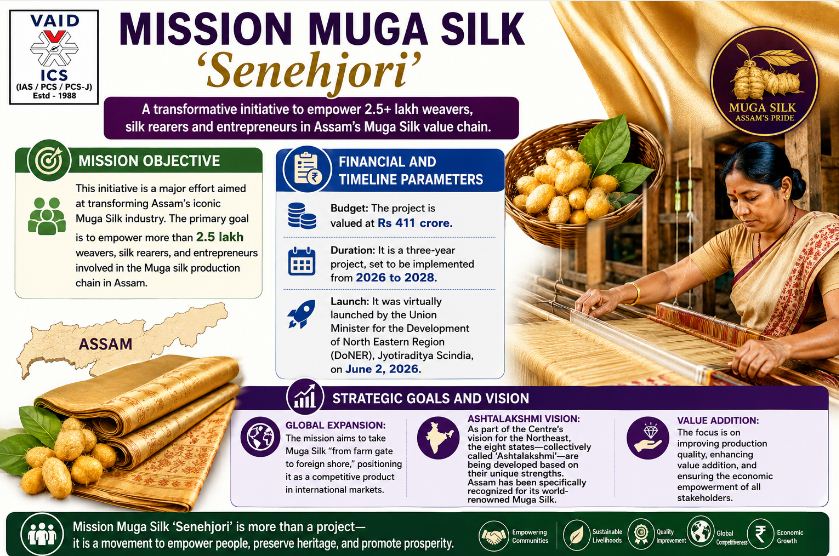
This initiative is a major effort aimed at transforming Assam’s iconic Muga Silk industry. The primary goal is to empower more than 2.5 lakh weavers, silk rearers, and entrepreneurs involved in the Muga silk production chain in Assam.
Financial and Timeline Parameters:
- Budget: The project is valued at Rs 411 crore.
- Duration: It is a three-year project, set to be implemented from 2026 to 2028.
- Launch: It was virtually launched by the Union Minister for the Development of North Eastern Region (DoNER), Jyotiraditya Scindia, on June 2, 2026.
Strategic Goals and Vision:
- Global Expansion: The mission aims to take Muga Silk “from farm gate to foreign shore,” positioning it as a competitive product in international markets.
- Ashtalakshmi Vision: As part of the Centre’s vision for the Northeast, the eight states—collectively called ‘Ashtalakshmi’—are being developed based on their unique strengths. Assam has been specifically recognized for its world-renowned Muga Silk.
- Value Addition: The focus is on improving production quality, enhancing value addition, and ensuring the economic empowerment of all stakeholders.
Implementation and Infrastructure:
- Collaborative Effort: The mission involves a collaboration between 11 stakeholders, including the Ministry of DoNER, the Government of Assam, the Ministry of Textiles, the Ministry of Cooperation, APEDA, ICAR, and DRDO.
- Modern Facilities: To modernize production, five state-of-the-art reeling units will be established in Jorhat, Sivasagar, Sualkuchi, Majuli, and Lakhimpur.
- Processing Capabilities: A dedicated Muga spun silk unit will be set up in Dhemaji to strengthen processing and value-addition capabilities.
Significance and Expected Impact:
- Cultural Heritage: Muga Silk serves as a symbol of Assam’s pride and cultural identity.
- Unlocking Potential: The mission is designed to unlock the vast, largely untapped economic potential of the Muga silk sector.
Leveraging the GI Tag: Having already secured a Geographical Indication (GI) tag, the product possesses a distinct identity; this mission aims to leverage that brand to significantly increase both the quality and volume of production.
India holds the unique distinction of being the only country in the world that produces all four commercially recognized varieties of natural silk. The silk industry in India is a major pillar of rural economy and heritage, regulated by the Central Silk Board (CSB).
The Four Types of Silk Produced in India:
India produces both mulberry silk and non-mulberry (“Vanya”) silks. Each type is derived from different silkworm species and thrives in specific climatic regions.
| Silk Type | Scientific Name | Characteristics | Key Producing Regions |
| Mulberry | Bombyx mori | Most common; smooth, fine, and lustrous. | Karnataka, Andhra Pradesh, West Bengal. |
| Muga | Antheraea assamensis | Naturally golden, rare, durable, and highly exclusive. | Assam (GI tagged). |
| Tasar | Antheraea mylitta | Copper-toned, coarse, and earthy texture. | Jharkhand, Chhattisgarh, Odisha. |
| Eri | Samia cynthia ricini | “Peace silk”; soft, warm, and wool-like texture. | Northeast India (Assam, Meghalaya). |
Deep Dive: Muga Silk (The Golden Thread):
Muga silk is often called the “Golden Silk of Assam.” It is unique because it is the only naturally golden-colored silk in the world.
-
Cultural Significance: Historically reserved for royalty, it is known for its extreme durability and natural luster that actually improves with every wash.
-
The “Senehjori” Initiative: As discussed, the new Mission Muga Silk ‘Senehjori’ (2026–2028) aims to modernize the production chain, provide GI authentication, and boost global exports by establishing new reeling and processing units.
-
Ecological Niche: Unlike mulberry silkworms, which are domesticated, Muga silkworms are semi-domesticated and feed on Som and Soalu trees.
About The Central Silk Board (CSB):
Established in 1949 by an Act of Parliament, the Central Silk Board is the statutory body under the Ministry of Textiles, Government of India, responsible for the overall development of the sericulture and silk industry.
Core Mandate:
-
Research & Development: Conducting scientific research to improve silkworm breeds, host plants, and post-cocoon technology (reeling, spinning, weaving).
-
Quality Standards: Standardizing quality parameters for cocoons and silk yarn to keep Indian silk globally competitive.
-
Seed Organization: Maintaining the national network for silkworm seed production to ensure farmers have access to high-quality genetic stock.
-
Policy Advisory: Acting as the primary advisor to the Union Government on matters concerning the silk industry, including exports, subsidies, and international trade agreements.
-
Support Schemes: Implementing national projects like “Silk Samagra,” which provides training, technical support, and financial aid to millions of stakeholders, including weavers and farmers.

May 19, 2026
October 17, 2025
October 16, 2025
October 6, 2025

