June 3, 2026
Producer Price Index (PPI)
Why in News ? Starting June 15, 2026, India is transitioning from the traditional Wholesale Price Index (WPI) to a modern Producer Price Index (PPI)-based framework. This shift is designed to align India’s inflation monitoring with international best practices and provide a more granular view of economic costs.
Key Components of the New System:
- Base Year Revision: The Office of Economic Adviser will release a revised WPI series with a base year of 2022-23, replacing the outdated 2011-12 series.
- The New PPI Indices:
- Output PPI (OPPI): Measures prices received by producers at the factory gate (Basic Price: excludes taxes/trade margins).
- Input PPI (IPPI): Measures the cost of production inputs (Purchaser’s Price: includes taxes/trade/transportation margins).
- Service PPI: A new quarterly index covering seven key service sectors: banking, securities, insurance, pension funds, railways, air transport, and telecommunications.
Implementation Roadmap:
- Phased Transition: The WPI will continue to be published alongside the new PPI framework for a transition period of five years.
- Sunset Date: The government plans to fully phase out the WPI by 2031.
- Frequency: OPPI and IPPI will be released monthly; Service PPI will be released quarterly.
Strategic Advantages of the PPI Framework:
- Cost-Push Analysis: By comparing Input PPI and Output PPI, policymakers can track how cost pressures at the raw material stage are passed through to final output prices.
- Accuracy: Reduces the risk of “double counting” inflation, which is a structural concern in the current WPI model.
- Modernization: Reflects the growing importance of the services sector in the Indian economy, which was previously under-represented in the WPI.
- International Standards: Ensures India’s macroeconomic data is consistent with the frameworks used by advanced global economies.
Why the Shift Matters?
The government’s “Whole-of-Government” approach aims to provide businesses and policymakers with a clearer signal of inflationary trends. By tracking the Input PPI (costs faced by businesses) versus the Output PPI (prices received by producers), the RBI and the government can better manage monetary policy and supply-side interventions, ultimately leading to more stable long-term economic planning.
About Wholesale Price Index (WPI):
The WPI tracks the average change in the price of a representative basket of goods at the wholesale level—that is, the price at which goods are sold in bulk before they reach the retail market.
- Current Scope: Historically, it has focused primarily on goods.
- Purpose: It serves as an early indicator of inflation, capturing price trends before they reach the final consumer.
- The Transition: The government is issuing a revised WPI series with a new base year of 2022-23 (replacing the 2011-12 base) to keep it relevant during the five-year transition period before its eventual discontinuation.
About Producer Price Index (PPI):
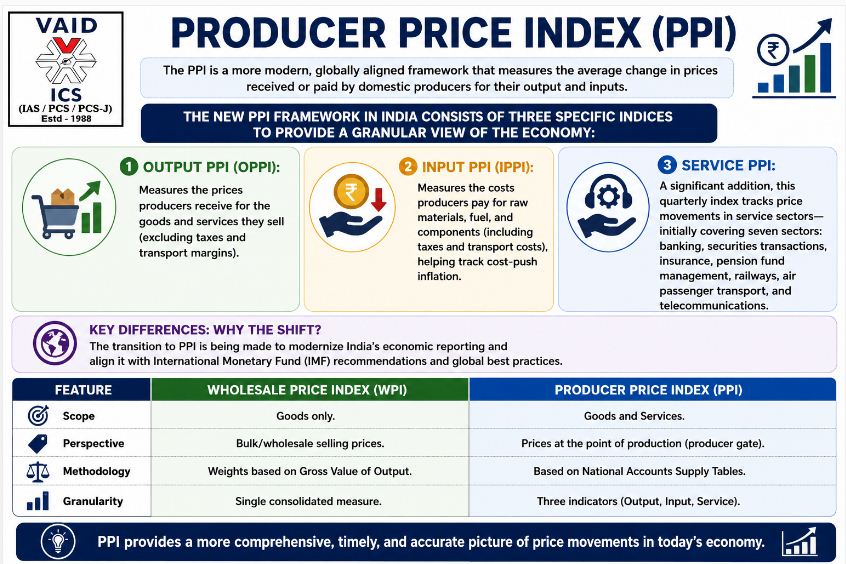
The PPI is a more modern, globally aligned framework that measures the average change in prices received or paid by domestic producers for their output and inputs.
The new PPI framework in India consists of three specific indices to provide a granular view of the economy:
- Output PPI (OPPI): Measures the prices producers receive for the goods and services they sell (excluding taxes and transport margins).
- Input PPI (IPPI): Measures the costs producers pay for raw materials, fuel, and components (including taxes and transport costs), helping track cost-push inflation.
- Service PPI: A significant addition, this quarterly index tracks price movements in service sectors—initially covering seven sectors: banking, securities transactions, insurance, pension fund management, railways, air passenger transport, and telecommunications.
प्रोड्यूसर प्राइस इंडेक्स (PPI): महत्वपूर्ण जानकारी
समाचार में क्यों? 15 जून, 2026 से, भारत पारंपरिक थोक मूल्य सूचकांक (WPI) से एक आधुनिक प्रोड्यूसर प्राइस इंडेक्स (PPI) आधारित ढांचे की ओर बढ़ रहा है। यह बदलाव भारत की मुद्रास्फीति (inflation) की निगरानी को अंतरराष्ट्रीय सर्वोत्तम प्रथाओं के अनुरूप बनाने और आर्थिक लागत का अधिक सटीक (granular) विवरण प्रदान करने के लिए डिज़ाइन किया गया है।
नई प्रणाली के प्रमुख घटक:
-
आधार वर्ष में संशोधन: आर्थिक सलाहकार का कार्यालय 2011-12 की पुरानी श्रृंखला को बदलकर 2022-23 के आधार वर्ष के साथ एक संशोधित WPI श्रृंखला जारी करेगा।
-
नए PPI सूचकांक:
-
आउटपुट PPI (OPPI): कारखाने के गेट पर उत्पादकों द्वारा प्राप्त कीमतों को मापता है (मूल्य: इसमें कर/व्यापार मार्जिन शामिल नहीं है)।
-
इनपुट PPI (IPPI): उत्पादन इनपुट (कच्चा माल) की लागत को मापता है (खरीदार की कीमत: इसमें कर/व्यापार/परिवहन मार्जिन शामिल है)।
-
सर्विस PPI: सात प्रमुख सेवा क्षेत्रों को कवर करने वाला एक नया त्रैमासिक सूचकांक: बैंकिंग, प्रतिभूति लेनदेन (securities), बीमा, पेंशन फंड प्रबंधन, रेलवे, हवाई परिवहन और दूरसंचार।
-
कार्यान्वयन रोडमैप:
-
चरणबद्ध संक्रमण: WPI को पांच साल की संक्रमण अवधि के लिए नए PPI ढांचे के साथ प्रकाशित करना जारी रखा जाएगा।
-
समापन तिथि: सरकार 2031 तक WPI को पूरी तरह से समाप्त करने की योजना बना रही है।
-
आवृत्ति: OPPI और IPPI मासिक रूप से जारी किए जाएंगे; सर्विस PPI त्रैमासिक आधार पर जारी किया जाएगा।
PPI ढांचे के रणनीतिक लाभ:
-
कॉस्ट-पुश विश्लेषण: इनपुट PPI और आउटपुट PPI की तुलना करके, नीति निर्माता यह देख सकते हैं कि कच्चे माल के स्तर पर लागत का दबाव अंतिम कीमतों तक कैसे पहुँचता है।
-
सटीकता: यह मुद्रास्फीति की “दोहरी गणना” (double counting) के जोखिम को कम करता है।
-
आधुनिकीकरण: भारतीय अर्थव्यवस्था में सेवा क्षेत्र के बढ़ते महत्व को दर्शाता है, जिसे पहले WPI में कम प्रतिनिधित्व मिला था।
-
अंतरराष्ट्रीय मानक: यह सुनिश्चित करता है कि भारत का व्यापक आर्थिक डेटा उन्नत वैश्विक अर्थव्यवस्थाओं के अनुरूप हो।
यह बदलाव क्यों मायने रखता है? सरकार का “होल-ऑफ-गवर्नमेंट” दृष्टिकोण व्यवसायों और नीति निर्माताओं को मुद्रास्फीति के रुझान का स्पष्ट संकेत प्रदान करना है। इनपुट PPI (व्यवसायों द्वारा सामना की जाने वाली लागत) और आउटपुट PPI (उत्पादकों द्वारा प्राप्त कीमतें) को ट्रैक करके, RBI और सरकार मौद्रिक नीति और आपूर्ति-पक्ष के हस्तक्षेप को बेहतर ढंग से प्रबंधित कर सकते हैं, जिससे लंबी अवधि की आर्थिक योजना अधिक स्थिर हो सकेगी।
थोक मूल्य सूचकांक (WPI) के बारे में
WPI थोक स्तर पर वस्तुओं की एक प्रतिनिधि टोकरी की औसत कीमत में बदलाव को ट्रैक करता है—यानी वह कीमत जिस पर खुदरा बाजार तक पहुँचने से पहले सामान थोक में बेचा जाता है।
-
वर्तमान दायरा: ऐतिहासिक रूप से, यह मुख्य रूप से वस्तुओं (goods) पर केंद्रित रहा है।
-
उद्देश्य: यह मुद्रास्फीति के शुरुआती संकेतक के रूप में कार्य करता है।
-
संक्रमण: सरकार 2022-23 के आधार वर्ष के साथ एक संशोधित WPI श्रृंखला जारी कर रही है ताकि 2031 में इसके बंद होने तक इसे प्रासंगिक रखा जा सके।
प्रोड्यूसर प्राइस इंडेक्स (PPI) के बारे में
PPI एक आधुनिक और वैश्विक स्तर पर स्वीकृत ढांचा है जो घरेलू उत्पादकों द्वारा अपने आउटपुट और इनपुट के लिए प्राप्त या भुगतान की गई कीमतों में औसत बदलाव को मापता है। भारत में नए PPI ढांचे में तीन विशिष्ट सूचकांक शामिल हैं:
-
आउटपुट PPI (OPPI): उन वस्तुओं और सेवाओं की कीमतों को मापता है जिन्हें उत्पादक बेचते हैं (कर और परिवहन मार्जिन को छोड़कर)।
-
इनपुट PPI (IPPI): उन लागतों को मापता है जो उत्पादक कच्चे माल, ईंधन और घटकों के लिए भुगतान करते हैं।
-
सर्विस PPI: यह सेवा क्षेत्रों (बैंकिंग, बीमा, रेलवे आदि) में मूल्य आंदोलनों को ट्रैक करता है, जो भारतीय

May 19, 2026
October 17, 2025
October 16, 2025
October 6, 2025

