May 30, 2026
What is Social Stock Exchange (SSE)?सोशल स्टॉक एक्सचेंज (SSE)/Zero Coupon Zero Principal (ZCZP) Instruments.
Maritime Reforms & CSR Innovation
Part 1: Modernizing India’s Maritime Sector
Context
The Ministry of Ports, Shipping and Waterways (MoPSW) launched the Logistics Port Performance Index (LPPI) and four major digital initiatives to enhance the efficiency, transparency, and global competitiveness of Indian ports.
Logistics Port Performance Index (LPPI):
- Objective: A national benchmarking mechanism under the Sagar Aankalan
- Alignment: Complements PM Gati Shakti, Maritime India Vision 2030, and Maritime Amrit Kaal Vision 2047.
- Evaluation Criteria: Assesses ports across three segments (Dry bulk, Liquid bulk, Container cargo).
- Operational Indicators: Cargo handled, vessel turnaround time, berth idle time, pre-berthing waiting time, container dwell time, and ship berth day output.
- Unique Feature: Equal weightage given to absolute performance and year-on-year (YoY) improvement to incentivize continuous growth.
Key Digital Initiatives (Directorate General of Shipping);
- e-Navik (Grievance Redressal Module): 24×7 platform for seafarers to register complaints via WhatsApp, email, or toll-free numbers, ensuring compliance with the Maritime Labour Convention, 2006.
- e-Samudra (Ship Registration Module): Simplifies vessel registration to align with global standards.
- Medical Practitioner Module: Centralized registration/monitoring of authorized doctors; prevents fraudulent medical certifications.
- Unified Ship Recycling Credit Note Module: A part of the ₹70,000-crore maritime package. Yards compliant with the Hong Kong Convention generate credits (worth 40% of scrap value) for ship owners, redeemable for new shipbuilding in India.
Part 2: CSR Innovation via Social Stock Exchange (SSE):
Policy Update;
The Ministry of Corporate Affairs (MCA) has amended Schedule VII and the CSR Policy Rules, 2014, allowing CSR funds to be invested in Zero Coupon Zero Principal (ZCZP) Instruments.
Key Features;
- Mechanism: Not-for-Profit Organizations (NPOs) issue ZCZP instruments on the Social Stock Exchange (SSE) to raise funds for welfare projects.
- Compliance Cap: Expenditure by a company on these instruments cannot exceed 10% of its total CSR budget for that financial year.
- Regulatory Framework: Governed under Rule 4A of the CSR Rules; designed to provide transparency and regulated fund flow for social impact.
- Objective: Enables ease of compliance for corporates and provides NPOs with a structured, transparent channel to attract philanthropic capital.
Way Forward:
- Scaling Success: Other minor ports should adopt the “Sagar Aankalan” framework to create a pan-India performance map.
- Data Integration: Ensure the digital modules (e-Navik, e-Samudra) are interoperable with the National Logistics Portal (NLP) for a truly unified ecosystem.
- Monitoring: Periodic audit of NPOs utilizing ZCZP funds on the SSE is essential to ensure that CSR objectives are met without leakage.
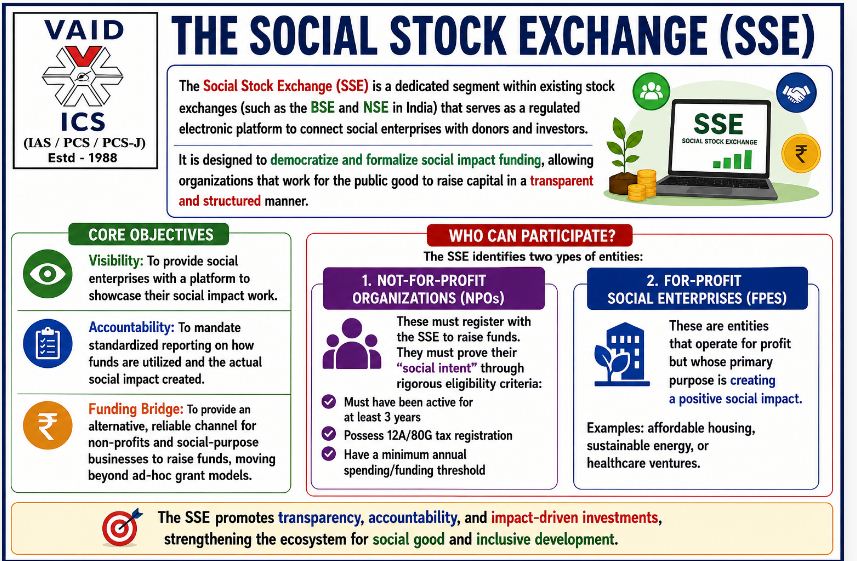
What is SSE?
The Social Stock Exchange (SSE) is a dedicated segment within existing stock exchanges (such as the BSE and NSE in India) that serves as a regulated electronic platform to connect social enterprises with donors and investors.
It is designed to democratize and formalize social impact funding, allowing organizations that work for the public good to raise capital in a transparent and structured manner.
Core Objectives:
- Visibility: To provide social enterprises with a platform to showcase their social impact work.
- Accountability: To mandate standardized reporting on how funds are utilized and the actual social impact created.
- Funding Bridge: To provide an alternative, reliable channel for non-profits and social-purpose businesses to raise funds, moving beyond ad-hoc grant models.
Who Can Participate?
The SSE identifies two types of entities:
Not-for-Profit Organizations (NPOs): These must register with the SSE to raise funds. They must prove their “social intent” through rigorous eligibility criteria (e.g., they must have been active for at least 3 years, possess 12A/80G tax registration, and have a minimum annual spending/funding threshold).
For-Profit Social Enterprises (FPEs): These are entities that operate for profit but whose primary purpose is creating a positive social impact (e.g., affordable housing, sustainable energy, or healthcare ventures).
What is Zero Coupon Zero Principal (ZCZP) Instruments?
A Zero Coupon Zero Principal (ZCZP) Instrument is a unique financial instrument introduced to facilitate fundraising by Not-for-Profit Organizations (NPOs) on the Social Stock Exchange (SSE). As the name suggests, these instruments do not carry any interest (coupon) and do not provide for the repayment of the principal amount to the investor.
Key Features:
- Nature: It functions essentially as a social grant or a donation rather than a traditional debt or equity investment.
- Issuer: Only Not-for-Profit Organizations (NPOs) registered with the Social Stock Exchange are eligible to issue these instruments.
- Maturity: Since no principal is to be repaid, the concept of a “maturity date” does not apply in the traditional sense; once the project concludes, the obligation to the investor is fulfilled through the realization of social impact.
- Purpose: The funds raised are exclusively utilized for projects that fall under Schedule VII of the Companies Act, 2013 (activities related to social welfare, education, healthcare, etc.).
Mechanism of Operation:
Listing: NPOs that meet the stringent eligibility criteria set by the Securities and Exchange Board of India (SEBI) list their social projects on the Social Stock Exchange.
Subscription: Investors (individuals, institutional donors, or corporates using CSR funds) purchase these instruments.
Utilization: The NPO uses the raised capital to execute the specific social project.
Accountability: The issuer is mandated to provide an Annual Impact Report, which must be audited by a registered Social Auditor. This report confirms the utilization of funds and the social outcomes achieved.
Significance for Corporate Social Responsibility (CSR):
- Regulatory Facilitation: The Ministry of Corporate Affairs (MCA) has amended the Companies (CSR Policy) Rules, 2014, to include ZCZP instruments as an approved mode for CSR spending.
- Investment Limit: Companies can deploy up to 10% of their total annual CSR expenditure into ZCZP instruments.
- Ease of Compliance: It provides a transparent, regulated, and standardized route for corporations to fulfill their CSR mandates, moving away from fragmented donation practices.
Advantages:
- Transparency: By operating on a stock exchange platform, the entire process—from fund solicitation to impact reporting—is subject to rigorous regulatory oversight.
- Credibility: Only NPOs with proven track records and strong governance standards can list on the SSE, reducing the risk of fund misappropriation.
- Efficient Impact: It creates a direct link between “social investors” and the “social impact” generated, allowing donors to track the efficacy of their contributions.
Conclusion:
The introduction of ZCZP instruments marks a paradigm shift in Indian philanthropy. It professionalizes the social sector by applying market-based transparency mechanisms to charitable giving, thereby ensuring that social capital is directed toward measurable, high-impact public welfare initiatives.
भारत के समुद्री क्षेत्र का आधुनिकीकरण:
संदर्भ
पत्तन, पोत परिवहन और जलमार्ग मंत्रालय (MoPSW) ने भारतीय बंदरगाहों की दक्षता, पारदर्शिता और वैश्विक प्रतिस्पर्धात्मकता बढ़ाने के लिए लॉजिस्टिक्स पोर्ट परफॉरमेंस इंडेक्स (LPPI) और चार प्रमुख डिजिटल पहल शुरू की हैं।
1. लॉजिस्टिक्स पोर्ट परफॉरमेंस इंडेक्स (LPPI):
-
उद्देश्य: ‘सागर आकलन’ (Sagar Aankalan) ढांचे के तहत एक राष्ट्रीय बेंचमार्किंग तंत्र।
-
संरेखण: यह PM गति शक्ति, मैरीटाइम इंडिया विजन 2030 और मैरीटाइम अमृत काल विजन 2047 के अनुरूप है।
-
मूल्यांकन मानदंड: तीन कार्गो श्रेणियों (ड्राई बल्क, लिक्विड बल्क और कंटेनर कार्गो) का मूल्यांकन।
-
परिचालन संकेतक: कार्गो हैंडलिंग, वेसल टर्नअराउंड टाइम, बर्थ आइडल टाइम, प्री-बर्थिंग वेटिंग टाइम, कंटेनर ड्वेल टाइम और शिप बर्थ डे आउटपुट।
-
अनूठी विशेषता: इसमें ‘पूर्ण प्रदर्शन’ और ‘वर्ष-दर-वर्ष सुधार’ को बराबर महत्व दिया गया है ताकि निरंतर विकास को प्रोत्साहित किया जा सके।
2. प्रमुख डिजिटल पहल (पत्तन महानिदेशालय):
-
e-Navik (शिकायत निवारण): नाविकों के लिए 24×7 प्लेटफॉर्म। यह ‘मैरीटाइम लेबर कन्वेंशन, 2006’ का पालन सुनिश्चित करता है।
-
e-Samudra (जहाज पंजीकरण): वैश्विक मानकों के अनुरूप जहाज पंजीकरण प्रक्रिया का सरलीकरण।
-
मेडिकल प्रैक्टिशनर मॉड्यूल: अधिकृत डॉक्टरों का केंद्रीकृत पंजीकरण/निगरानी; फर्जी मेडिकल प्रमाणपत्रों पर रोक।
-
यूनिफाइड शिप रीसाइक्लिंग क्रेडिट नोट: हांगकांग कन्वेंशन के अनुरूप रीसाइक्लिंग करने वाले यार्ड्स को क्रेडिट दिया जाता है, जिसे नए जहाज निर्माण में उपयोग किया जा सकता है।
भाग 2: सोशल स्टॉक एक्सचेंज (SSE) और CSR नवाचार:
पॉलिसी अपडेट
कॉर्पोरेट मामलों के मंत्रालय (MCA) ने अनुसूची VII और CSR नीति नियमों, 2014 में संशोधन किया है, जिससे जीरो कूपन जीरो प्रिंसिपल (ZCZP) उपकरणों में CSR फंड के निवेश की अनुमति मिल गई है।
SSE क्या है?
यह मौजूदा स्टॉक एक्सचेंजों (BSE/NSE) के भीतर एक समर्पित खंड है जो सामाजिक उद्यमों, दानदाताओं और निवेशकों को जोड़ने के लिए एक विनियमित इलेक्ट्रॉनिक प्लेटफॉर्म के रूप में कार्य करता है।
-
उद्देश्य: सामाजिक प्रभाव फंडिंग को लोकतांत्रिक और औपचारिक बनाना।
-
सहभागी:
-
NPO (गैर-लाभकारी संगठन): जो सामाजिक उद्देश्य के लिए कार्य करते हैं और 3 साल से सक्रिय हैं।
-
FPE (लाभकारी सामाजिक उद्यम): जो लाभ तो कमाते हैं लेकिन उनका प्राथमिक लक्ष्य सकारात्मक सामाजिक प्रभाव (जैसे- स्वास्थ्य, शिक्षा, सतत ऊर्जा) पैदा करना होता है।
-
जीरो कूपन जीरो प्रिंसिपल (ZCZP) उपकरण
यह एक अनूठा वित्तीय साधन है जो NPOs को SSE पर धन जुटाने में मदद करता है।
-
नाम का अर्थ: इसमें कोई ब्याज (कूपन) नहीं मिलता और मूलधन (प्रिंसिपल) भी वापस नहीं मिलता। यह एक प्रकार का सामाजिक अनुदान (Social Grant) है।
-
CSR के लिए महत्व: कंपनियाँ अपने वार्षिक CSR खर्च का अधिकतम 10% ZCZP में निवेश कर सकती हैं।
कार्यप्रणाली:
-
सूचीकरण (Listing): SEBI के मानदंडों के तहत NPO अपने प्रोजेक्ट सूचीबद्ध करते हैं।
-
अंशदान (Subscription): निवेशक (कॉर्पोरेट्स/व्यक्ति) इन उपकरणों को खरीदते हैं।
-
उत्तरदायित्व: NPO को ‘वार्षिक प्रभाव रिपोर्ट’ (Annual Impact Report) देनी होती है, जिसका ऑडिट एक ‘सोशल ऑडिटर’ द्वारा किया जाता है।
निष्कर्ष और आगे की राह:
-
स्केलिंग: ‘सागर आकलन’ फ्रेमवर्क को सभी छोटे बंदरगाहों पर लागू करना चाहिए।
-
डेटा एकीकरण: e-Navik और e-Samudra को ‘नेशनल लॉजिस्टिक्स पोर्टल’ (NLP) के साथ एकीकृत करना आवश्यक है।
-
पारदर्शिता: SSE के माध्यम से ZCZP का उपयोग CSR के लिए करना न केवल अनुपालन में आसानी प्रदान करता है, बल्कि सामाजिक क्षेत्र में जवाबदेही भी बढ़ाता है। यह भारतीय परोपकार (Philanthropy) में एक प्रतिमान बदलाव (Paradigm Shift) है।

May 19, 2026
October 17, 2025
October 16, 2025
October 6, 2025

