May 26, 2026
Padma Awards for 2026
Why in News?
The President of India recently conferred the Padma Awards for 2026 at the Civil Investiture Ceremony-I held at Rashtrapati Bhavan, recognizing individuals for their distinguished service across various fields.
Key Facts About Padma Awards
-
Origin: Instituted in 1954. Restructured in 1955 into three tiers:
-
Padma Vibhushan: Exceptional and distinguished service (2nd highest civilian award after Bharat Ratna).
-
Padma Bhushan: Distinguished service of high order.
-
Padma Shri: Distinguished service in any field.
-
-
Announcement & Conferment: Announced annually on the eve of Republic Day; conferred by the President in March/April.
Constitutional & Legal Framework:
-
Article 18(1): Abolishes “titles.” However, the Supreme Court in Balaji Raghavan v. Union of India (1996) held that Padma Awards are “National Awards” recognizing merit, not prohibited titles, provided they are not used as prefixes or suffixes to the name.
-
Professional Demarcation: In Indira Jaising v. Supreme Court of India (2017), the court clarified that designations like ‘Senior Advocate’ are professional distinctions based on proficiency, not prohibited titles.
4. Eligibility & Selection Process:
-
People’s Padma: Open to all, regardless of race, occupation, rank, or gender (includes NRIs/OCIs/Foreigners).
-
Exclusions: Government servants (including those in PSUs) are ineligible while in service, with the exception of doctors and scientists.
-
Committee Composition: * Constituted by: Prime Minister.
-
Chaired by: Cabinet Secretary.
-
Members: Home Secretary, Secretary to the President, and 4–6 eminent persons.
-
-
Criteria: Focuses on “excellence plus” and lifetime achievement rather than mere seniority.
Regulatory Constraints:
-
Numerical Cap: Maximum 120 awards per year (excluding posthumous and non-citizen recipients).
-
Time Gap: A higher category award requires at least five years since the previous Padma award.
-
Posthumous Policy: Normally not conferred posthumously, but exceptions are made for “highly deserving” cases.
Historical Context & Suspensions:
The awards were suspended twice in independent India:
-
1978–79: During the Janata Party government.
-
1993–97: During the pendency of the Balaji Raghavan litigation in the Supreme Court.
Civilian Awards:
These are conferred to recognize distinguished contributions in various fields such as art, literature, science, public service, and sports. They are open to all persons regardless of race, occupation, position, or sex.
-
Bharat Ratna: The highest civilian award of India. It is conferred for exceptional service/performance of the highest order in any field of human endeavor.
-
Padma Awards: Instituted in 1954, these are categorized into three tiers:
-
Padma Vibhushan: For “exceptional and distinguished service.”
-
Padma Bhushan: For “distinguished service of a high order.”
-
Padma Shri: For “distinguished service.”
-
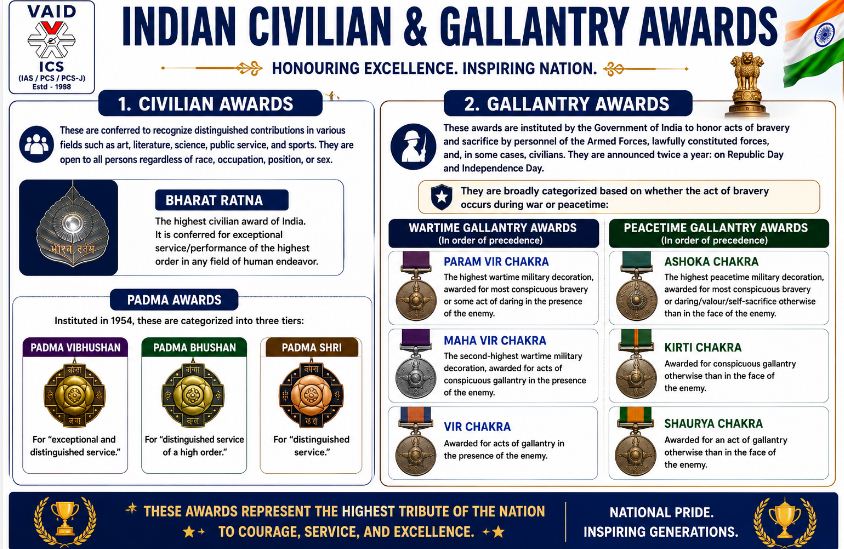
2. Gallantry Awards:
These awards are instituted by the Government of India to honor acts of bravery and sacrifice by personnel of the Armed Forces, lawfully constituted forces, and, in some cases, civilians. They are announced twice a year: on Republic Day and Independence Day.
They are broadly categorized based on whether the act of bravery occurs during war or peacetime:
Wartime Gallantry Awards (In order of precedence):
-
Param Vir Chakra: The highest wartime military decoration, awarded for most conspicuous bravery or some act of daring in the presence of the enemy.
-
Maha Vir Chakra: The second-highest wartime military decoration, awarded for acts of conspicuous gallantry in the presence of the enemy.
-
Vir Chakra: Awarded for acts of gallantry in the presence of the enemy.
Peacetime Gallantry Awards (In order of precedence):
-
Ashoka Chakra: The highest peacetime military decoration, awarded for most conspicuous bravery or daring/valour/self-sacrifice otherwise than in the face of the enemy.
-
Kirti Chakra: Awarded for conspicuous gallantry otherwise than in the face of the enemy.
-
Shaurya Chakra: Awarded for an act of gallantry otherwise than in the face of the enemy.
पद्म पुरस्कार 2026 हाल ही में राष्ट्रपति द्रौपदी मुर्मू द्वारा नई दिल्ली स्थित राष्ट्रपति भवन में आयोजित पहले नागरिक अलंकरण समारोह (Civil Investiture Ceremony-I) में प्रदान किए गए।
हालिया अपडेट (समारोह 2026):
-
समारोह: पहले समारोह के दौरान 66 प्रतिष्ठित हस्तियों को सम्मानित किया गया। कुल स्वीकृत सूची में से शेष प्राप्तकर्ताओं को बाद में आयोजित होने वाले दूसरे समारोह में सम्मानित किया जाएगा।
-
कुल अनुमोदन: राष्ट्रपति ने वर्ष 2026 के लिए कुल 131 पद्म पुरस्कारों की मंजूरी दी है, जिसमें शामिल हैं:
-
05 पद्म विभूषण
-
13 पद्म भूषण
-
113 पद्म श्री
-
-
प्रमुख सम्मानित व्यक्ति:
-
पद्म विभूषण: दिग्गज अभिनेता धर्मेंद्र सिंह देओल (मरणोपरांत, उनकी पत्नी हेमा मालिनी द्वारा प्राप्त) और वायलिन वादक डॉ. एन. राजम को प्रदान किया गया।
-
पद्म भूषण: उत्तराखंड के पूर्व मुख्यमंत्री भगत सिंह कोश्यारी, उद्योगपति उदय सुरेश कुमार कोटक और बहुश्रुत डॉ. आर. गणेश शामिल हैं।
-
पद्म श्री: भारतीय महिला क्रिकेट कप्तान हरमनप्रीत कौर भुल्लर सहित विभिन्न क्षेत्रों की कई हस्तियाँ।
-
पद्म पुरस्कारों के बारे में मुख्य तथ्य
-
उत्पत्ति और संरचना: 1954 में स्थापित और 1955 में पुनर्गठित, ये पुरस्कार तीन श्रेणियों में दिए जाते हैं:
-
पद्म विभूषण: असाधारण और विशिष्ट सेवा (भारत रत्न के बाद दूसरा सर्वोच्च नागरिक पुरस्कार)।
-
पद्म भूषण: उच्च क्रम की विशिष्ट सेवा।
-
पद्म श्री: किसी भी क्षेत्र में विशिष्ट सेवा।
-
-
घोषणा: परंपरागत रूप से प्रतिवर्ष गणतंत्र दिवस की पूर्व संध्या पर घोषित किए जाते हैं।
-
संवैधानिक ढांचा: अनुच्छेद 18(1) के तहत राज्य ‘उपाधियां’ (titles) प्रदान नहीं कर सकता। हालांकि, सर्वोच्च न्यायालय (बालाजी राघवन बनाम भारत संघ, 1996) ने माना कि ये ‘राष्ट्रीय पुरस्कार’ हैं जो योग्यता को मान्यता देते हैं, बशर्ते इनका उपयोग नाम के आगे या पीछे उपसर्ग/प्रत्यय के रूप में न किया जाए।
-
पात्रता और चयन:
-
यह जाति, व्यवसाय, पद या लिंग के भेदभाव के बिना सभी के लिए खुला है।
-
सरकारी कर्मचारी (पीएसयू सहित) सेवा के दौरान आमतौर पर अपात्र होते हैं, हालांकि डॉक्टरों और वैज्ञानिकों के लिए अपवाद हैं।
-
प्रधानमंत्री द्वारा गठित और कैबिनेट सचिव की अध्यक्षता वाली पद्म पुरस्कार समिति ‘उत्कृष्टता प्लस’ और आजीवन उपलब्धि के आधार पर चयन करती है।
-
-
नियामक बाधाएं:
-
सीमा: प्रति वर्ष अधिकतम 120 पुरस्कार (मरणोपरांत और गैर-नागरिक प्राप्तकर्ताओं को छोड़कर)।
-
अंतराल: उच्च श्रेणी के पुरस्कार के लिए पिछले पद्म पुरस्कार से कम से कम पांच वर्ष का अंतराल आवश्यक है।
-
मरणोपरांत नीति: आमतौर पर मरणोपरांत नहीं दिए जाते, लेकिन अत्यंत योग्य मामलों में अपवाद किए जा सकते हैं।
-
-
ऐतिहासिक निलंबन: ये सम्मान दो बार निलंबित किए गए: 1978–79 (जनता पार्टी सरकार) और 1993–97 (संवैधानिक मुकदमेबाजी के कारण)।
नागरिक पुरस्कार (Civilian Awards):
ये पुरस्कार कला, साहित्य, विज्ञान, सार्वजनिक सेवा और खेल जैसे क्षेत्रों में असाधारण और विशिष्ट योगदान को पहचानने के लिए दिए जाते हैं। ये जाति, व्यवसाय, पद या लिंग के भेदभाव के बिना सभी व्यक्तियों के लिए खुले हैं।
-
भारत रत्न: यह भारत का सर्वोच्च नागरिक सम्मान है। यह किसी भी क्षेत्र में मानवीय प्रयास के सर्वोच्च क्रम की असाधारण सेवा/प्रदर्शन के लिए दिया जाता है।
-
पद्म पुरस्कार: इनकी स्थापना 1954 में हुई थी और इन्हें तीन श्रेणियों में बांटा गया है:
-
पद्म विभूषण: ‘असाधारण और विशिष्ट सेवा’ के लिए।
-
पद्म भूषण: ‘उच्च क्रम की विशिष्ट सेवा’ के लिए।
-
पद्म श्री: ‘विशिष्ट सेवा’ के लिए।
-
2. वीरता पुरस्कार (Gallantry Awards):
ये पुरस्कार सशस्त्र बलों, विधिवत गठित बलों और कुछ मामलों में नागरिकों द्वारा दिखाई गई वीरता और बलिदान के सम्मान में दिए जाते हैं। इनकी घोषणा वर्ष में दो बार की जाती है: गणतंत्र दिवस और स्वतंत्रता दिवस पर।
इन्हें इस आधार पर वर्गीकृत किया गया है कि वीरता का कार्य युद्ध के दौरान हुआ या शांति के समय:
युद्धकालीन वीरता पुरस्कार (वरीयता के क्रम में):
-
परमवीर चक्र: सर्वोच्च युद्धकालीन सैन्य अलंकरण, जो दुश्मन की उपस्थिति में सबसे विशिष्ट वीरता या साहस के कार्य के लिए दिया जाता है।
-
महावीर चक्र: दूसरा सर्वोच्च युद्धकालीन सैन्य अलंकरण, जो दुश्मन की उपस्थिति में विशिष्ट वीरता के कार्यों के लिए दिया जाता है।
-
वीर चक्र: दुश्मन की उपस्थिति में वीरता के कार्यों के लिए दिया जाता है।
शांतिपूर्ण वीरता पुरस्कार (वरीयता के क्रम में):
-
अशोक चक्र: सर्वोच्च शांतिपूर्ण सैन्य अलंकरण, जो दुश्मन का सामना किए बिना सबसे विशिष्ट वीरता या साहस/आत्म-बलिदान के लिए दिया जाता है।
-
कीर्ति चक्र: दुश्मन का सामना किए बिना विशिष्ट वीरता के लिए दिया जाता है।
-
शौर्य चक्र: दुश्मन का सामना किए बिना वीरता के कार्य के लिए दिया जाता है।

May 19, 2026
October 17, 2025
October 16, 2025
October 6, 2025

