May 26, 2026
6th schedule/Article 371 (A and G):
Why in News?
-
Context: Negotiations are ongoing between the Ministry of Home Affairs (MHA) and activists from Ladakh (represented by the Leh Apex Body and Kargil Democratic Alliance).
-
The Proposal: The Centre has offered constitutional safeguards for Ladakh under Article 371 (similar to provisions for Nagaland/Mizoram) as an alternative to the long-standing demand for inclusion under the Sixth Schedule.
-
Governance Structure: The government has agreed in principle to a unified legislative body for the entire region, rather than limiting powers to existing district-level councils.
Key Highlights of the Proposal:
-
Beyond District Councils: The proposal shifts focus toward a holistic governance model for the entire Union Territory (UT) of Ladakh, moving away from the limited scope of the current Ladakh Autonomous Hill Development Councils (LAHDC).
-
Nature of Safeguards: The government aims to protect Ladakh’s unique cultural, linguistic, and land rights, likely drawing inspiration from the special status models of Article 371.
-
Status of Talks: The process is currently in a consultative phase; no final agreement has been signed yet.
Understanding Article 371 (A and G):
Articles 371A to 371J contain “Special Provisions” for various states to address regional aspirations, protect local customs, and manage land ownership.
-
Article 371A (Nagaland): * No act of the Parliament regarding religious/social practices of Nagas, Naga customary law, administration of civil/criminal justice involving customary law, or land ownership/transfer shall apply to Nagaland unless the State Legislative Assembly passes a resolution.
-
The Governor has special responsibility regarding law and order.
-
-
Article 371G (Mizoram):
-
Similar to 371A, it provides that no Act of Parliament concerning Mizo religious/social practices, customary law, or ownership/transfer of land shall apply to Mizoram unless the State Assembly decides to apply it.
-
What is the Sixth Schedule?
-
Constitutional Basis: Provided under Articles 244(2) and 275(1).
-
Objective: Designed for the administration of “Tribal Areas” in the states of Assam, Meghalaya, Tripura, and Mizoram.
-
Key Features:
-
Autonomous District Councils (ADCs): These are empowered to make laws on specific matters like land, forests, canal water, shifting cultivation, village administration, etc.
-
Legislative & Judicial Powers: ADCs have the power to constitute village councils or courts for trials of suits/cases between tribes.
-
Financial Autonomy: ADCs can assess and collect land revenue and impose certain taxes.
-
-
Why Ladakh demanded it: The Sixth Schedule offers the most robust constitutional protection for indigenous demographics, land ownership, and local autonomy.
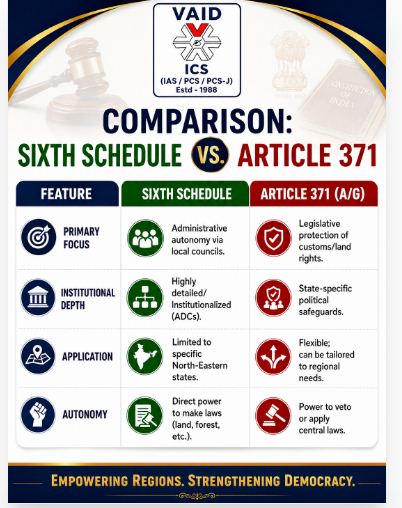
5. Comparison: Sixth Schedule vs. Article 371
| Feature | Sixth Schedule | Article 371 (A/G) |
| Primary Focus | Administrative autonomy via local councils. | Legislative protection of customs/land rights. |
| Institutional Depth | Highly detailed/Institutionalized (ADCs). | State-specific political safeguards. |
| Application | Limited to specific North-Eastern states. | Flexible; can be tailored to regional needs. |
| Autonomy | Direct power to make laws (land, forest, etc.). | Power to veto or apply central laws. |
6. Conclusion/Way Forward
-
The “Ladakh” Context: Ladakh seeks protection due to its unique demography and fragile ecology. The demand for the Sixth Schedule was rooted in the fear of losing cultural identity and land to external commercial exploitation.
-
Balanced Approach: Whether through the Sixth Schedule or Article 371, the core necessity is to balance National Integration with Local Empowerment.
-
Significance: This development is a test of India’s “asymmetric federalism,” where constitutional tools are used to address regional grievances in a sensitive border region.

May 19, 2026
October 17, 2025
October 16, 2025
October 6, 2025

