May 23, 2026
Egocentric” data: What is Vision-Language-Action (VLA) Models/
Why in the News?
- India as a Global Hotspot: According to a report ,India has emerged as a major hub for collecting first-person “egocentric” data to train advanced robotics and embodied AI systems.
- Privacy and Job Security Concerns: The surge in this data collection method has triggered significant concerns regarding workers’ privacy and the long-term threat of job displacement.
Key Points:
The Process of Data Collection:
- On-the-Job Recording: Workers across various sectors—including factories, warehouses, kitchens, and retail spaces—are required to wear head-mounted cameras while performing their daily tasks.
- Massive Datasets: This setup captures hundreds of thousands of hours of real-world, first-person video footage and sensor data.
- Training Next-Gen AI: This vast amount of human-generated data is directly fed into advanced robotics systems and humanoid AI models to teach them how to navigate the physical world.
Worker Exploitation and Apprehensions:
- The Automation Paradox: Workers are growing increasingly anxious that the very data they are helping to generate will ultimately be used to automate their roles, eventually making their own jobs obsolete.
Factors Making India the Preferred Choice:
- Inexpensive Labour: India offers a massive, cost-effective workforce compared to Western nations, significantly lowering data acquisition costs for tech firms.
- Weak Regulatory Frameworks: Relatively weak worker protection laws and loose data privacy regulations allow global tech companies to conduct large-scale monitoring with minimal legal friction.
What is ‘Egocentric’ Data?
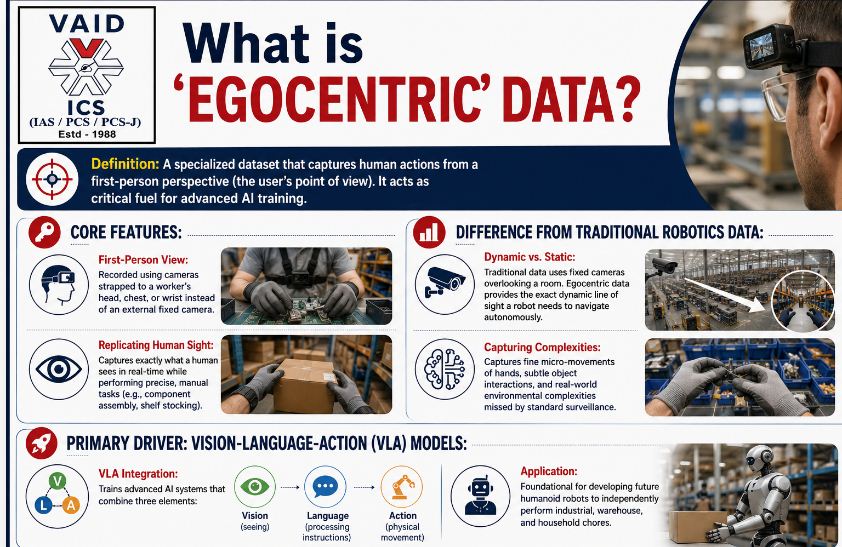
Egocentric data is a specialized form of dataset that captures human actions from a first-person perspective, acting as a crucial fuel for the global AI race.
Core Features:
- First-Person Perspective: Unlike traditional footage, this data is recorded from the exact viewpoint of the person executing the task. Cameras are typically strapped to the worker’s head, chest, or wrist.
- Replicating Human Sight: It captures exactly what a worker sees in real-time while performing intricate tasks like assembling components, handling fragile objects, or organizing warehouse shelves.
How It Differs from Traditional Robotics Data:
- Dynamic vs. Static: Traditional datasets rely on fixed, static cameras overlooking a room. Egocentric data, however, perfectly replicates the exact line of sight a robot would need while operating autonomously in a real-world environment.
- Capturing Complexities: Robotics firms consider this data critical because it captures micro-movements of hands, subtle object interactions, and environmental complexities that standard surveillance cameras completely miss.
Driving the Demand: Vision-Language-Action (VLA) Models:
- The primary driver behind this intensive data collection is the training of Vision-Language-Action (VLA) models.
- These advanced AI systems integrate three core elements: visual understanding (seeing), language processing (understanding instructions), and physical movement (taking action).
- VLA models are considered foundational for the development of future humanoid robots capable of independently managing industrial, warehouse, and household chores.
What is Egocentric data?
Egocentric data (also known as first-person data) refers to video, audio, and sensor recordings captured entirely from the perspective of the person performing an action.
Instead of a camera looking at a person, the camera moves with the person—typically mounted on their head, chest, smart glasses, or wrist—showing exactly what their eyes see and what their hands are doing.
Key Characteristics of Egocentric Data:
- First-Person Viewpoint: It captures the world from an “I” or “me” perspective (hence the term ego-centric).
- Focus on Hands and Objects: The footage prominently captures detailed hand movements, tool handling, and immediate physical interactions with objects.
- Dynamic Environment: As the human moves, tilts their head, or walks, the camera angle shifts naturally, capturing the real-world complexity, lighting changes, and obstacles exactly as a human experiences them.
Why is it Suddenly Crucial for AI and Robotics?
Traditional AI was trained on exocentric data (third-person view), like static security cameras or YouTube videos looking at a scene from a distance. However, modern robotics companies are heavily investing in egocentric data for several breakthrough reasons:
What is Vision-Language-Action (VLA) models?
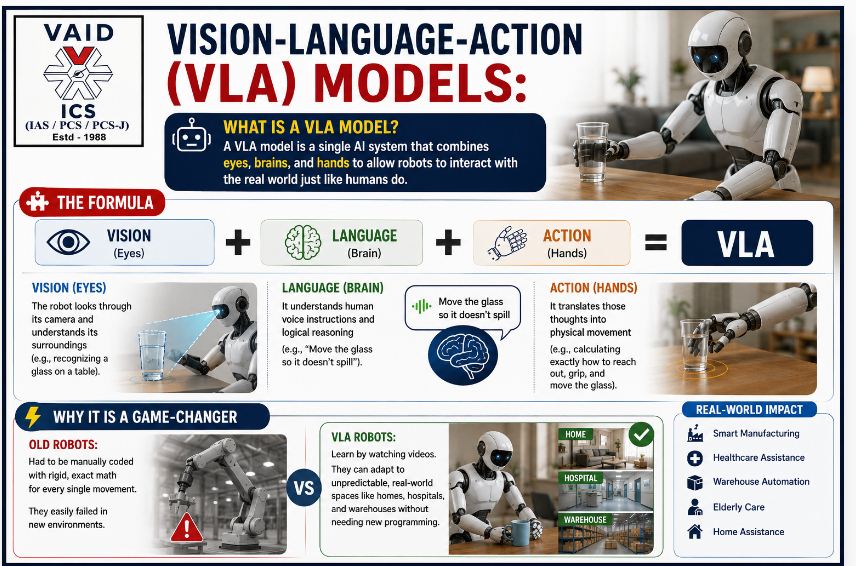
To understand Vision-Language-Action (VLA) models in simple terms, think of them as the “brain, eyes, and hands” of next-generation AI and robots all combined into a single system.
Historically, AI could only do one thing well. You had AI that could see images (Vision), AI that could chat (Language), and robots that could perform pre-programmed mechanical movements (Action). VLA models fuse all three together.
The Three Core Elements of VLA:
Vision (The Eyes): The AI looks at the real world through a camera. It doesn’t just see pixels; it understands what it is looking at (e.g., “There is a glass cup sitting near the edge of a slippery table”).
Language (The Brain/Reasoning): The AI can understand human instructions, context, and logic. If you tell it, “Move the cup so it doesn’t fall,” it understands what “fall” implies and what safety means.
Action (The Hands/Body): Instead of just typing out a text reply like ChatGPT, a VLA model outputs physical coordinates and motor commands. It tells a robotic arm exactly how much to open its grip, how fast to move, and how much pressure to apply to pick up that specific cup.
A Real-World Example: How it Works?
Imagine a humanoid robot powered by a VLA model standing in a messy kitchen. You give it a vague command: “Clean up the spilled milk.”
- Without VLA (Old Robotics): The robot would fail because it doesn’t have a specific pre-programmed code for “spilled milk” at that exact spot.
- With VLA (New AI): * Vision: The robot scans the counter, identifies the white puddle (milk), and spots a sponge nearby.
- Language: It processes your command and reasons: “To clean liquid, I need to pick up that sponge and wipe the counter.”
- Action: It instantly translates that thought into physical motor movements—reaching out, gripping the sponge with the right amount of force, and wiping the surface in a fluid, human-like motion.
Why are VLA Models a Game Changer?
- No More Pre-Programming: Traditional robots have to be coded with exact math for every single movement. VLA models learn from watching videos (like the egocentric data we discussed) and can handle completely new situations they’ve never seen before.
- General-Purpose Robots: This technology is the missing link needed to transition robots out of tightly controlled car factories and bring them into unpredictable, real-world environments like warehouses, hospitals, and your home. In short, while an LLM (Large Language Model) like ChatGPT can tell you how to fix a tire, a VLA model can look at the tire, understand your request, and actually change it for you.

May 19, 2026
October 17, 2025
October 16, 2025
October 6, 2025

