May 19, 2026
SMILE Satellite Mission
Why in News?
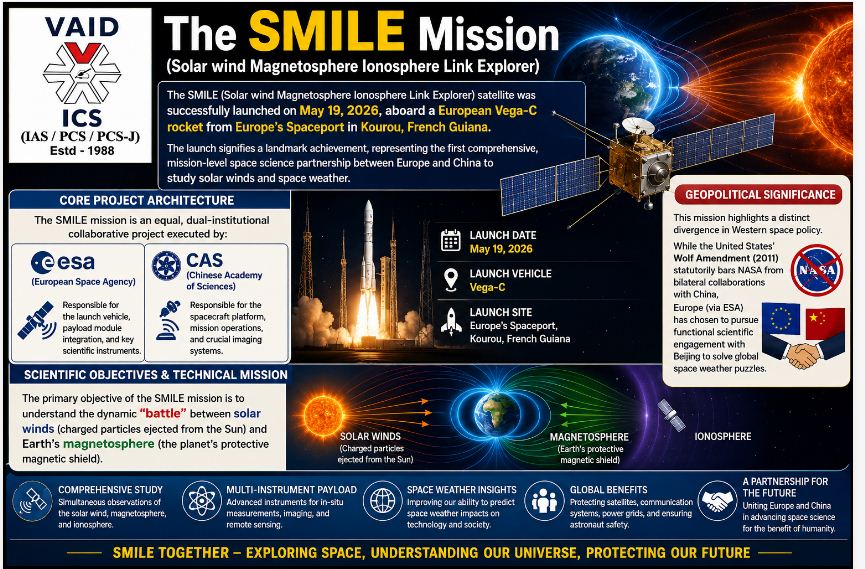
The SMILE (Solar wind Magnetosphere Ionosphere Link Explorer) satellite was successfully launched on May 19, 2026, aboard a European Vega-C rocket from Europe’s Spaceport in Kourou, French Guiana.
The launch signifies a landmark achievement, representing the first comprehensive, mission-level space science partnership between Europe and China to study solar winds and space weather.
Core Project Architecture:
The SMILE mission is an equal, dual-institutional collaborative project executed by:
- ESA (European Space Agency): Responsible for the launch vehicle, payload module integration, and key scientific instruments.
- CAS (Chinese Academy of Sciences): Responsible for the spacecraft platform, mission operations, and crucial imaging systems.
Geopolitical Significance: This mission highlights a distinct divergence in Western space policy. While the United States’ Wolf Amendment (2011) statutorily bars NASA from bilateral collaborations with China, Europe (via ESA) has chosen to pursue functional scientific engagement with Beijing to solve global space weather puzzles.
Scientific Objectives & Technical Mission:
The primary objective of the SMILE mission is to understand the dynamic “battle” between solar winds (charged particles ejected from the Sun) and Earth’s magnetosphere (the planet’s protective magnetic shield).
A. Key Scientific Focus Areas:
- Magnetosphere Mapping: Achieving the first-ever global, wide-field imaging of Earth’s magnetic boundaries to watch the “invisible armor” react to solar plasma and Coronal Mass Ejections (CMEs).
- Space Weather Mitigation: Improving prediction models for severe geomagnetic storms, which have the potential to knock out communication satellites, disrupt terrestrial power grids, and endanger astronauts in orbit.
- Continuous Aurora Observation: Tracking how solar storms trigger intense northern and southern lights (Aurora Borealis and Australis).
B. Orbital Mechanics & Instrumentation:
- Highly Elliptical Orbit: The spacecraft travels along an extremely elongated orbit. When passing over the North Pole at an apogee of 121,000 km, its unique trajectory allows it to observe the northern lights non-stop for up to 45 hours at a time.
- Soft X-ray Imager (SXI): A groundbreaking wide-field camera designed to take the world’s first X-ray observations of the interaction zone where solar winds slam into the magnetosphere.
- Ultraviolet Imager (UVI): Dedicated to continuously monitoring the polar ionosphere and the evolution of auroral storms.
Key Takeaways for UPSC Mains:
- Global Commons & Shared Vulnerabilities: Space weather is a borderless threat. Just as solar storms can damage global telecommunication networks indiscriminately, monitoring them requires unified global scientific commons.
- Technological Self-Reliance vs. Cooperation: The mission underlines that while strategic areas require indigenous development (like ISRO’s Aditya-L1), international data-sharing models expand multi-angle tracking of solar phenomena.
- Multipolar Space Diplomacy: The collaboration establishes a precedent where middle powers and regional blocs (like the EU) build independent scientific bridges with China, charting an alternative path to standard US-led space coalitions.
SMILE सैटेलाइट मिशन:
चर्चा में क्यों?
SMILE (सोलर विंड मैग्नेटोस्फीयर आयनोस्फीयर लिंक एक्सप्लोरर) उपग्रह को फ्रेंच गुयाना के कौरू स्थित यूरोपीय स्पेसपोर्ट से एक यूरोपीय वेगा-सी (Vega-C) रॉकेट के माध्यम से सफलतापूर्वक लॉन्च किया गया है।
यह प्रक्षेपण सौर हवाओं (Solar Winds) और अंतरिक्ष मौसम (Space Weather) के अध्ययन के लिए यूरोप और चीन के बीच पहले व्यापक, मिशन-स्तरीय अंतरिक्ष विज्ञान सहयोग का प्रतिनिधित्व करता है।
मिशन की मूल संरचना (Core Project Architecture):
SMILE मिशन दो प्रमुख वैश्विक अंतरिक्ष संस्थानों के बीच एक द्विपक्षीय और सहयोगात्मक परियोजना है:
-
ESA (यूरोपीय अंतरिक्ष एजेंसी): यह प्रक्षेपण यान (Launch Vehicle), पेलोड मॉड्यूल एकीकरण और प्रमुख वैज्ञानिक उपकरणों के लिए जिम्मेदार है।
-
CAS (चीनी विज्ञान अकादमी): यह अंतरिक्ष यान प्लेटफॉर्म, मिशन संचालन (Operations) और महत्वपूर्ण इमेजिंग प्रणालियों के लिए उत्तरदायी है।
भू-राजनीतिक महत्व: यह मिशन पश्चिमी अंतरिक्ष नीति में एक अलग बदलाव को दर्शाता है। जहाँ अमेरिका का वोल्फ संशोधन (Wolf Amendment, 2011) नासा (NASA) को चीन के साथ द्विपक्षीय सहयोग करने से कानूनी रूप से रोकता है, वहीं यूरोप (ESA) ने अंतरिक्ष मौसम की वैश्विक गुत्थियों को सुलझाने के लिए बीजिंग के साथ कार्यात्मक वैज्ञानिक सहयोग का मार्ग चुना है।
वैज्ञानिक उद्देश्य और तकनीकी विशेषताएँ:
SMILE मिशन का प्राथमिक उद्देश्य सौर हवाओं (सूर्य से निकलने वाले आवेशित कणों/Charged Particles) और पृथ्वी के मैग्नेटोस्फीयर (पृथ्वी के सुरक्षात्मक चुंबकीय कवच) के बीच होने वाले गतिशील संघर्ष को समझना है।
A. प्रमुख वैज्ञानिक फोकस क्षेत्र:
-
मैग्नेटोस्फीयर का मानचित्रण: पृथ्वी की चुंबकीय सीमाओं की पहली बार व्यापक और वैश्विक इमेजिंग प्राप्त करना, ताकि यह देखा जा सके कि पृथ्वी का यह “अदृश्य कवच” सौर प्लाज्मा और कोरोनल मास इजेक्शन (CMEs) के प्रति कैसे प्रतिक्रिया करता है।
-
अंतरिक्ष मौसम के खतरों को कम करना: तीव्र भू-चुंबकीय तूफानों (Geomagnetic Storms) के सटीक पूर्वानुमान मॉडल में सुधार करना, जो संचार उपग्रहों को नष्ट करने, स्थलीय पावर ग्रिड को ठप करने और अंतरिक्ष यात्रियों को खतरे में डालने की क्षमता रखते हैं।
-
ध्रुवीय ज्योतियों (Auroras) का निरंतर अवलोकन: यह ट्रैक करना कि कैसे सौर तूफान तीव्र उत्तरी और दक्षिणी ध्रुवीय ज्योतियों (ऑरोरा बोरियालिस और ऑरोरा ऑस्ट्रेलिस) को ट्रिगर करते हैं।
B. कक्षीय गतििकी और उपकरण (Orbital Mechanics & Instrumentation):
-
अत्यधिक अण्डाकार कक्षा (Highly Elliptical Orbit): यह अंतरिक्ष यान एक अत्यधिक विस्तारित कक्षा में यात्रा करता है। जब यह 121,000 किमी की अपनी अधिकतम ऊंचाई (Apogee) पर उत्तरी ध्रुव के ऊपर से गुजरता है, तो इसका अनूठा प्रक्षेपवक्र (Trajectory) इसे एक बार में 45 घंटे तक लगातार उत्तरी ध्रुवीय ज्योति (Aurora) का निरीक्षण करने की अनुमति देता है।
-
सॉफ्ट एक्स-रे इमेजर (SXI): यह एक अभूतपूर्व वाइड-फील्ड कैमरा है, जिसे उस अंतःक्रिया क्षेत्र (Interaction Zone) के विश्व के पहले एक्स-रे अवलोकन के लिए डिज़ाइन किया गया है जहाँ सौर हवाएं मैग्नेटोस्फीयर से टकराती हैं।
-
अल्ट्रावॉयलेट इमेजर (UVI): यह उपकरण विशेष रूप से ध्रुवीय आयनमंडल (Polar Ionosphere) और ऑरोरा तूफानों के विकास की निरंतर निगरानी के लिए समर्पित है।
यूपीएससी मुख्य परीक्षा के लिए मुख्य निष्कर्ष (Key Takeaways);
-
वैश्विक संपदा और साझा संवेदनशीलता (Global Commons): अंतरिक्ष मौसम एक सीमाहीन खतरा है। जिस प्रकार सौर तूफान बिना किसी भेदभाव के वैश्विक दूरसंचार नेटवर्क को नुकसान पहुंचा सकते हैं, उसी प्रकार उनकी निगरानी के लिए एक एकीकृत वैश्विक वैज्ञानिक सहयोग की आवश्यकता होती है।
-
तकनीकी आत्मनिर्भरता बनाम सहयोग: यह मिशन रेखांकित करता है कि जहाँ रणनीतिक क्षेत्रों में स्वदेशी विकास की आवश्यकता होती है (जैसे भारत का आदित्य-L1 मिशन), वहीं अंतर्राष्ट्रीय डेटा-साझाकरण मॉडल सौर घटनाओं के बहु-कोणीय (Multi-angle) ट्रैकिंग का विस्तार करते हैं।
-
बहुध्रुवीय अंतरिक्ष कूटनीति (Multipolar Space Diplomacy): यह सहयोग एक ऐसी मिसाल कायम करता है जहाँ क्षेत्रीय ब्लॉक (जैसे यूरोपीय संघ) चीन के साथ स्वतंत्र वैज्ञानिक संबंध बना रहे हैं, जो अमेरिका के नेतृत्व वाले पारंपरिक अंतरिक्ष गठबंधनों से अलग एक वैकल्पिक मार्ग प्रस्तुत करता है।

May 19, 2026
October 17, 2025
October 16, 2025
October 6, 2025

