May 14, 2026
National Coal Gasification Scheme: Towards Aatmanirbharta. WHAT IS Synthesis Gas (Syngas)?
National Coal Gasification Scheme: Towards Aatmanirbharta
Core Objective & Targets:
Mission: To convert India’s vast coal and lignite reserves into Synthesis Gas (Syngas) for use in fertilizers, chemicals, and fuel.
Key Target: Gasification of 75 million tonnes (MT) of coal/lignite under this scheme, contributing to the national goal of 100 MT by 2030.
Energy Resource: India holds 401 billion tonnes of known coal reserves, sufficient for the next 200 years.
Strategic Necessity: Reducing Import Vulnerability;
India faces high import dependence on critical substitutable products:
Financial Impact: The import bill for LNG, Urea, and Methanol stood at ₹2.77 lakh crore in FY25.
Sectoral Dependence:
- Ammonia: ~100% imported.
- Methanol: ~90% imported.
- LNG: >50% imported.
- Urea: 20% imported.
Geopolitical Resilience: Domestication of these products reduces exposure to supply disruptions in West Asia.
Financial Incentives & Project Framework;
Total Outlay: ₹37,500 crore approved by the Union Cabinet.
Financial Support: Investors get up to 20% of the cost of plant and machinery, disbursed in four installments tied to milestones.
Investment Caps:
- Per Project: Capped at ₹5,000 crore.
- Per Entity Group: Capped at ₹12,000 crore across all projects.
Selection: Through competitive bidding based on project cost and syngas output benchmarks.
Key Policy Reforms & Flagship Projects:
Coal Linkage Extension: Tenure extended to 30 years, providing long-term policy certainty for investors.
Technology: The scheme is technology-agnostic but prioritizes indigenous technologies.
Ongoing JVs:
- CIL-GAIL: Coal-to-SNG plant (West Bengal).
- CIL-BHEL: Coal-to-Ammonium Nitrate plant (Odisha).
Projected Socio-Economic Impact:
Investment Mobilization: Expected to attract ₹3 lakh crore.
Job Creation: Estimated 50,000 direct and indirect jobs across 25 projects in coal-bearing regions.
Exchequer Revenue: Projected ₹6,300 crore annually in revenue, excluding GST and other levies.
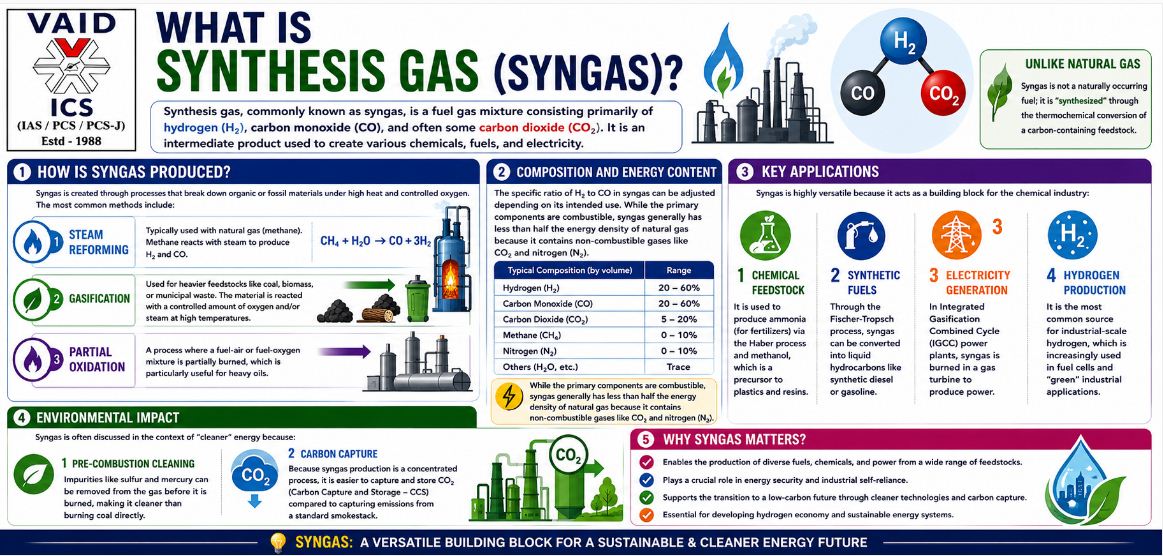
What is Synthesis Gas (Syngas)?
Synthesis gas, commonly known as syngas, is a fuel gas mixture consisting primarily of hydrogen (H2), carbon monoxide (CO), and often some carbon dioxide (CO2). It is an intermediate product used to create various chemicals, fuels, and electricity.
Unlike natural gas, syngas is not a naturally occurring fuel; it is “synthesized” through the thermochemical conversion of a carbon-containing feedstock.
How is Syngas Produced?
Syngas is created through processes that break down organic or fossil materials under high heat and controlled oxygen. The most common methods include:
Steam Reforming: Typically used with natural gas (methane). Methane reacts with steam to produce H2 and CO.
CH4+H2O→CO+3H2
Gasification: Used for heavier feedstocks like coal, biomass, or municipal waste. The material is reacted with a controlled amount of oxygen and/or steam at high temperatures.
Partial Oxidation: A process where a fuel-air or fuel-oxygen mixture is partially burned, which is particularly useful for heavy oils.
Composition and Energy Content:
The specific ratio of H2 to CO in syngas can be adjusted depending on its intended use. While the primary components are combustible, syngas generally has less than half the energy density of natural gas because it contains non-combustible gases like CO2 and nitrogen (N2).
Key Applications:
Syngas is highly versatile because it acts as a building block for the chemical industry:
Chemical Feedstock: It is used to produce ammonia (for fertilizers) via the Haber process and methanol, which is a precursor to plastics and resins.
Synthetic Fuels: Through the Fischer-Tropsch process, syngas can be converted into liquid hydrocarbons like synthetic diesel or gasoline.
Electricity Generation: In Integrated Gasification Combined Cycle (IGCC) power plants, syngas is burned in a gas turbine to produce power.
Hydrogen Production: It is the most common source for industrial-scale hydrogen, which is increasingly used in fuel cells and “green” industrial applications.
Environmental Impact;
Syngas is often discussed in the context of “cleaner” energy because:
Pre-combustion cleaning: Impurities like sulfur and mercury can be removed from the gas before it is burned, making it cleaner than burning coal directly.
Carbon Capture: Because syngas production is a concentrated process, it is easier to capture and store CO2 (Carbon Capture and Storage – CCS) compared to capturing emissions from a standard smokestack.

October 17, 2025
October 16, 2025
October 6, 2025
September 24, 2025

