May 12, 2026
E-Governance in the judiciary. “One Case, One Data” System
Bail Reform: Speeding Up Justice:
To prevent the prolonged incarceration of undertrials, the Supreme Court issued strict timelines for bail pleas:
- Listing: Fresh bail applications must be listed within one week of filing.
- Follow-up: Matters must be heard weekly or fortnightly; if a plea is not taken up, it must be automatically relisted.
- Mandatory Filing: A status report must be filed before the first hearing, and a copy of the application must be served to the Advocate General.
- High Court Role: All High Courts must now set an outer timeline for the final disposal of bail cases.
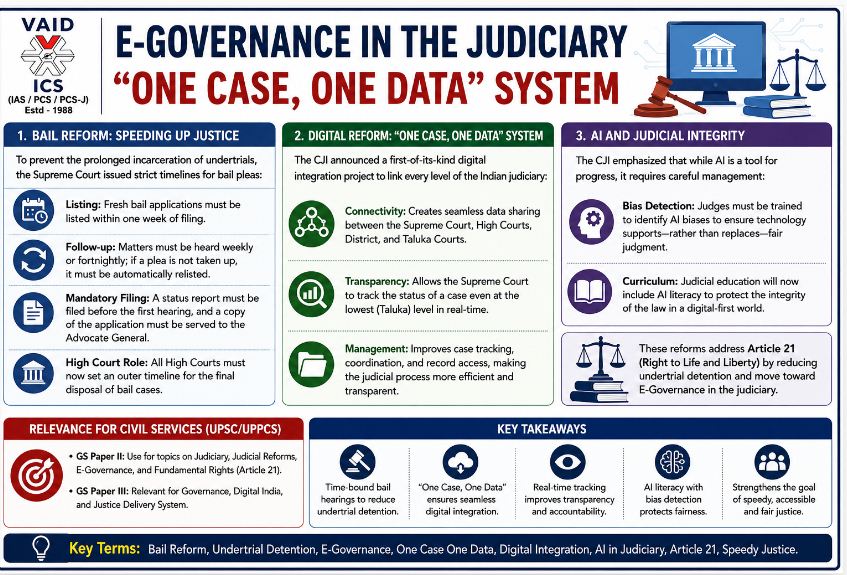
Digital Reform: “One Case, One Data” System:
The CJI announced a first-of-its-kind digital integration project to link every level of the Indian judiciary:
- Connectivity: Creates seamless data sharing between the Supreme Court, High Courts, District, and Taluka Courts.
- Transparency: Allows the Supreme Court to track the status of a case even at the lowest (Taluka) level in real-time.
- Management: Improves case tracking, coordination, and record access, making the judicial process more efficient and transparent.
AI and Judicial Integrity:
The CJI emphasized that while AI is a tool for progress, it requires careful management:
- Bias Detection: Judges must be trained to identify AI biases to ensure technology supports—rather than replaces—fair judgment.
- Curriculum: Judicial education will now include AI literacy to protect the integrity of the law in a digital-first world.
These reforms address Article 21 (Right to Life and Liberty) by reducing undertrial detention and move toward E-Governance in the judiciary. For GS Paper II, focus on these as “Judicial Interventions to reduce Pendency and ensure Speedy Trials.”

Gist of daily Article /The Hindu 17oct 2025
October 17, 2025
Daily Gist of the Hindu/Indian Express : 16 Oct 2025
October 16, 2025
Daily Gist of The Hindu/Indian Express: 6 Oct 2025
October 6, 2025
Daily Gist of Article /The Hindu /Indian Express: 24 Sep 2025
September 24, 2025

