May 12, 2026
Gist of Daily Article: 12 May 2026: What is Women’s Political Inclusion?
Women’s Political Inclusion in India:
Note for UPSC/UPPCS Aspirants: * Relevant GS Paper: GS II (Social Justice, Governance, Constitution).
- Keywords to use: Descriptive vs. Substantive representation, Structural Intervention, Nari Shakti Vandan Adhiniyam, Proxy Politics, Global Best Practices.
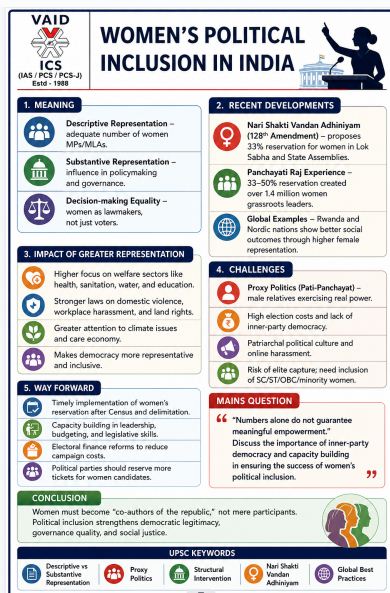
What is Women’s Political Inclusion?
It is the process of ensuring that women have an equal right and opportunity to participate in the political life of their country. This includes:
- Descriptive Representation: Having a proportional number of women in legislative bodies (MP/MLAs).
- Substantive Representation: Ensuring women have the power to influence policy agendas, law-making, and budget allocations.
- Equality in Decision-Making: Moving beyond being just “voters” to becoming “creators” of the law.
Recent Examples and Legislative Milestones:
- Nari Shakti Vandan Adhiniyam (128th Constitutional Amendment Bill): The most significant recent milestone, which seeks to reserve 33% of seats for women in the Lok Sabha and State Assemblies.
- Panchayati Raj Experience: India has nearly 30 years of experience with 33% (and in states like UP/Bihar, 50%) reservation in local bodies. This has created a pipeline of over 1.4 million women leaders at the grassroots level.
- Global Precedents: Countries like Rwanda (the world leader in female representation) and Nordic nations (Sweden/Norway) serve as models where quotas led to improved social indicators.
The Impact: How the “Agenda” Changes:
When women enter the legislature in a “critical mass,” the focus of governance shifts:
- Welfare Priority: Increased spending on “soft” but vital infrastructure like drinking water, primary schools, sanitation, and public health.
- Addressing Gender Violence: Stronger advocacy for laws regarding domestic violence, workplace harassment, and land rights.
- Climate and Social Equity: Women often bring a different perspective on climate distress and the “care economy” (unpaid work at home) that male-dominated boards often miss.
- Democratic Honesty: A diverse Parliament reflects the actual population, making the democracy more representative and legitimate.
Key Challenges:
- The “Proxy” Culture (Pati-Panchayat): In many areas, women are elected, but their male relatives exercise the actual power.
- Structural Barriers: High cost of election campaigning and the lack of “inner-party democracy” make it hard for women without political backgrounds to get tickets.
- Sexist Political Culture: Informal exclusion, online harassment, and patriarchal mindsets within legislative buildings.
- Intersectional Imbalance: Ensuring that reservation also benefits women from marginalized communities (SC/ST/OBC and minorities) to avoid “elite capture.”
Way Forward:
- Effective Implementation: Linking reservation to the completion of “Delimitation” and the Census so it doesn’t remain an empty promise.
- Capacity Building: Training women leaders in legislative procedures, budgeting, and public speaking to move beyond “proxy” status.
- Campaign Finance Reform: Making elections less expensive so that talented women from ordinary backgrounds can participate.
- Party-Level Reform: Political parties should voluntarily reserve a percentage of “tickets” for women candidates during elections.
Conclusion:
As Shweta Bansal noted, women should not just be “guests” in the halls of power but “co-authors of the republic.” Political inclusion is not just a “women’s issue”—it is a necessity for a more honest, balanced, and effective Indian democracy.

October 17, 2025
October 16, 2025
October 6, 2025
September 24, 2025

