May 5, 2026
FRA vs. Forest Conservation Act
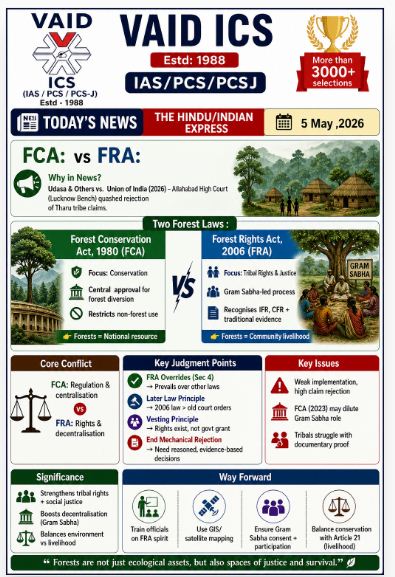
Why in News?
The Lucknow Bench of the Allahabad High Court, in the case of Udasa & Others vs. Union of India (2026), quashed a government order that rejected the forest claims of the Tharu tribe in Lakhimpur Kheri. The Court ruled that administrative bodies cannot use outdated judicial orders to bypass modern social justice legislation.
The Legal Conflict: FRA 2006 vs. FCA 1980:
The tension lies between Environmental Regulation and Human Rights:
| Feature | Forest Conservation Act (FCA), 1980 | Forest Rights Act (FRA), 2006 |
| Primary Goal | Protection: To limit deforestation and regulate “non-forest” use of land. | Justice: To recognize the rights of tribes living there for generations. |
| Approach | Top-Down: The Central Government holds the power to permit or deny land use. | Bottom-Up: The Gram Sabha initiates the recognition of rights. |
| Legal Status | Land is viewed as State property to be conserved. | Land is viewed as a traditional home to be “vested” in the dwellers. |
Key Points of the Allahabad HC Ruling (2026):
- The “Non-Obstante” Rule: The Court emphasized Section 4 of the FRA, which states the Act works “notwithstanding anything contained in any other law.” This means the 2006 Act takes precedence over the 1980 Act regarding tribal rights.
- Time-Travel Legal Error: The Court held that officials cannot rely on a year 2000 Supreme Court interim order to ignore a 2006 Act of Parliament. A later law naturally updates or overrides the context of an older court order.
- Vesting vs. Granting: The Court clarified that the government is not “gifting” land to the Tharu tribe. It is merely recognizing a right that has existed for centuries but was never recorded.
- End of “Mechanical” Decisions: The Court slammed the “robotic” rejection of claims. Officials must pass Reasoned Orders based on actual field evidence (cultural ties, usage history) rather than just looking at old maps.
Major Challenges:
- Implementation Gaps: In many districts, District Level Committees (DLCs) lack the training to understand the nuances of the FRA, leading to high rejection rates.
- The 2023 Amendment Conflict: Recent amendments to the FCA (1980) have eased rules for “strategic projects,” which critics fear might be used to bypass the mandatory consent of the Gram Sabha under the FRA.
- Evidence Hurdle: Tribal communities often struggle to provide the “written proof” required by a rigid bureaucracy, despite the FRA allowing for oral and traditional evidence.
Way Forward:
- Sensitization of Bureaucracy: Training for UP forest and revenue officials is needed to ensure they apply the “Social Justice” spirit of the FRA rather than just the “Regulatory” spirit of the FCA.
- Digital Mapping: Using satellite imagery and GPS to document traditional boundaries can reduce human error in the claims process.
- Harmonious Construction: The judiciary must continue to balance ecological conservation with tribal survival, ensuring that “conservation” does not become a tool for “eviction.”

Gist of daily Article /The Hindu 17oct 2025
October 17, 2025
Daily Gist of the Hindu/Indian Express : 16 Oct 2025
October 16, 2025
Daily Gist of The Hindu/Indian Express: 6 Oct 2025
October 6, 2025
Daily Gist of Article /The Hindu /Indian Express: 24 Sep 2025
September 24, 2025

