May 5, 2026
Model Code of Conduct (MCC):
Why in News?
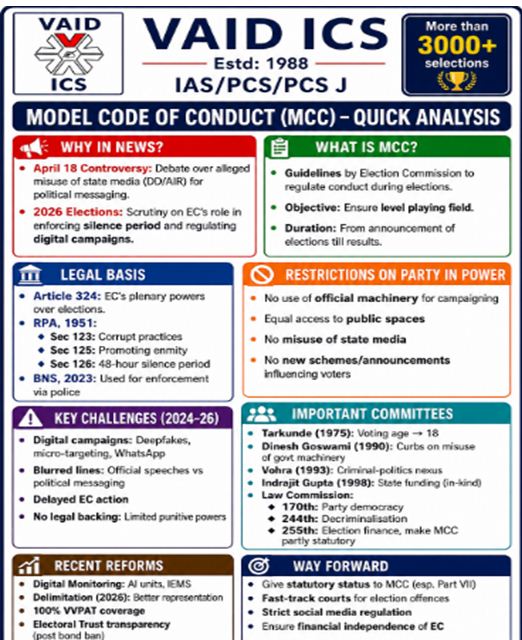
- The April 18 Controversy: Prime Minister Narendra Modi’s address to the nation regarding the 131st Constitution Amendment Bill has sparked a massive debate on the misuse of state-controlled media (Doordarshan/AIR) for partisan criticism.
- 2026 Election Cycle: With the Assembly results in Tamil Nadu, Kerala, and West Bengal being declared today (May 5), the role of the Election Commission (EC) in enforcing the “silence period” and regulating digital campaigns has come under intense judicial and public scrutiny.
What is the Model Code of Conduct (MCC)?
The MCC is a set of guidelines issued by the EC to regulate the conduct of political parties and candidates during elections.
- Objective: To ensure a “Level Playing Field” and prevent the party in power from using its official position to gain an unfair advantage.
- Timeline: It comes into force immediately upon the announcement of the election schedule and remains in effect until the results are declared.
Constitutional & Statutory Provisions:
While the MCC itself is not a law passed by Parliament, it derives its authority from several legal pillars:
- Article 324 (Constitution of India): The “fountainhead” of the EC’s power. It grants the EC the power of “superintendence, direction, and control” of elections. The Supreme Court (in Mohinder Singh Gill v. CEC) held that Article 324 is a plenary power that operates where existing laws are silent.
- Representation of the People Act (RPA), 1951:
- Section 123: Defines “Corrupt Practices” (bribery, undue influence, appeals to religion).
- Section 125: Penalizes promoting enmity between classes.
- Section 126: Prohibits public meetings and “campaigning” during the 48 hours before the conclusion of the poll (the “Silence Period”).
- Bharatiya Nyaya Sanhita (BNS), 2023: Provisions related to public order, defamation, and criminal intimidation are invoked to enforce MCC guidelines through the local police.
Part VII: The “Party in Power” Constraints
- Combine Official Work with Electioneering: Ministers cannot use official machinery or personnel for campaign tours.
- Monopolize Public Spaces: Rest houses, grounds, and helipads must be available to all parties on equal terms.
- Misuse Public Media: State-funded media (TV/Radio/Newspapers) cannot be used for partisan coverage or to highlight government “achievements” during the poll period.
- Ad-hoc Appointments/Grants: No new financial grants or projects can be announced that could influence voters.
Recent Issues & Challenges (2024–2026)
- Digital Encroachment: The MCC was designed for a physical era. It struggles with Deepfakes, AI-driven micro-targeting, and campaigns on encrypted platforms like WhatsApp.
- The “National Address” Dilemma: When high-ranking officials use public broadcasters for “informative” speeches that contain political critiques, the line between official duty and campaigning blurs.
- Delayed Enforcement: Critics argue that the EC often takes “belated action” against Star Campaigners, rendering the punishment ineffective once the voting phase is over.
- Lack of Statutory Backing: Because the MCC isn’t a law, the EC cannot directly “punish” violators with jail time; it can only censure, advise, or file an FIR under the RPA/BNS.
Related committee/Commissions:
Tarkunde Committee (1975)
- Major Recommendation: Suggested lowering the voting age from 21 to 18 years (later implemented via the 61st Amendment, 1988).
Dinesh Goswami Committee (1990):
- Recommendations:
- Introduction of EVMs/Voter ID Cards/Bye-elections:/Official Machinery: Strict curbs on the “Party in Power” using government vehicles and funds for campaigning.
Vohra Committee (1993):
- Focus: Criminalisation of Politics.
- Recommended a nodal agency to gather intelligence on mafia-political links, leading to stricter disqualification debates.
Indrajit Gupta Committee (1998):
- Recommendation: Endorsed “partial state funding” but only in-kind (e.g., free airtime on media, fuel for vehicles, paper for posters) rather than cash, to curb the influence of black money.
Law Commission Reports (170th, 244th, 255th):
- 170th Report (1999): Proposed a whole chapter in the RPA to regulate the internal democracy of political parties.
- 244th Report (2014): Focused on “De-criminalization”—recommended disqualification of candidates upon the framing of charges by a court for serious offences.
- 255th Report (2015): Comprehensive report on Election Finance Reform and “Paid News.” It suggested making Part VII of the MCC (Party in Power) a statutory law.
Steps Taken: Recent Structural Changes (2024–2026):
Beyond the historical committees, specific administrative and technological steps have been taken to modernize the process:
- Digital Enforcement (2025-2026):
- Integrated Election Management System (IEMS): Mandating parties to file all contribution reports and expenditure digitally to ensure real-time auditing.
- AI Monitoring Units: Special cells within the EC to track “Deepfake” campaign videos and trace their digital signatures.
- The Delimitation Bill (2026):
- As of May 2026, the government is moving toward redrawing constituency boundaries based on the latest census data. This is a massive step towards “One Man, One Value” representation.
- Voter Verifiable Paper Audit Trail (VVPAT):
- Ensuring 100% VVPAT coverage in all Assembly and Lok Sabha polls to enhance transparency.
- Electoral Trust Transparency:
- Post the 2024 ban on Electoral Bonds, the focus has shifted back to Electoral Trusts, which must now disclose 95% of their funds’ distribution to the EC.
Way Forward & Recommendations:
- Statutory Teeth for Part VII: The Law Commission (244th Report) suggested making Part VII of the MCC legally binding to prevent the misuse of state resources.
- Fast-Track Election Courts: To ensure that “Corrupt Practices” are prosecuted within the election cycle, not years later.
- Social Media Accountability: Mandating that tech platforms “take down” MCC-violating content within a strict 1-2 hour window.
- Independent EC Funding: Ensuring the EC’s budget is “charged” on the Consolidated Fund of India to shield it from executive pressure.

October 17, 2025
October 16, 2025
October 6, 2025
September 24, 2025

