May 4, 2026
What is Multi-Lane Free Flow (MLFF)?
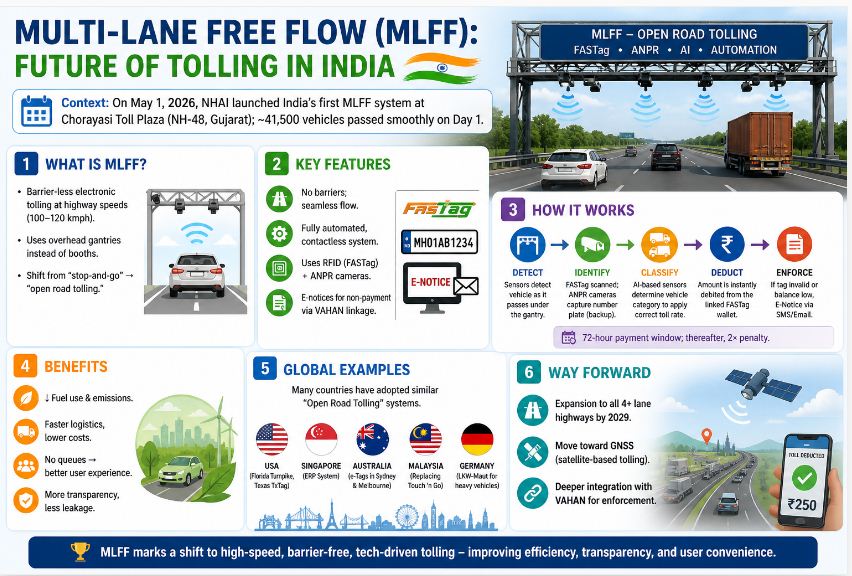
Why in news? the National Highways Authority of India (NHAI) marked a milestone by launching the country’s first Multi-Lane Free Flow (MLFF) tolling system at the Chorayasi Toll Plaza (Surat–Bharuch section, NH-48) in Gujarat. On its first day, approximately 41,500 vehicles transitioned through this barrier-less system successfully.
1. What is Multi-Lane Free Flow (MLFF)?
MLFF is a barrier-less, high-speed electronic tolling system that allows vehicles to pass through toll points at normal highway speeds (up to 100-120 kmph) without stopping or slowing down.
-
Infrastructure: It replaces physical toll booths and boom barriers with overhead gantries equipped with sophisticated sensors and cameras.
-
Paradigm Shift: It moves from “Stop-and-Go” (FASTag with barriers) to “Open Road Tolling” (fully automated).
2. Key Features of the MLFF System:
-
Barrier-Free Movement: No physical gates; vehicles flow continuously.
-
Contactless & Automated: Minimal human intervention in the tolling process.
-
Hybrid Identification: Combines RFID (FASTag) and ANPR (Automatic Number Plate Recognition) for 100% accuracy.
-
Electronic Enforcement: Issues E-Notices for non-payment or insufficient balance, linked directly to the VAHAN database.
3. How It Works (The Technology Chain);
-
Detection: As a vehicle passes under the overhead gantry, sensors detect its presence.
-
Identification:
-
FASTag Reader: Scans the RFID tag for account-based deduction.
-
ANPR Cameras: Capture the high-resolution image of the number plate (used as a backup or for non-FASTag vehicles).
-
-
Classification: AI-based sensors determine the vehicle category (Car, Truck, etc.) to apply the correct toll rate.
-
Deduction: The amount is instantly debited from the linked FASTag wallet.
-
Enforcement: If the tag is invalid or balance is low, an E-Notice is triggered via SMS/Email.
-
Note: Users have 72 hours to pay the normal fee; thereafter, a 2x penalty is applied
-
4. Benefits: Why India is Moving to MLFF:
-
Environmental: Significant reduction in vehicular emissions and fuel wastage caused by idling.
-
Logistics Efficiency: Reduces the “National Freight Lag,” lowering the overall cost of logistics in India.
-
Ease of Living: Eliminates the frustration of long queues and “toll plaza friction.”
-
Transparency: Plugs revenue leakages and reduces the operational cost of maintaining physical toll booths.
5. Global Examples:
Many developed nations have already transitioned to similar “Open Road Tolling” architectures:
-
USA: Widely used in states like Florida (Turnpike) and Texas (TxTag).
-
Singapore: The Electronic Road Pricing (ERP) system is a pioneer in urban MLFF.
-
Australia: Major motorways in Sydney and Melbourne use “e-Tags” with no physical barriers.
-
Malaysia: Recently started implementing MLFF to replace their “Touch ‘n Go” barrier lanes.
-
Germany: The LKW-Maut system for heavy vehicles uses satellite-based MLFF.
6. Way Forward for India:
The Government aims to expand this to all National Highways with four or more lanes by March 2029. The pilot at Chorayasi (and the upcoming one at Mundka, Delhi) serves as the blueprint for:
-
Satellite-based Tolling (GNSS): The next evolution where tolls are deducted based on distance traveled using GPS coordinates
-
Integration with VAHAN: Ensuring that vehicles with unpaid tolls are restricted from services like fitness certificates or ownership transfers.

October 17, 2025
October 16, 2025
October 6, 2025
September 24, 2025

