April 23, 2026
Esports & Online Gaming Regulation in India
Core Concept & Industry Status:
- Definition: Organized, competitive video gaming (individuals/teams) in structured formats with professional recognition and a spectator base. Distinct from casual gaming.
- Market Dynamics: * Valuation: Estimated $1-1.5 billion
- Drivers: High smartphone penetration, low data costs, and a massive youth demographic.
- Dominant Segment: Mobile esports (accessibility-led) vs. PC/Console (infrastructure-led).
- Ecosystem: Comprises players, franchises, tournament organizers, and streaming platforms. Revenue via media rights, sponsorships, and in-game purchases.
Regulatory Framework: The 2025 Paradigm;
- Legal Recognition: Recognized as part of “Multi-sports events” under the Ministry of Youth Affairs and Sports (MYAS).
- Primary Legislation: Promotion and Regulation of Online Gaming Act, 2025.
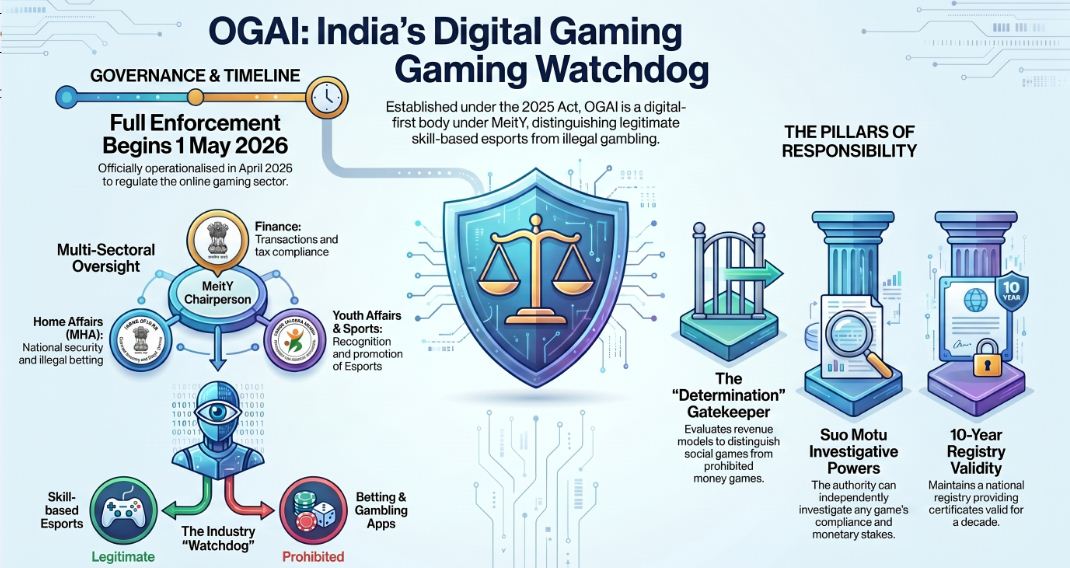
- Key Regulator: Online Gaming Authority of India (OGAI).
- 6-member body under MeitY.
- Multi-ministerial representation for inter-sectoral oversight.
- Functions: Compliance, safety standards, and grievance redressal.
Key Provisions & Compliance:
- Mandatory Registration: Compulsory for Esports platforms; optional for other “non-risk” games unless flagged.
- Tiered Approach: “Light-touch” regulation for low-risk games to foster innovation.
- Financial Gatekeeping: * Banks must verify the legal status of a platform before enabling transactions.
- Restrictions on services to non-compliant/illegal entities.
- User Protection: Mandatory operational safeguards against financial fraud and psychological harm (addiction).
- Grievance Redressal: Platforms must have internal systems; users can escalate to OGAI if unresolved.
Critical Challenges & Concerns:
- The “Betting” Blur: Difficulty in distinguishing skill-based esports from illegal offshore betting/gambling, especially via VPNs.
- Health & Social Risks: Rising concerns over gaming addiction and the need for future Age Classification Systems.
- Financial Integrity: Preventing money laundering through in-game currency and unregulated skin-trading.
- Enforcement: Regulating offshore platforms remains a technical and legal challenge for authorities.
About OGAI:
Composition & Structure:
The OGAI is designed as a multi-sectoral, “digital-first” body under the Ministry of Electronics and Information Technology (MeitY).
- Chairperson: An ex officio official in the rank of Additional Secretary, MeitY.
- Members: High-level representatives (Joint Secretary level) from key ministries to ensure 360-degree oversight:
-
- Home Affairs (MHA): For national security and illegal betting.
- Finance: To monitor financial transactions and tax compliance.
- Information & Broadcasting (MIB): To regulate gaming advertisements.
- Youth Affairs & Sports: Specifically for the recognition and promotion of Esports.
- Law & Justice: For legal vetting and compliance.
Core Functions & Powers:
The OGAI has three main “pillars” of responsibility:
- The “Determination” Gatekeeper: It determines whether a game is a permissible Online Social Game/Esport or a prohibited Online Money Game (OMG).
-
- It can act suo motu (on its own) to investigate a game.
- It evaluates the game’s revenue model and whether users are playing for a “monetary stake” or “expectation of winning money.”
- Registry Management: It maintains the National Online Social Games and E-sports Registry. A digital certificate of registration issued by OGAI is valid for 10 years.
- Enforcement & Directions:
- Financial Controls: OGAI can issue direct orders to banks and payment gateways to block transactions for non-compliant or “blacklisted” gaming platforms.
- Content & Safety: It sets “Codes of Practice” for user safety, including age-gating, time limits, and parental controls

Gist of daily Article /The Hindu 17oct 2025
October 17, 2025
Daily Gist of the Hindu/Indian Express : 16 Oct 2025
October 16, 2025
Daily Gist of The Hindu/Indian Express: 6 Oct 2025
October 6, 2025
Daily Gist of Article /The Hindu /Indian Express: 24 Sep 2025
September 24, 2025

