April 22, 2026
What is a Privilege Notice?
Why in News? On April 21, 2026, Congress MP KC Venugopal filed a Privilege Notice against Prime Minister Narendra Modi. This action followed a televised national address by the PM on April 18, 2026.
The Prime Minister’s address came after the Constitution (131st Amendment) Bill 2026—which sought to implement women’s reservation while simultaneously amending Article 82 regarding delimitation—failed to pass in the Lok Sabha. Venugopal alleges that the PM:
- Cast aspersions on the voting patterns and motives of Opposition members (violating Article 105).
- Misused official machinery for a partisan “address to the nation” while the Model Code of Conduct (MCC) is in effect for Assembly elections in West Bengal and Tamil Nadu.
What is a Privilege Notice?
A Privilege Notice is a formal complaint moved by a member of the House (Lok Sabha or Rajya Sabha) when they believe that the rights, immunities, and exemptions of the House or its individual members have been violated.
- Objective: To protect the dignity and authority of the Parliament.
- The Mechanism: Under Rule 222 of the Lok Sabha Rules (and Rule 187 of Rajya Sabha), a member may raise a question of privilege with the consent of the Speaker or Chairman.
- Committees: If the Speaker finds a prima facie case, the matter is referred to the Committee of Privileges, which examines the case and recommends action (which can include a warning, reprimand, or even suspension/expulsion).
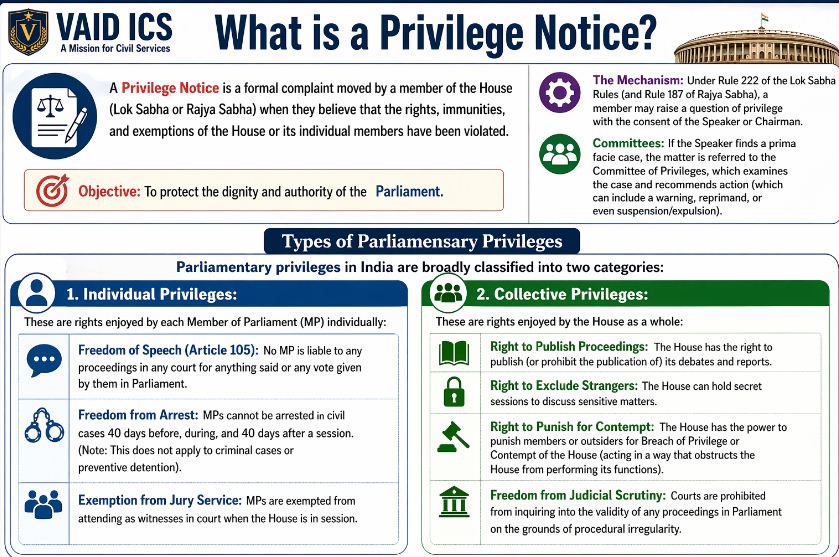
Types of Parliamentary Privileges:
Parliamentary privileges in India are broadly classified into two categories:
Individual Privileges:
These are rights enjoyed by each Member of Parliament (MP) individually:
- Freedom of Speech (Article 105): No MP is liable to any proceedings in any court for anything said or any vote given by them in Parliament.
- Freedom from Arrest: MPs cannot be arrested in civil cases 40 days before, during, and 40 days after a session. (Note: This does not apply to criminal cases or preventive detention).
- Exemption from Jury Service: MPs are exempted from attending as witnesses in court when the House is in session.
Collective Privileges:
These are rights enjoyed by the House as a whole:
- Right to Publish Proceedings: The House has the right to publish (or prohibit the publication of) its debates and reports.
- Right to Exclude Strangers: The House can hold secret sessions to discuss sensitive matters.
- Right to Punish for Contempt: The House has the power to punish members or outsiders for Breach of Privilege or Contempt of the House (acting in a way that obstructs the House from performing its functions).
- Freedom from Judicial Scrutiny: Courts are prohibited from inquiring into the validity of any proceedings in Parliament on the grounds of procedural irregularity.

October 17, 2025
October 16, 2025
October 6, 2025
September 24, 2025

