April 21, 2026
Ecologically Critical Area (ECA)
To protect the world’s largest mangrove forest, the Bangladesh government has officially approved a ban on new industrial projects within a 10-kilometer radius of the Sundarbans’ Ecologically Critical Area (ECA).
Ecologically Critical Area (ECA):
Subject: Environment & Ecology (UPSC GS Paper III)
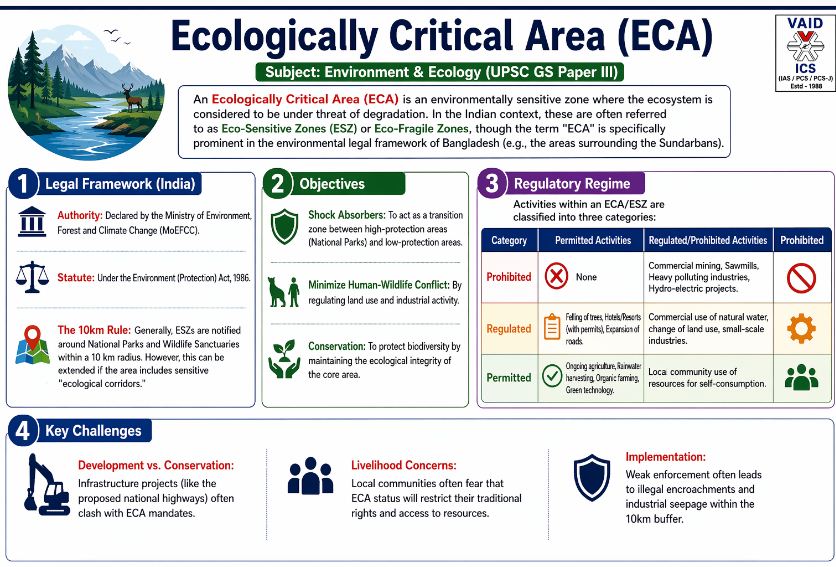
An Ecologically Critical Area (ECA) is an environmentally sensitive zone where the ecosystem is considered to be under threat of degradation. In the Indian context, these are often referred to as Eco-Sensitive Zones (ESZ) or Eco-Fragile Zones, though the term “ECA” is specifically prominent in the environmental legal framework of Bangladesh (e.g., the areas surrounding the Sundarbans).
1. Legal Framework (India):
-
Authority: Declared by the Ministry of Environment, Forest and Climate Change (MoEFCC).
-
Statute: Under the Environment (Protection) Act, 1986.
-
The 10km Rule: Generally, ESZs are notified around National Parks and Wildlife Sanctuaries within a 10 km radius. However, this can be extended if the area includes sensitive “ecological corridors.”
2. Objectives:
-
Shock Absorbers: To act as a transition zone between high-protection areas (National Parks) and low-protection areas.
-
Minimize Human-Wildlife Conflict: By regulating land use and industrial activity.
-
Conservation: To protect biodiversity by maintaining the ecological integrity of the core area.
3. Regulatory Regime:
Activities within an ECA/ESZ are classified into three categories:
| Category | Permitted Activities | Regulated/Prohibited Activities |
| Prohibited | None | Commercial mining, Sawmills, Heavy polluting industries, Hydro-electric projects. |
| Regulated | Felling of trees, Hotels/Resorts (with permits), Expansion of roads. | Commercial use of natural water, change of land use, small-scale industries. |
| Permitted | Ongoing agriculture, Rainwater harvesting, Organic farming, Green technology. | Local community use of resources for self-consumption. |
4. Key Challenges:
-
Development vs. Conservation: Infrastructure projects (like the proposed national highways) often clash with ECA mandates.
-
Livelihood Concerns: Local communities often fear that ECA status will restrict their traditional rights and access to resources.
-
Implementation: Weak enforcement often leads to illegal encroachments and industrial seepage within the 10km buffer.
5. Recent Context (2026):
-
Sundarbans Focus: The recent ban on industrial projects within 10km of the Sundarbans ECA highlights a shift toward “Zero-Industrial zones” to combat rising sea levels and salinity.
-
Judicial Oversight: The Supreme Court has increasingly emphasized the Precautionary Principle, ensuring that development does not come at the cost of irreversible ecological damage.

May 19, 2026
October 17, 2025
October 16, 2025
October 6, 2025

