April 18, 2026
Gist of Daily Articles: Daily Mains Qn/Model Answer/Mains Concise Note
The recent observations by the Supreme Court regarding the Sabarimala review petitions touch upon the delicate balance between religious autonomy and constitutional morality. Below is a comprehensive analysis of the issues, observations, and legal framework surrounding this matter.
1. Key Issues Involved:
-
Judicial Review vs. Religious Freedom: Whether the judiciary has the authority to test the “rationality” of deeply held religious beliefs.
-
Locus Standi of Non-Believers: Whether a person who does not follow a specific faith (a non-believer) has the right to challenge the practices of that faith in court.
-
Essential Religious Practices (ERP): The extent to which the court can determine what constitutes an “essential” part of a religion.
-
Constitutional Morality vs. Religious Morality: Which should prevail when a religious practice appears to violate fundamental rights (like equality).
2. Supreme Court’s Key Observations:
-
Rationality and Belief: The Court noted that for a believer, faith is often beyond logic. However, it questioned if a court can apply a “rationality test” to a practice, especially when the challenge comes from someone outside that faith.
-
Judicial Impartiality: The Court emphasized that judges must set aside their personal religious leanings and be guided strictly by the “Freedom of Conscience” and the constitutional framework.
-
Denominational Scrutiny: The Court clarified that religious denominations are not exempt from judicial scrutiny if their practices infringe upon the rights of individuals.
3. Constitutional Provisions:
-
Article 14: Right to Equality (used to challenge practices that discriminate against women).
-
Article 15: Prohibition of discrimination on grounds of religion, race, caste, sex, or place of birth.
-
Article 25: Freedom of conscience and free profession, practice, and propagation of religion. (Note: This is subject to public order, morality, and health).
-
Article 26: Freedom to manage religious affairs (protects religious denominations).
4. Relevant Case Laws:
-
Sabarimala Case (Indian Young Lawyers Association v. State of Kerala, 2018): The original judgement that allowed women of all ages to enter the temple, citing that “devotion cannot be subjected to gender discrimination.”
-
Shirur Mutt Case (1954): This case originated the “Essential Religious Practices” doctrine, stating that the court will protect only those practices that are integral to the religion.
-
S.R. Bommai v. Union of India: Established that secularism is a basic feature of the Constitution, implying that religious practices must align with secular constitutional values.
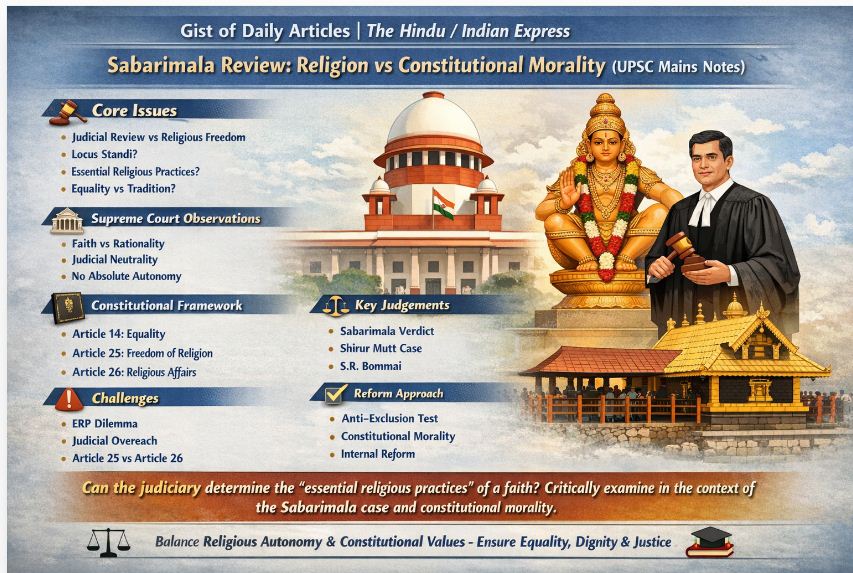
5. Challenges:
-
Subjectivity of “Essentiality”: Critics argue that secular judges are not equipped to decide what is “essential” to a religion; this should be left to religious heads.
-
Social Friction: Judicial interference in age-old traditions often leads to massive public protests and a sense of “judicial overreach” among believers.
-
Conflict of Rights: A direct clash between Article 25 (individual right to worship) and Article 26 (group right to manage internal affairs).
6. Suggestions and Reforms:
-
The “Anti-Exclusion” Test: Instead of looking at “essentiality,” courts should look at whether a practice excludes a certain group (like women or Dalits) from the social mainstream.
-
Constitutional Morality: The judiciary should continue to prioritize the values of dignity and equality over traditional practices that are exclusionary.
-
Internal Reform: Encouraging religious institutions to evolve internally rather than waiting for “top-down” judicial mandates.
7. Way Forward:
The Supreme Court’s decision to refer these questions to a larger bench (the “9-Judge Bench”) is a step toward creating a permanent “Constitutional Roadmap” for religion.
-
Clarifying Locus Standi: The court needs to define who can file a Public Interest Litigation (PIL) in matters of faith.
-
Harmonious Construction: There must be a balance where religious autonomy is respected, but not at the cost of “Untouchability” (Article 17) or gender discrimination.
-
Secularism in Practice: The judiciary must remain a “neutral umpire” that protects the rights of the minority/individual against the tyranny of the majority or tradition.

October 17, 2025
October 16, 2025
October 6, 2025
September 24, 2025

