April 17, 2026
State of India’s Bats (2024-25)
State of India’s Bats (2024-25)
This report represents a landmark study conducted over two years by 36 experts from 27 institutions. It highlights a critical “data dark spot” and significant neglect regarding the conservation of bats in India.
Key Statistics:
- Total Species: India is home to approximately 135 bat species.
- Endemic Species: 16 species are found only in India.
- Threatened Status: 7 endemic species are currently listed as “threatened” by the IUCN.
- Data Deficiency: 35 species have not been assessed or lack sufficient data to determine their health.
Primary Threats:
The report identifies several factors contributing to the decline of bat populations:
- Habitat Loss: Driven by urbanization, deforestation, and land-use changes.
- Human Activity: Mining (specifically in Meghalaya) and “persecution-fuelled hunting.”
- Infrastructure: Unexpected threats from renewable energy infrastructure.
- Climate Change: Broader environmental impacts affecting survival.
The “Stigma” Barrier:
The researchers noted that the Covid-19 pandemic significantly harmed bat conservation efforts:
- Public Perception: Increased stigma as bats were cast primarily as disease carriers.
- Bureaucracy: Despite the need to study zoonotic spillover, research permits are difficult to obtain due to bureaucratic hurdles.
- Misunderstood Benefits: The public often overlooks their “ecosystem services,” such as pollinating plants, dispersing seeds, controlling crop pests, and providing soil nutrients (guano).
Recommendations:
- Urgent Research: Step up studies on habitats, hotspots, ecology, and diet.
- Inter-agency Collaboration: Conservation should involve agencies beyond just the Forest Department.
- Pathogen Surveillance: Increase monitoring in Northeast India and the Western Ghats to prevent future zoonotic spillovers.
- Targeted Protection: Address specific cases like the Khasian Leaf-nosed bat, which is under threat but currently lacks official IUCN classification.
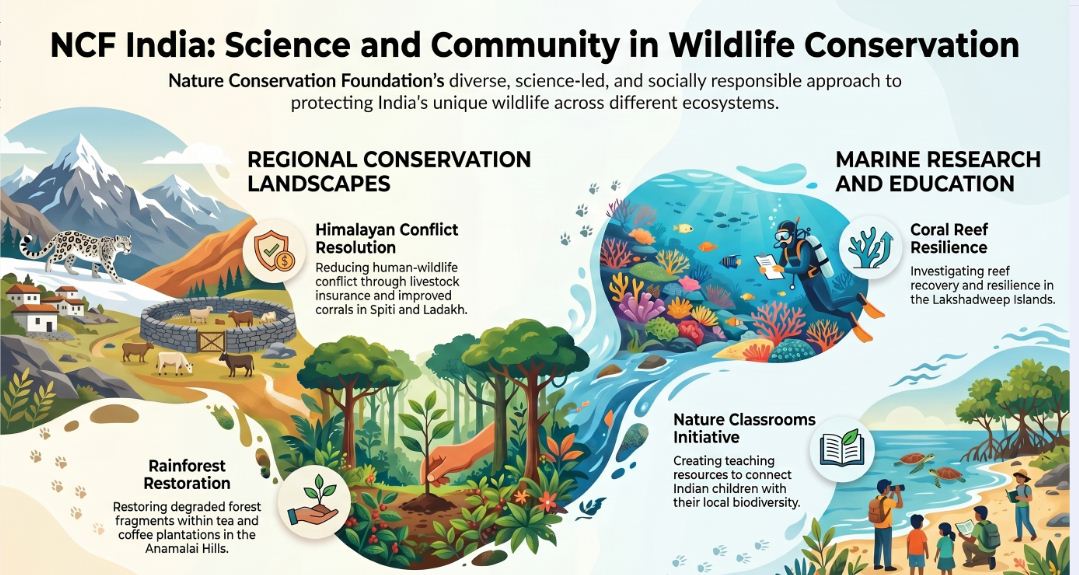
Nature Conservation Foundation (India):
Established in 1996, the Nature Conservation Foundation (NCF) is one of India’s leading wildlife conservation and research NGOs. They are known for a “science-based and socially responsible” approach to conservation.
- Core Mission: To contribute to the knowledge and conservation of India’s unique wildlife heritage through innovative research and community-based solutions.
- Key Landscapes & Projects:
-
- High Himalayas: They pioneered Project Snow Leopard, working with local communities in Spiti and Ladakh to reduce human-wildlife conflict through livestock insurance and improved corrals.
- Western Ghats: They run a massive Rainforest Restoration program in the Anamalai Hills, working with tea and coffee plantations to restore degraded forest fragments.
- Ocean & Coasts: Research on coral reef resilience and recovery in the Lakshadweep Islands.
- Nature Education: They lead the Nature Classrooms initiative, creating teaching resources to help children in India connect with their local biodiversity.

Gist of daily Article /The Hindu 17oct 2025
October 17, 2025
Daily Gist of the Hindu/Indian Express : 16 Oct 2025
October 16, 2025
Daily Gist of The Hindu/Indian Express: 6 Oct 2025
October 6, 2025
Daily Gist of Article /The Hindu /Indian Express: 24 Sep 2025
September 24, 2025

