April 17, 2026
Gist of Article/The Hindu/ Daily Mains Question-Model Answer/Delimitation in India: Mains Preparation Notes
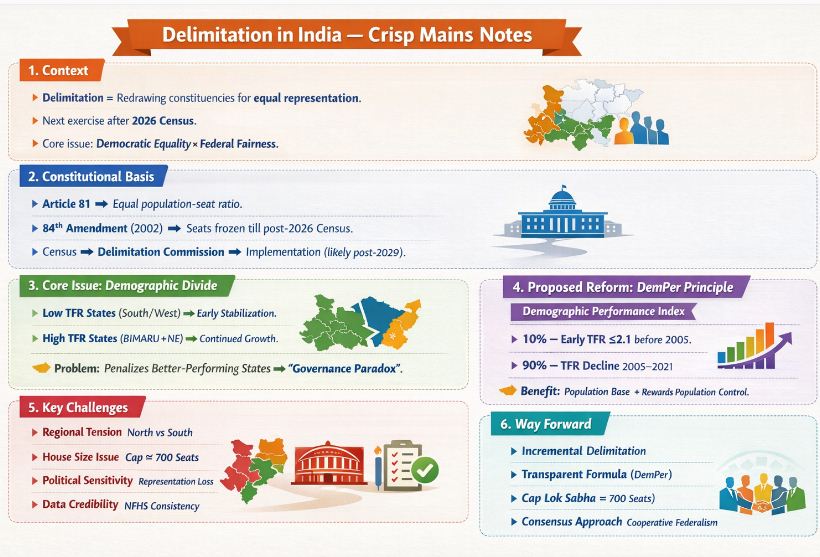
Delimitation is the process of fixing boundaries of territorial constituencies to ensure equal representation. The 2026 Census provides the triggers for the next delimitation exercise. The central challenge lies in balancing “One Person, One Vote” (population-based representation) with “Federal Fairness” (protecting states that succeeded in population control).
Constitutional & Legal Framework:
-
Article 81: Mandates the seat-to-population ratio to be similar across all states.
-
84th Constitutional Amendment (2002): Froze Lok Sabha and State Legislative seats until the first Census after 2026. This was intended to provide a “breathing room” for states to focus on family planning.
-
Process: Post-2026 Census (results expected by 2028) $\rightarrow$ Constitution of Delimitation Commission (DC) -Post-2029 election implementation.
The Core Conflict: Demographic Divergence:
The primary tension exists between states that stabilized their population early and those where growth remains high.
-
Early Achievers: TFR \le 2.1(Replacement level) achieved before 2005 (e.g., Kerala, Tamil Nadu, Karnataka, Andhra Pradesh, Punjab, Himachal Pradesh, Delhi, Goa, Telangana).
-
Lagging States: TFR significantly higher than the national average (e.g., Bihar, UP, Jharkhand, Meghalaya, Manipur).
-
The Inequity Trap: A purely population-based approach punishes “good governance” (states that invested in healthcare and social development) by reducing their relative parliamentary weight.
Proposed Solution: The Demographic Performance (DemPer) Principle:
To resolve this, experts suggest integrating a DemPer Index into the allocation formula, drawing inspiration from the Finance Commission’s devolution criteria.
The Proposed Model:
| Component | Weightage | Criteria |
| Historical Achievement | 10% | TFR \le 2.1achieved before 2005. |
| Sustained Effort | 90% | Rate of TFR decline between 2005–2021. |
-
Key Advantage: It keeps the population principle as the driver (DemPer applies only to additional seats beyond the current 543) while providing a reward for states that prioritized population stabilization.
Challenges to Implementation:
-
North-South Political Tension: Risk of shrinking the parliamentary footprint of southern states, potentially fueling regional resentment.
-
Optimal Parliament Size: Total population has tripled since 1971. A proportional increase might make the house unwieldy. A cap of ~700 seats is widely recommended.
-
Political Misconception: It is not purely a North-South issue; many Northern/Central states also meet stabilization goals, making this a pan-India concern for federal equity.
-
Data Reliability: The DC must ensure consistent NFHS data across all rounds to avoid partisan allegations.
The Way Forward:
-
Institutionalize Incrementalism: Move away from long “freezes” (e.g., 2001–2026). The DC should aim for incremental seat additions after every Census to prevent massive imbalances.
-
Transparent Methodology: Public consultation on the DemPer formula is essential to gain cross-party legitimacy.
-
Legislative Ceiling: Formally cap the Lok Sabha at 700 seats to maintain the quality of legislative debate.
Answer Structure: Practice Question:
Question: “Delimitation in India raises a critical tension between democratic equality and federal fairness.” Discuss in the context of the upcoming post-2026 delimitation exercise.
Suggested Framework:
-
Introduction (approx. 30 words): Define delimitation as a constitutional necessity; mention the 84th Amendment and the 2026 census context. Define the central conflict (Population parity vs. Demographic reward).
-
Body Paragraph 1 – The Tension (approx. 60 words): Explain the Demographic Divergence (refer to TFR data). Explain why a purely population-based model is perceived as punitive to progressive states.
-
Body Paragraph 2 – The Federalism Argument (approx. 60 words): Discuss the potential impact on India’s cooperative federalism (regional grievances, political representation of the South).
-
Body Paragraph 3 – The Way Forward/Solution (approx. 60 words): Propose the “DemPer” index. Mention the Finance Commission precedent. Highlight the need for a seat cap (e.g., 700) to ensure the House remains functional.
-
Conclusion (approx. 30 words): Summarize that delimitation is a test of political maturity. Conclude that a “balanced approach” (Population + Performance) is the only path to maintain democratic integrity without undermining federal harmony.

October 17, 2025
October 16, 2025
October 6, 2025
September 24, 2025

