April 16, 2026
Long Range Forecast (LRF)/Positive Indian Ocean Dipole (IOD)
The India Meteorological Department (IMD) recently released its first Long Range Forecast (LRF) for the 2026 Southwest Monsoon (issued on April 13, 2026).
Key Highlights :
- The Prediction: The IMD has forecast “below normal” rainfall at 92% of the Long Period Average (LPA), with a 5% margin of error.
- The “El Niño” Factor: A primary reason for this pessimistic outlook is the expected development of El Niño during the second half of the monsoon (August–September). Historically, El Niño is notorious for suppressing rainfall in the Indian subcontinent.
- The Offset: On a slightly positive note, the IMD mentioned a possible Positive Indian Ocean Dipole (IOD), which could partially counter El Niño’s drying effect, though its strength remains uncertain.
- Economic & Food Security: Coming at a time of geopolitical tension in West Asia (impacting gas and fertilizer prices), a weak monsoon threatens Kharif crop yields (paddy, pulses, oilseeds), which could spike food inflation and hurt the rural economy.
Summary of IMD Rainfall Categories:
|
Category |
Rainfall Range (% of LPA) | 2026 Forecast Status |
| Deficient | < 90% | Risk area if error margin leans negative |
| Below Normal | 90% – 95% | Current Forecast (92%) |
| Normal | 96% – 104% | — |
| Above Normal | 105% – 110% | — |
| Excess | > 110% | — |
Long Range Forecast (LRF):
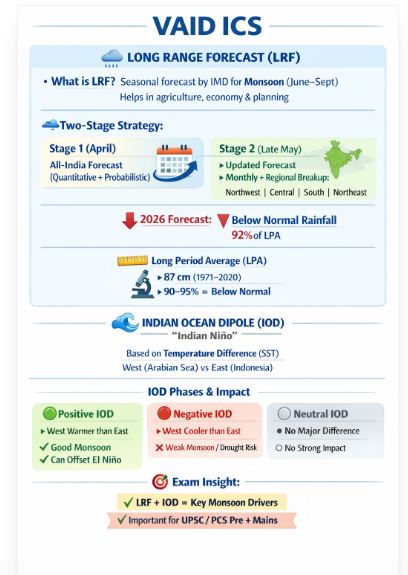
The LRF is a seasonal prediction issued by the IMD to provide early signals about the upcoming monsoon (June to September). It is crucial for food security and economic planning.
- Two-Stage Strategy: * Stage 1 (April): Provides a quantitative and probabilistic forecast for the country as a whole.
- Stage 2 (Late May): Provides updated data, including monthly forecasts and regional distributions (Northwest, Central, South Peninsula, and Northeast India).
- The 2026 Outlook: The current forecast predicts “Below Normal” rainfall at 92% of the Long Period Average (LPA).
- The Baseline (LPA): The LPA for the 1971–2020 period is 87 cm. Anything between 90–95% of this value is categorized as “Below Normal.”
- Scientific Tools: The IMD uses the Monsoon Mission Climate Forecast System (MMCFS), a dynamic coupled model, alongside statistical models to arrive at these numbers.
Indian Ocean Dipole (IOD):
Often called the “Indian Niño,” the IOD is an ocean-atmosphere phenomenon in the tropical Indian Ocean. It is defined by the difference in sea surface temperatures (SST) between the western part (Arabian Sea) and the eastern part (south of Indonesia).
The Three Phases
| Phase | Physical Condition | Impact on Indian Monsoon |
| Positive IOD | Western Indian Ocean is warmer than the Eastern part. | Good for India. It brings more moisture and can often neutralize the drying effect of El Niño. |
| Negative IOD | Western Indian Ocean is cooler than the Eastern part. | Bad for India. It suppresses the monsoon and can lead to droughts, especially if it coincides with El Niño. |
| Neutral IOD | Temperatures are roughly equal across the ocean. | Little to no additional influence on the monsoon strength. |

Gist of daily Article /The Hindu 17oct 2025
October 17, 2025
Daily Gist of the Hindu/Indian Express : 16 Oct 2025
October 16, 2025
Daily Gist of The Hindu/Indian Express: 6 Oct 2025
October 6, 2025
Daily Gist of Article /The Hindu /Indian Express: 24 Sep 2025
September 24, 2025

