April 6, 2026
Extended Producer Responsibility (EPR):
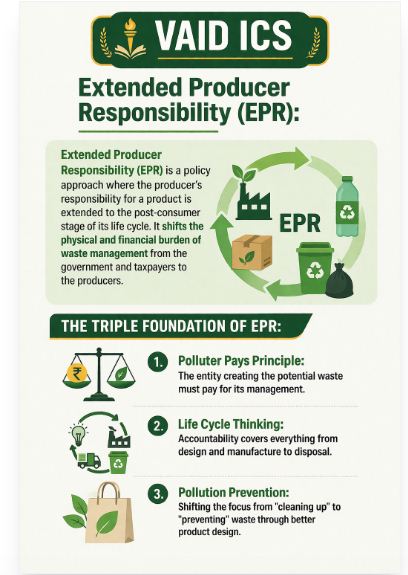
Extended Producer Responsibility (EPR):
Extended Producer Responsibility (EPR) is a policy approach where the producer’s responsibility for a product is extended to the post-consumer stage of its life cycle. It shifts the physical and financial burden of waste management from the government and taxpayers to the producers.
The Triple Foundation of EPR:
- Polluter Pays Principle: The entity creating the potential waste must pay for its management.
- Life Cycle Thinking: Accountability covers everything from design and manufacture to disposal.
- Pollution Prevention: Shifting the focus from “cleaning up” to “preventing” waste through better product design.
The Indian Legal Landscape:
EPR is not a single law but is codified across various waste-specific rules under the Environment (Protection) Act, 1986, and monitored by the Central Pollution Control Board (CPCB).
| Rule | Key Targets / Features |
| Plastic Waste (2016/2026) | 100% collection target; mandates for recycled content (30% to 60%) in packaging. |
| E-Waste (2022) | Targets 60% recycling initially, rising to 80% by 2027-28. Includes “E-waste Exchange.” |
| Battery Waste (2022) | Covers Portable, EV, and Industrial batteries. Recovery targets of 70-90%. |
| Used Oil (2024) | Newest addition; requires recycling of lubricating oils to prevent soil/water contamination. |
Strategic Implementation Mechanisms:
To make EPR functional, the Indian government uses several modern tools:
- Centralized EPR Portals: PIBOs (Producers, Importers, and Brand Owners) must register digitally for real-time tracking.
- EPR Certificates: A market-based tool where producers can buy “credits” from authorized recyclers to meet their targets.
- PROs (Producer Responsibility Organizations): Third-party agencies that producers hire to handle the actual collection and logistics of waste.
- Environmental Compensation: A “fining” mechanism where non-compliant firms pay a fee, though this does not exempt them from their original recycling obligations.
EPR and the Circular Economy:
EPR acts as the “engine” for a circular economy by:
- Resource Recovery: Reclaiming rare earth metals from e-waste and polymers from plastic reduces the need for “virgin” mining.
- Eco-Design: Since producers pay for disposal, they are incentivized to make products easier to dismantle and recycle (e.g., modular electronics).
- Reducing “Leaking” Waste: By formalizing collection, waste is diverted from landfills and oceans into formal recycling streams.
Critical Challenges & The “Way Forward”:
Challenges:
- Informal Sector Dominance: Over 90% of waste in India is handled by the informal sector (ragpickers/small scrap dealers). EPR often struggles to integrate them safely.
- Data Integrity: Risks of “fake” recycling certificates and fraudulent reporting on digital portals.
- Infrastructure Gap: High targets (like 80-100% collection) often outpace the actual number of scientific recycling plants available in India.
The Way Forward:
- Formalization: Integrating the informal “kabadiwallahs” into the PRO network to provide them with safety gear and fair wages.
- Stricter Audits: Using blockchain or AI-based tracking on the CPCB portal to ensure “Certificate Trading” is transparent.
Incentivizing Over-compliance: Rewarding companies that go beyond their 100% target with tax breaks or “Green Credits

October 17, 2025
October 16, 2025
October 6, 2025
September 24, 2025

