March 31, 2026
The Somato-Cognitive Action Network (SCAN)
The Somato-Cognitive Action Network (SCAN) is a recently discovered brain network that links thinking (cognition), body sensations, and movement (action) into one integrated system.
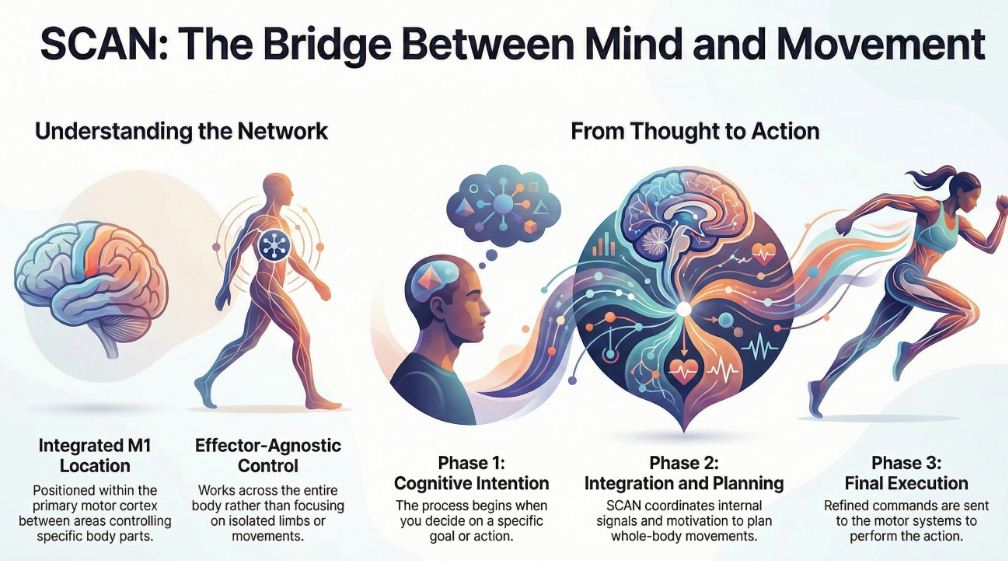
What exactly is SCAN?
- Location: It is located mainly in the primary motor cortex (M1), positioned between areas controlling specific body parts (like the hand, foot, or mouth).
- Whole-Body Control: Unlike traditional motor regions—which control specific, isolated movements—SCAN is “effector-agnostic,” meaning it works across the entire body rather than focusing on a single limb.
Main Function:
SCAN acts as a bridge between intention and action:
- Cognitive Intention: You decide what you want to do.
- Integration: SCAN integrates internal body signals, motivation, and physiology.
- Planning: It helps plan and coordinate “whole-body” actions.
- Execution: It sends refined commands to the motor systems for final execution.
In simple terms: SCAN is the “thinking → body coordination → action execution” system.
Key Features:
- Integration: It blends motor control (movement), cognitive goals (decision-making), and internal body states (heart rate, breathing, etc.).
- Complexity: It helps in complex, coordinated actions rather than just small, simple movements.
- Collaboration: It works closely with other networks, such as the cingulo-opercular network (the brain’s action control system).
Why is it important?
- Updated Brain Mapping: It challenges the old idea of a simple, linear “motor map” (the Homunculus) in the brain.
- Mind-Body Link: It proves that movement is deeply connected with our thoughts and physical physiology.
- Clinical Significance: It is increasingly linked to movement and neurological disorders, including:
- Parkinson’s disease
- Dystonia

Citizenship (Amendment) Rules, 2026
May 19, 2026
Gist of daily Article /The Hindu 17oct 2025
October 17, 2025
Daily Gist of the Hindu/Indian Express : 16 Oct 2025
October 16, 2025
Daily Gist of The Hindu/Indian Express: 6 Oct 2025
October 6, 2025

