March 26, 2026
WTO 14th Ministerial Conference (MC14)
Why in News?
The MC14 is being held from March 26 to 29, 2026, in Yaoundé, Cameroon. As the WTO’s highest decision-making body, this conference is meeting at a time when the global multilateral trading system is facing an existential crisis due to rising unilateralism, geopolitical tensions (US-China), and the collapse of the dispute settlement mechanism.
Key Points of the Crisis
-
Retreat of Multilateralism: Large economies, particularly the U.S., are moving toward unilateralism (imposing tariffs arbitrarily) and securitization of trade (using national security as a reason to block trade).
-
US-China Rivalry: The U.S. believes the WTO has failed to “discipline” China’s state-led economic model. Consequently, the U.S. has paralyzed the Appellate Body (the WTO’s highest court) by blocking member appointments.
-
Legislative Logjam: Since the WTO works on consensus, creating new rules is nearly impossible. Only two major agreements (Trade Facilitation and Fisheries Subsidies) have been reached in 30 years.
Understanding Core WTO Principles:
A. Most Favoured Nation (MFN) Rule
-
The Concept: Under the WTO agreements, countries cannot normally discriminate between their trading partners. If you grant someone a special favor (such as a lower customs duty rate for one of their products), you have to do the same for all other WTO members.
-
Significance: It ensures non-discrimination and prevents powerful nations from playing favorites or using trade as a tool for political coercion.
B. Special and Differential Treatment (SDT):
-
The Concept: It recognizes that developing countries and Least Developed Countries (LDCs) are not on an equal footing with developed nations.
-
Provisions: SDT allows developing countries longer timeframes to implement agreements, provides them with technical assistance, and grants them “special rights” to protect their infant industries.
-
Current Conflict: The U.S. wants to exclude “large” developing economies like India, China, and Brazil from these benefits, arguing they are no longer “poor.”
C. Plurilateral Agreements vs. Multilateralism
-
Multilateral: Involves all 166 members (requires consensus).
-
Plurilateral: Agreements between a smaller group of members (e.g., Investment Facilitation).
-
The Debate: Some see plurilateral deals as a way to bypass the “consensus logjam.” India, however, fears this will lead to the fragmentation of the WTO and weaken the voice of the developing world.
Key Issues at MC14:
-
E-commerce Moratorium: Since 1998, members have agreed not to impose customs duties on electronic transmissions (Netflix, software, e-books). Developed nations want this permanent; India and others worry about revenue loss.
-
Dispute Settlement Reform: The urgent need to revive the Appellate Body to ensure trade rules are legally enforceable.
-
Annex 4 Inclusion: Whether new plurilateral deals (like Investment Facilitation) can be added to the WTO rulebook without 100% consensus.
India’s Role & Way Forward:
-
Normative Leadership: India needs to lead the Global South (the “Third World”) to ensure that the interests of LDCs and developing nations are not trampled by the U.S. and China.
-
Innovative Solutions: India might need to consider new ideas, such as voting to appoint Appellate Body members (bypassing the U.S. block) or reconsidering its absolute opposition to plurilateral deals to keep the WTO relevant.
-
Conclusion: If MC14 fails, it marks a victory for “might is right” (coercion) over “rule of law” (multilateralism), which would be highly detrimental to developing economies.
The concept of Least Developed Countries (LDCs) is a cornerstone of international trade and development law, particularly within the framework of the WTO MC14 currently taking place in Cameroon.
What are Least Developed Countries (LDCs)?
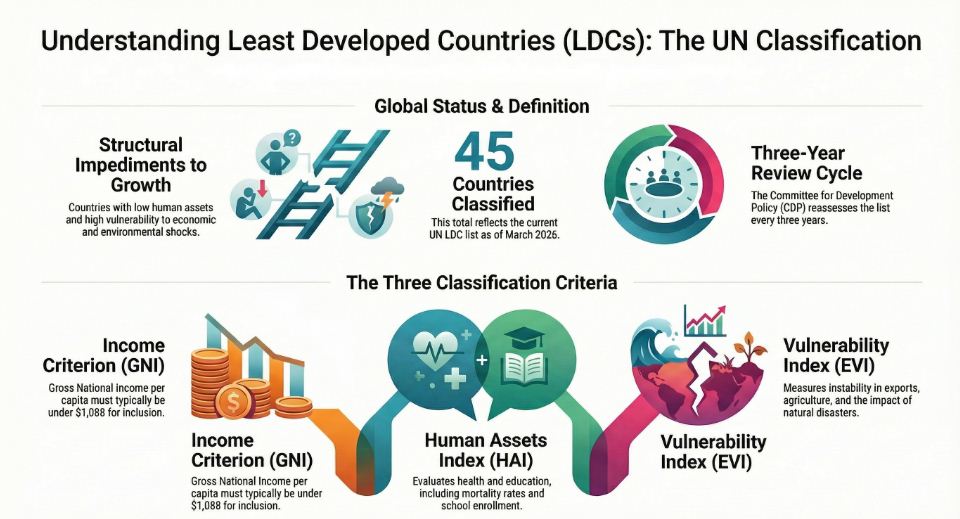
LDCs are low-income countries confronting severe structural impediments to sustainable development. They have low levels of human assets and are highly vulnerable to economic and environmental shocks.
As of March 2026, there are 45 countries classified as LDCs by the United Nations. The list is reviewed every three years by the Committee for Development Policy (CDP).
Criteria for LDC Classification:
To be classified as an LDC, a country must meet three specific criteria:
-
Income Criterion: Based on a three-year average estimate of the Gross National Income (GNI) per capita. (The threshold is typically under $1,088 for inclusion).
-
Human Assets Index (HAI): Measures health and education outcomes, including under-five mortality, maternal mortality, and secondary school enrollment.
-
Economic and Environmental Vulnerability Index (EVI): Measures the instability of agricultural production, instability of exports, and victims of natural disasters.
LDCs in the WTO (Special Rights):
Under the WTO’s Special and Differential Treatment (SDT), LDCs enjoy “most favored” status to help them integrate into the global economy:
-
Duty-Free Quota-Free (DFQF) Access: Developed members (and some developing ones like India) allow LDCs to export products without paying customs duties or facing quantity limits.
-
Extended Implementation Periods: LDCs are given much longer timeframes to comply with WTO agreements (e.g., Intellectual Property/TRIPS).
-
Technical Assistance: Priority in receiving aid to build trade infrastructure (Aid for Trade).
-
Exemption from Certain Disciplines: They are often exempt from reducing agricultural subsidies or industrial tariffs that other members must cut.
The “Graduation” Challenge:
When an LDC’s economy improves significantly, it “graduates” from the list (e.g., Bhutan recently graduated, and Bangladesh is in the transition process).
-
The Crisis: Once a country graduates, it loses LDC-specific benefits (like DFQF access).
-
MC14 Context: At the Yaoundé Ministerial, LDCs are pushing for a “Transition Period”—demanding that their trade preferences continue for several years after graduation to ensure their economies don’t collapse once the “crutches” of LDC status are removed.

October 17, 2025
October 16, 2025
October 6, 2025
September 24, 2025

