March 20, 2026
India’s New GDP Series: 2022-23
India’s New GDP Series
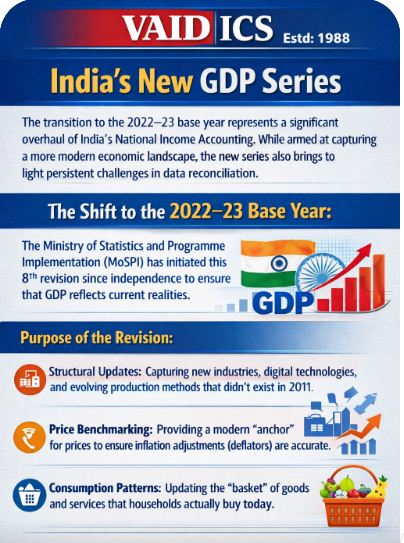
The transition to the 2022–23 base year represents a significant overhaul of India’s National Income Accounting. While aimed at capturing a more modern economic landscape, the new series also brings to light persistent challenges in data reconciliation.
The Shift to the 2022–23 Base Year:
The Ministry of Statistics and Programme Implementation (MoSPI) has initiated this 8th revision since independence to ensure that GDP reflects current realities.
Purpose of the Revision:
- Structural Updates: Capturing new industries, digital technologies, and evolving production methods that didn’t exist in 2011.
- Price Benchmarking: Providing a modern “anchor” for prices to ensure inflation adjustments (deflators) are accurate.
- Consumption Patterns: Updating the “basket” of goods and services that households actually buy today.
Analyzing the “Statistical Discrepancy:
A major point of contention in the new series is the gap between the two ways India measures its economy:
- Production Side (GVA): Value added by sectors like agriculture and industry.
- Expenditure Side (GDP): Total spending by households, government, and businesses.
The Discrepancy Problem: Ideally, these two figures should be identical. However, when they don’t match, MoSPI uses a “balancing figure” called a discrepancy.
The Rising Mismatch:
- FY25 Data: Discrepancies surged by 230%, reaching approximately 3.5 lakh crore.
- FY26 Projection: Discrepancies are expected to hit
- 4.9 lakh crore.
- Impact: When the “gap” is this large, it leads to skepticism among global investors and economists regarding the true rate of “Real GDP” growth.
The Anatomy of India’s Economy (Expenditure Side):
To understand where the data gaps lie, we look at the four pillars of spending:
| Component | Share of GDP | Description |
| PFCE | ~60% | Private Consumption: What you and I spend on daily life. |
| GFCF | ~30% | Fixed Investment: Spending on infrastructure, factories, and tech. |
| GFCE | ~10% | Government Spending: Salaries, operations, and public services. |
| Net Exports | Variable | The difference between what we sell abroad vs. what we buy. |
Why Do These Gaps Persist?
The “mismatch” usually occurs because of three main technical hurdles:
- The “Informal” Factor: A massive portion of India’s economy (MSMEs and daily wage labor) is not captured in real-time digital records.
- Sample Survey Limitations: We rely on periodic “samples” of household spending rather than a total census, which can lead to estimation errors.
- Deflator Accuracy: Converting “Nominal GDP” (current prices) to “Real GDP” (inflation-adjusted) requires precise price indices. While MoSPI has increased deflators from 180 to 600, errors still creep in as we move further from the base year.
Path toward Credibility:
To turn these statistics into gold-standard data, the following steps are essential:
- Digital Integration: Leveraging GST and UPI data to track the informal sector in real-time.
- Satellite Imaging: Using technology to verify agricultural output and infrastructure progress.
- SUT Refinement: Improving Supply and Use Tables to ensure that what is produced is accurately tracked to where it is consumed.

October 17, 2025
October 16, 2025
October 6, 2025
September 24, 2025

