March 14, 2026
What is Economic Stabilisation Fund (ESF)?
Why in the news? The proposal comes as a response to the ongoing West Asia crisis (specifically tensions involving Israel, Iran, and the US) which has pushed oil prices toward $100 per barrel.
- Supplementary Grants: The government sought parliamentary approval for a gross additional expenditure of Rs 81 lakh crore for the financial year 2025-26.
- Fiscal Management: The fund is designed to act as a “shock absorber” to protect India’s macro-stability without deviating from the 4% fiscal deficit target.
About the Economic Stabilisation Fund (ESF):
What is it?
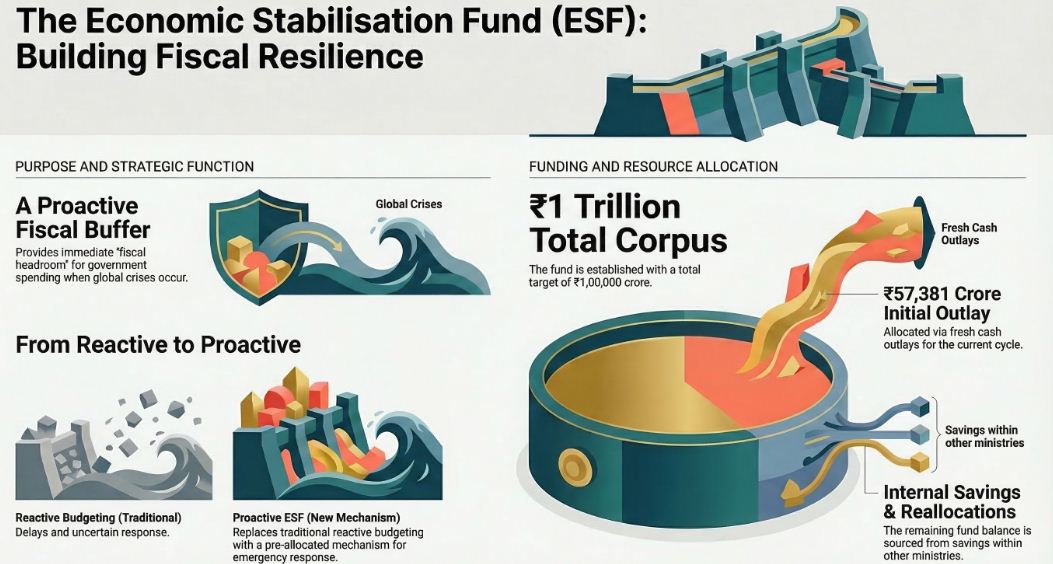
It is a fiscal buffer (reserve fund) created under the Department of Economic Affairs (DEA). Unlike traditional budgeting, which is reactive, the ESF is a proactive mechanism to provide “fiscal headroom”—meaning the government has pre-allocated money to spend immediately when a global crisis hits.
How is it Funded?
- Total Corpus: ₹1,00,000 crore (₹1 trillion).
- Initial Outlay: For the current cycle, ₹57,381 crore has been allocated via fresh cash outlays.
- Savings: The remaining portion of the fund is being met through internal reallocations and savings from other ministries.
Key Objectives :
- Price Shock Protection: The primary goal is to insulate Indian consumers and industries from sudden spikes in energy (oil/gas) and fertilizer prices caused by global supply chain disruptions.
- Support for Specific Sectors: The fund allows the government to intervene in sub-sectors of the economy that might face unexpected shocks (e.g., exporters or manufacturing).
- Macroeconomic Resilience: By having this fund ready, India can absorb international shocks without needing to cut back on essential infrastructure or welfare spending.
- Other Major Allocations in the Same Bill:
- Defence: ₹41,822 crore for revenue services.
- Fertilizer Subsidy: Additional ₹19,230 crore to prevent shortages for farmers.
- Food Security: ₹23,641 crore for the PM Garib Kalyan Anna Yojana (PMGKAY).
- Rural Employment: ₹30,000 crore additional for MGNREGA-related schemes.
As the Finance Minister stated, the fund is being built “in anticipation of what cannot be anticipated.” It marks a shift in India’s economic strategy toward building a permanent “safety net” against a volatile global order.

October 17, 2025
October 16, 2025
October 6, 2025
September 24, 2025

