March 12, 2026
What is an Organised Group A Service (OGAS)?Central Armed Forces (General Administration) Bill
Why in News ? The government is set to introduce the Central Armed Forces (General Administration) Bill during the Budget Session.
- Purpose: To codify (formally write into law) how the CAPFs are governed and managed.
- Current Status: The Union Cabinet has already given its approval (cleared the Bill) as of Tuesday.
The Legal Catalyst: Supreme Court Ruling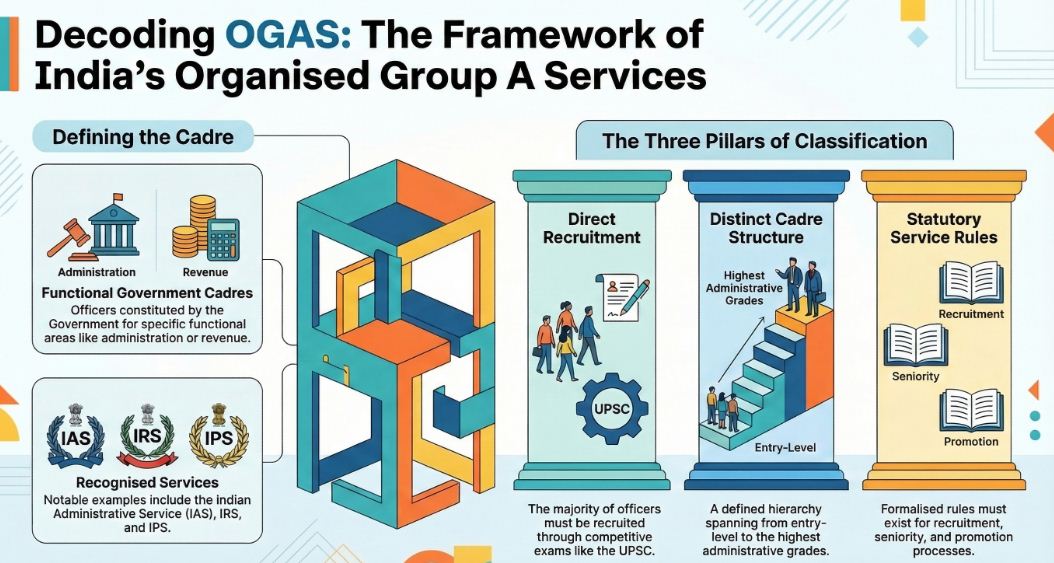
The Bill is a direct response to a Supreme Court judgment dated May 23, 2025. The court issued two critical mandates:
- Reduce IPS Deputation: The MHA was ordered to “progressively reduce” the number of IPS officers serving in CAPFs up to the rank of Inspector-General (IG) within two years.
- OGAS Status: The court upheld the Organised Group A Service (OGAS) status for CAPF officers. This is a massive victory for direct-entry CAPF officers as it grants them better promotion prospects, non-functional financial upgrades, and parity with other civil services.
The Conflict: MHA vs. The Judgment:
The Ministry of Home Affairs (MHA) has shown resistance to the immediate implementation of these changes:
- Review Petition: The MHA tried to challenge the ruling, but the Supreme Court dismissed their petition on October 28, 2025, making the order final and legally binding.
- Timeline Struggles: On March 9, 2026, the MHA approached the Court again, asking for a one-year extension.
- MHA’s Argument: They claim that “cadre review” is a complex, multi-layered process involving various government levels and Cabinet approval. They argue that service rules cannot be changed until the cadre strength is officially reviewed.
Key Forces Affected (The CAPFs):
The Bill will impact the “Seven Sisters” of India’s internal security:
- CRPF (Central Reserve Police Force)
- BSF (Border Security Force)
- CISF (Central Industrial Security Force)
- ITBP (Indo-Tibetan Border Police)
- SSB (Sashastra Seema Bal)
- NSG (National Security Guard)
- AR (Assam Rifles)
What is an Organised Group A Service (OGAS)?
An “Organised Service” is a cadre of officers constituted by the Government of India for a specific functional area (e.g., IAS, IRS, IPS). To be classified as OGAS, a service must meet certain criteria defined by the Department of Personnel and Training (DoPT):
- Direct Recruitment: The majority of officers must be recruited through a competitive exam (like the UPSC).
- Cadre Structure: A distinct hierarchy from entry-level up to the highest administrative grades.
- Service Rules: Defined rules for recruitment, seniority, and promotion.
The Core Benefit: NFFU:
The most critical advantage of OGAS status is Non-Functional Financial Upgradation (NFFU).
- How it works: If an officer of a particular batch (e.g., the 2010 batch) is not promoted due to a lack of vacancies, they still receive the pay scale and financial benefits of the higher rank once their “benchmark” peers in the IAS/IPS are promoted.
- Purpose: It compensates for “cadre stagnation” where officers remain in the same rank for decades despite having the seniority and merit for promotion.
Significance for CAPF Officers:
For the CRPF, BSF, CISF, ITBP, and SSB, the grant of OGAS status changes the fundamental nature of their service:
A. Ending “Cadre Stagnation”:
CAPF officers often spend 10–15 years in a single rank (like Second-in-Command or Commandant). OGAS ensures they get the financial parity of a DIG or IG even if the physical vacancy doesn’t exist.
B. The Deputation Issue (The “Cadre War”):
Traditionally, top leadership positions in CAPFs (DIG and above) have been occupied by IPS officers on deputation.
- OGAS Impact: By recognizing CAPF as an “Organised Service,” the Supreme Court has empowered cadre officers to claim these senior positions.
- The 2025/26 Ruling: As discussed in recent news, the SC has ordered the Ministry of Home Affairs to “progressively reduce” IPS deputation up to the IG rank to allow OGAS-status cadre officers to lead their own forces.
C. Parity with Other Services:
OGAS status places CAPF officers on the same administrative pedestal as the IRS (Income Tax), Indian Railway Services, and others, ensuring they are treated as a professional civil-military cadre rather than just “police subordinates.”

October 17, 2025
October 16, 2025
October 6, 2025
September 24, 2025

