March 6, 2026
What is a “Gravity Bomb”?
The Strategic Shift: “Stand-off” to “Direct Bombardment”
U.S. Defense Secretary Pete Hegseth announced that because Iranian air defenses have been “severely degraded,” the U.S. is moving away from stand-off munitions toward direct bombardment using gravity bombs.
-
Initial Strategy (Stand-off): Using long-range weapons like Tomahawk cruise missiles and LUCAS drones. These are launched from outside the reach of enemy defenses to dismantle radars and missile batteries while keeping pilots safe.
-
New Strategy (Direct): Now that the air space is less contested, aircraft can fly closer to targets to drop unpowered, high-yield gravity bombs.
What is a “Gravity Bomb”?
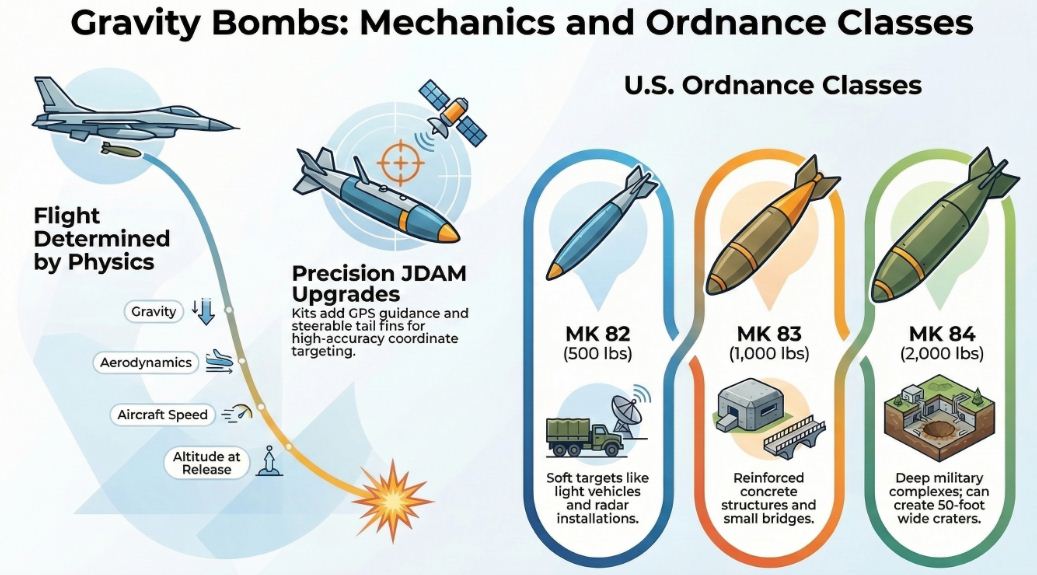
A gravity bomb, or “free-fall” bomb, is an unpowered munition. Unlike a cruise missile, it has no internal engine. Once released, its path is determined by:
-
Gravity (pulling it down).
-
Aerodynamics (its shape).
-
Speed/Altitude of the aircraft at the time of release.
Modern “Precision” Upgrades:
While they sound like old-fashioned weapons, modern gravity bombs are often equipped with JDAM (Joint Direct Attack Munition) kits. These kits add:
-
GPS guidance systems.
-
Steerable tail fins that allow the bomb to “glide” and hit specific coordinates with high accuracy.
Types of Conventional U.S. Gravity Bombs:
The U.S. utilizes three primary weight classes of these bombs, each designed for specific targets:
| Bomb Type | Weight | Primary Target/Use Case |
| MK 82 | 500 lbs | “Soft” targets: light vehicles, radar installations, and exposed infantry. |
| MK 83 | 1,000 lbs | Medium-yield: reinforced concrete structures, command posts, and small bridges. |
| MK 84 | 2,000 lbs | “Bunker-buster”: deep military complexes and large industrial facilities. Can create craters 50 feet wide and 36 feet deep. |

October 17, 2025
October 16, 2025
October 6, 2025
September 24, 2025

