March 6, 2026
Demographic Distribution in the Gulf/ NRI/PIOs Population in Gulf
Demographic Distribution in the Gulf:
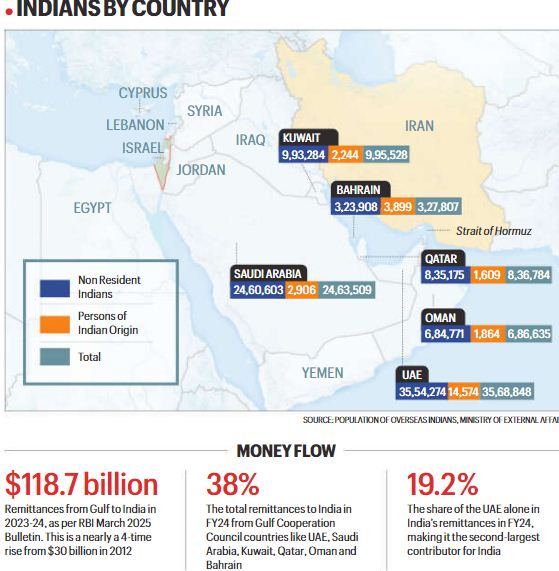
The data categorizes the Indian population into Non-Resident Indians (NRIs) and Persons of Indian Origin (PIOs) across six key Middle Eastern nations.
| Country | Non-Resident Indians (NRIs) | Persons of Indian Origin (PIOs) | Total Indian Diaspora |
| UAE | 3,554,274 | 14,574 | 3,568,848 |
| Saudi Arabia | 2,460,603 | 2,906 | 2,463,509 |
| Kuwait | 9,93,284 | 2,244 | 9,95,528 |
| Qatar | 8,35,175 | 1,609 | 8,36,784 |
| Oman | 6,84,771 | 1,864 | 6,86,635 |
| Bahrain | 3,23,908 | 3,899 | 3,27,807 |
Economic Impact: Money Flow:
The second half of the graphic highlights the massive scale of remittances sent back to India, which serves as a vital pillar for the Indian economy.
1. Global and Regional Volume
-
Total Remittances: India received $118.7 billion in remittances during 2023-24, according to the RBI March 2025 Bulletin.
-
Growth Trend: This represents a nearly 4-fold increase from the $30 billion recorded in 2012.
-
GCC Contribution: The Gulf countries (UAE, Saudi Arabia, Kuwait, Qatar, Oman, and Bahrain) account for 38% of the total remittances flowing into India.
2. The UAE Factor
The UAE stands out as the most significant individual contributor in the region:
-
It accounts for 19.2% of India’s total global remittances.
-
It is the second-largest contributor to India’s remittance pool worldwide.
Key Insights
-
Dominance of NRIs: In almost every country listed, the population is overwhelmingly comprised of NRIs rather than PIOs, indicating a large workforce of Indian citizens living abroad.
-
Strategic Importance of the Gulf: With over one-third of total remittances coming from these six nations, the GCC remains a critical economic partner for India’s foreign exchange reserves and household income support.
Non-Resident Indian (NRI):
An NRI is an Indian Citizen who resides outside of India.
-
Citizenship: Holds an Indian Passport.
-
Residency Requirement: Under the Income Tax Act, a person is generally considered an NRI if they spend less than 182 days in India during a financial year (subject to specific conditions regarding income from Indian sources).
-
Rights: They enjoy all the rights of a resident Indian citizen, including the right to vote (though they must be present in their constituency) and the right to hold government jobs or constitutional offices.
2. Person of Indian Origin (PIO):
A PIO is a Foreign Citizen (except for certain countries like Pakistan, Bangladesh, etc.) who has Indian ancestry.
-
Ancestry: They, their parents, grandparents, or great-grandparents were born in or were permanent residents of India.
-
Evolution of Status: The standalone “PIO Card” scheme was discontinued in 2015.
-
Current Status: All existing PIO cardholders are now “deemed to be” OCI cardholders. The government merged these categories to simplify the process and provide better benefits.
3. Overseas Citizen of India (OCI):
Since the PIO/OCI merger, the OCI card is the primary identification for foreign nationals of Indian origin.
-
Citizenship: They are citizens of another country and hold a foreign passport.
-
Visa Status: It acts as a lifelong, multi-purpose, multi-entry visa for visiting India.
-
Benefits:
-
No need to register with the FRRO (Foreigners Regional Registration Office) regardless of the length of stay.
-
Parity with NRIs in economic, financial, and educational fields.
-
Can own residential and commercial property (but not agricultural land).
-
-
Restrictions: Unlike NRIs, OCIs cannot vote, contest elections, or hold government/constitutional posts.
Comparison :
| Feature | NRI | OCI (Includes former PIOs) |
| Passport | Indian Passport | Foreign Passport |
| Citizenship | Indian Citizen | Foreign Citizen |
| Visa Requirement | None | None (Lifelong OCI Card) |
| Voting Rights | Yes | No |
| Government Jobs | Yes | No |
| Property Ownership | All (including Agricultural) | All except Agricultural/Plantation |

October 17, 2025
October 16, 2025
October 6, 2025
September 24, 2025

