February 19, 2026
The Loggerhead Turtle
Recent research published in early 2026 (notably in the journal Animals and Frontiers in Marine Science) has highlighted a “four-pronged” threat to Loggerhead turtles. The most significant finding is that while some populations seem to be thriving (more nests), they are actually working harder for less return due to a changing climate.
Latest Scientific Findings :
- Reproductive Delays: Female loggerheads are breeding less frequently. The interval between breeding seasons has shifted from every 2 years to a 4-year gap.
- Declining Body Size: Studies in Cabo Verde and Florida have observed a trend of smaller nesting females. Because clutch size is linked to body size, smaller females are laying fewer eggs.
- Earlier Nesting: Warmer sea surface temperatures are triggering turtles to arrive at nesting beaches earlier in the year. While this seems adaptive, it may lead to a mismatch with other environmental factors.
- Depleting Food Sources: Satellite data (tracking chlorophyll levels) shows a decline in ocean productivity in their foraging grounds. As “capital breeders,” loggerheads rely on stored energy to migrate; less food means they take longer to build the energy required for a nesting journey.
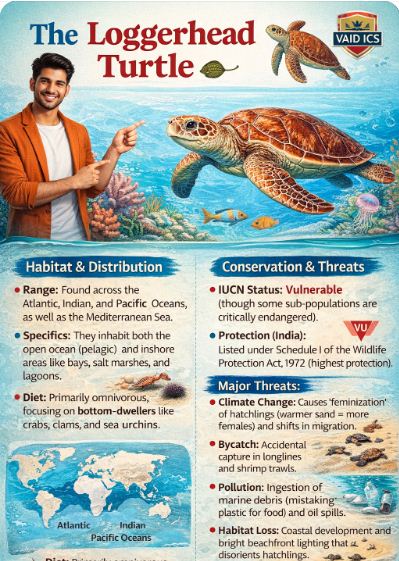
Profile: The Loggerhead Turtle (Caretta caretta)
| Feature | Details |
| Family | Cheloniidae |
| Distinction | Named for massive heads and powerful jaws designed to crush hard prey. |
| Size Record | The world’s largest hard-shelled turtle (second largest extant turtle overall after the leatherback). |
| Navigation | Uses the Earth’s geomagnetic field as an internal map for long-distance migration. |
| Lifespan | Can live up to 80 years or more. |
Habitat & Distribution:
- Range: Found across the Atlantic, Indian, and Pacific Oceans, as well as the Mediterranean Sea.
- Specifics: They inhabit both the open ocean (pelagic) and inshore areas like bays, salt marshes, and lagoons.
- Diet: Primarily omnivorous, focusing on bottom-dwellers like crabs, clams, and sea urchins.
Conservation & Threats:
- IUCN Status: Vulnerable (though some sub-populations are critically endangered).
- Protection (India): Listed under Schedule I of the Wildlife Protection Act, 1972 (highest protection).
- Major Threats:
- Climate Change: Causes “feminization” of hatchlings (warmer sand = more females) and shifts in migration.
- Bycatch: Accidental capture in longlines and shrimp trawls.
- Pollution: Ingestion of marine debris (mistaking plastic for food) and oil spills.
- Habitat Loss: Coastal development and bright beachfront lighting that disorients hatchlings.

Gist of daily Article /The Hindu 17oct 2025
October 17, 2025
Daily Gist of the Hindu/Indian Express : 16 Oct 2025
October 16, 2025
Daily Gist of The Hindu/Indian Express: 6 Oct 2025
October 6, 2025
Daily Gist of Article /The Hindu /Indian Express: 24 Sep 2025
September 24, 2025

