February 16, 2026
What is Economic Viability Test?
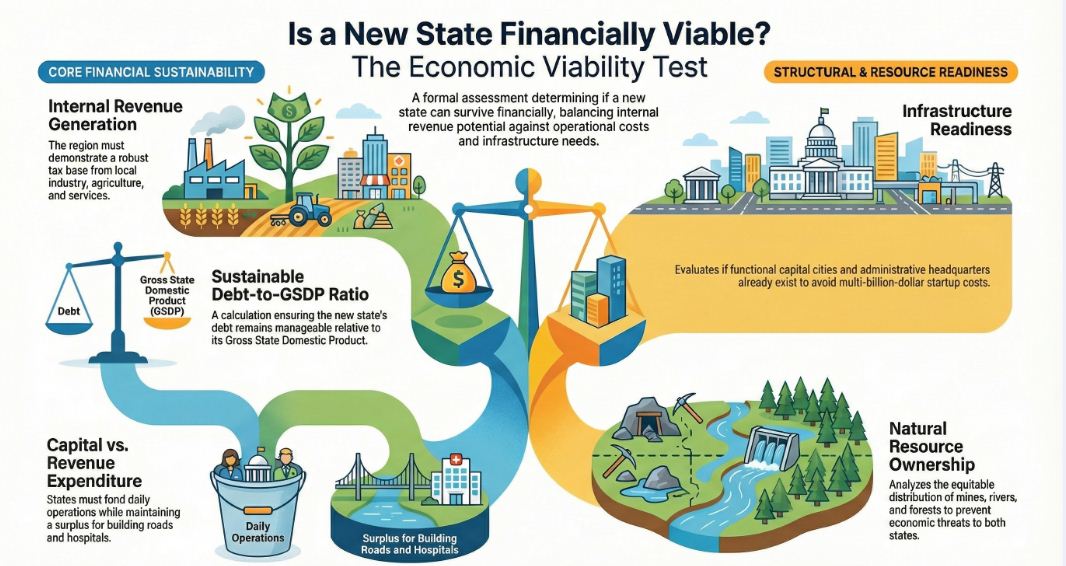
Economic Viability Test is a formal assessment used to determine if a proposed new state can survive and thrive financially on its own, without being a permanent burden on the Central Government.
Key Components of the Test:
To pass this “test,” a proposed state must demonstrate strength in several financial areas:
-
Revenue Generation (Internal Resources):
Does the region have enough industries, agriculture, or services to generate its own tax revenue (GST, excise, property taxes)?
-
Debt-to-GSDP Ratio:
A calculation of whether the new state’s debt will be manageable relative to its Gross State Domestic Product (GSDP).
-
Capital vs. Revenue Expenditure:
Can the state afford its “running costs” (salaries, pensions, electricity) while still having money left over for “capital assets” (building roads, hospitals, and schools)?
-
Infrastructure Readiness:
Does the region already have a functional capital city, high courts, and administrative headquarters, or will the Center have to spend billions to build them from scratch?
-
Natural Resource Ownership:
An analysis of who gets the mines, rivers, and forests. If a new state gets the minerals but the old state keeps the processing plants, the economic viability of both is threatened.
Why is this “Test” being proposed?
Currently, India does not have a strict, legal “Economic Viability Test.” States are often created based on political or identity-based demands.
-
The Problem: Some newer states have struggled with massive deficits. For example, when Telangana was created, it took the high-revenue hub of Hyderabad, leaving the “residuary” state of Andhra Pradesh with a significant financial gap.
-
The Goal: The Permanent Framework mentioned in your notes suggests making this test a non-negotiable precondition. This prevents “Internal Colonialism,” where a wealthy sub-region is drained to support a whole state, but also prevents “Fiscal Parasitism,” where a new state relies entirely on Central grants to survive.
Comparison: Ad-hoc vs. Viability Test
| Feature | Current “Ad-hoc” Method | Proposed “Viability Test” |
| Primary Trigger | Political protests / Language | Data-driven financial audits |
| Sustainability | Often ignored until after the split | Must be proven before the split |
| Central Grants | Heavily dependent on “Special Status” | Aimed at “Fiscal Self-Reliance” |

October 17, 2025
October 16, 2025
October 6, 2025
September 24, 2025

