February 11, 2026
No-confidence Motion against Lok Sabha Speaker Om Birla.
On February 10, 2026, the Indian Opposition led by the Congress party filed a formal notice for a no-confidence motion against Lok Sabha Speaker Om Birla. This is a rare and significant parliamentary move, as no Lok Sabha Speaker has ever been successfully removed through this process in Indian history.
The notice, signed by 118 MPs from various parties including the Samajwadi Party (SP) and DMK, was submitted under Article 94(c) of the Constitution.
1. Key Reasons for the Motion:
The Opposition cited several grievances regarding the Speaker’s conduct during the ongoing Budget Session:
-
Partisan Conduct: Allegations that the Speaker has been “blatantly partisan” in running the House.
-
Denial of Speaking Time: Specifically, the Opposition claimed Leader of the Opposition (LoP) Rahul Gandhi was repeatedly interrupted or stopped from speaking, most notably during the Motion of Thanks to the President’s Address.
-
Suspension of MPs: The recent “arbitrary” suspension of eight Opposition MPs for protesting in the Well of the House.
-
Selective Enforcement: Criticism that a BJP MP was allowed to make “objectionable and personalized attacks” on former Prime Ministers without being reprimanded.
2. The Legal & Procedural Framework:
The removal of a Speaker is governed by specific constitutional and parliamentary rules:
| Provision | Requirement |
| Constitutional Basis | Article 94(c) states a Speaker can be removed by a resolution passed by a majority of all the then members of the House. |
| Notice Period | A mandatory 14-day notice must be given before moving the resolution. |
| Support Threshold | Under Rule 200A, at least 50 members must rise in their seats to support the leave for the motion before it can be debated. |
| Presiding Rules | While the resolution is being considered, the Speaker cannot preside over the House, though they have the right to speak and take part in the proceedings (Article 96). |
3. Current Status & Controversies:
-
Technical Errors: The initial notice was flagged by the Lok Sabha Secretariat for mentioning the wrong year (2025 instead of 2026). Speaker Om Birla has since directed the Secretariat to allow the Opposition to rectify these errors and expedite the process.
-
TMC’s Stance: The Trinamool Congress (TMC) notably did not sign the initial notice. Abhishek Banerjee stated the party prefers a “calibrated” approach and suggested writing a formal letter of protest before jumping to the “last option” of removal.
-
Allegations of Misconduct: Union Minister Kiren Rijiju counter-alleged that 20–25 Congress MPs entered the Speaker’s chamber and “abused” him, an incident the government claims deeply hurt the Speaker.
4. What Happens Next?
Once the 14-day notice period expires (around late February 2026), the motion will be listed in the Business of the House. If 50 MPs support it, a date for discussion will be set. To succeed, the motion requires an effective majority (a majority of the total strength of the House, excluding vacancies).
Has a No-Confidence Motion Ever Passed?
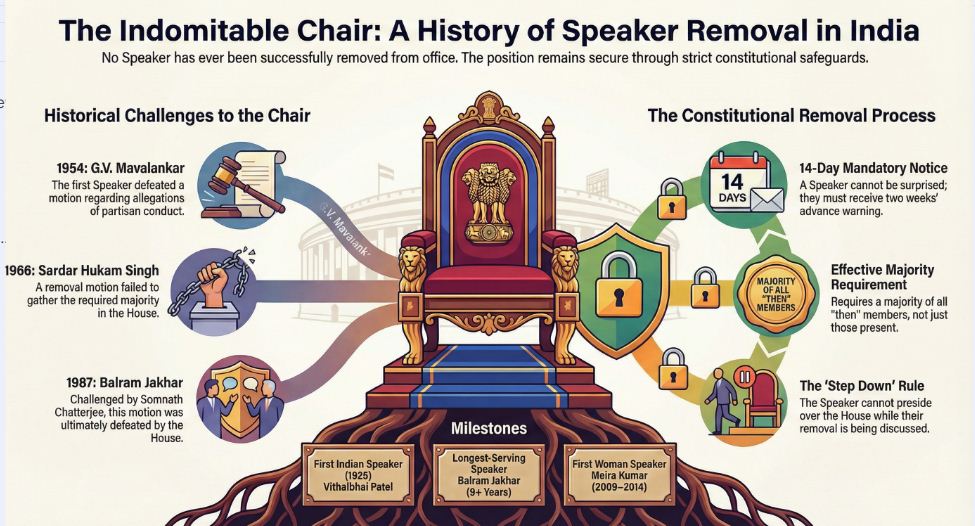
No. To date, there have been three major instances before the current 2026 notice where a resolution for the removal of the Speaker was moved, but none were successful:
-
1954: G.V. Mavalankar (The first Speaker)
-
The Challenger: Socialist leader Vigneshwar Misir.
-
The Reason: Allegations of being partisan and favoring the Congress government.
-
Outcome: The motion was defeated after a brief debate. Prime Minister Nehru famously defended the dignity of the Chair during this session.
-
-
1966: Sardar Hukam Singh
-
The Challenger: Socialist leader Madhu Limaye.
-
Outcome: The motion did not succeed as it failed to gather the required majority.
-
-
1987: Balram Jakhar
-
The Challenger: CPM MP Somnath Chatterjee.
-
The Reason: Allegations related to the Speaker’s conduct regarding certain parliamentary inquiries.
-
Outcome: The motion was defeated by the House.
-
[!IMPORTANT]
While “No-Confidence Motions” against Governments have passed (e.g., against Morarji Desai in 1979 and Atal Bihari Vajpayee in 1999), the Speaker’s position has remained technically secure through every challenge so far.
2. A Brief History of the Speaker’s Office:
The office of the Speaker in India evolved from the British model but has its own unique constitutional identity.
-
Pre-Independence: The office originated in 1921 under the Montagu-Chelmsford Reforms. Frederick Whyte was the first Speaker, but Vithalbhai Patel (1925) was the first Indian to be elected to the post.
-
Post-Independence: The Speaker is the “Guardian of the House.” Under Article 93 of the Constitution, the Lok Sabha must elect a Speaker as soon as it meets.
-
Longest Tenure: Balram Jakhar remains the longest-serving Speaker, holding the office for over 9 years (1980–1989).
-
First Woman Speaker: Meira Kumar (2009–2014).
3. How Removal Works (Article 94 & 96)?
For a motion to actually remove a Speaker (like the one currently against Om Birla), it must follow a very strict path:
-
14-Day Notice: You cannot surprise the Speaker; they must be given two weeks’ warning.
-
Effective Majority: Unlike regular bills, this requires a majority of all the “then” members (total strength minus vacancies), not just those present.
-
The “Step Down” Rule: While the motion is being discussed, the Speaker cannot preside over the House. They sit on the backbenches and have the right to speak and defend themselves, but they cannot vote except in the case of a tie (and even that is restricted).

October 17, 2025
October 16, 2025
October 6, 2025
September 24, 2025

