February 9, 2026
Daily Current Affairs for UPSC : 9 Feb 2026/ Tex-Eco Initiative:
Why in the news?
The textile industry is one of India’s oldest and most significant employers. The Budget 2026 is making headlines because it signals a transition from fragmented policy-making toward a value-chain approach. It aims to move India beyond being just a “cost-competitive supplier” to becoming a “value-setting player” in the global fashion economy.
Key Points of the 2026 Textile Budget:
Major New Initiatives:
The budget introduces several pillar programs aimed at different parts of the industry:
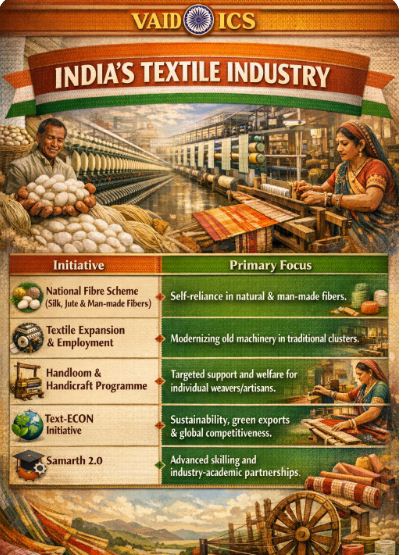
- National Fibre Scheme: Focused on raw material supply and sustainability.
- Textile Expansion and Employment Scheme: Aimed at scaling up manufacturing and job creation.
- Mahatma Gandhi Gram Swaraj Initiative: Specifically designed to strengthen the khadi, handloom, and handicraft sectors through better market access and branding.
- Samarth 2.0: An upgraded skill development program focused on workforce modernization.
Infrastructure & Scale:
The government proposes establishing new mega textile parks using a “challenge mode.” These hubs are intended to:
- Consolidate manufacturing in one place.
- Reduce high logistics costs.
- Encourage “value addition” (moving from raw fabric to finished fashion).
Critical Gaps Identified:
Despite the positive “moves,” the author points out three major areas where the budget remains silent:
- Value Creation: There is a lack of focus on design and brand ownership. Without these, India may remain a supplier rather than a global brand leader.
- Skill Framing: While Samarth 2.0 helps with operational skills, the author argues for more creative and managerial training to help translate traditional craft into modern markets.
- Artisan Vulnerability: While there is a focus on inclusion, the industry still faces fragmented supply chains and a lack of transparent pricing for local artisans.
Global Trade Challenges:
India faces “intense competition” from countries like Bangladesh. The article notes that while trade deals offer opportunities, long-term success depends on compliance with global standards and brand differentiation.
Tex-Eco Initiative:
Text-ECON” (often referred to as the Tex-Eco Initiative) is a strategic program launched by the Indian government to make India’s textile industry both globally competitive and environmentally sustainable.
Why was it launched?
The initiative is a direct response to new global trade regulations, specifically the European Union’s Ecodesign for Sustainable Products Regulation (ESPR). Starting in July 2026, the EU will ban the destruction of unsold textiles and require products to have “Digital Product Passports” to prove they are eco-friendly. Text-ECON helps Indian exporters meet these strict “green” standards so they don’t lose access to major international markets.
Key Pillars of the Text-ECON Initiative:
- Sustainability & Circularity: It provides financial and technical support for MSMEs to adopt circular manufacturing (recycling fabrics, reducing waste, and ensuring durability).
- Compliance with Global Standards: It helps factories meet international limits on things like microfiber shedding (ensuring less than 0.5g/kg per wash) and chemical usage.
- Eco-Certification: The scheme funds the creation of advanced testing and certification labs so Indian garments can be “green-certified” before being shipped abroad.
- Green Technology: It encourages the installation of Zero-Liquid Discharge (ZLD) systems to prevent water pollution in textile clusters like Tiruppur and Surat.

May 19, 2026
October 17, 2025
October 16, 2025
October 6, 2025

