February 6, 2026
Appointment of DGP :
Why in news ? The Supreme Court (SC) addressed the growing trend of states bypassing formal appointment processes to install “Ad-hoc” or “Acting” DGPs.
- The Issue: States like Telangana were found to be delaying the submission of eligible officer panels to the UPSC, often keeping “Acting” chiefs in place to avoid the UPSC’s oversight.
- SC Stance: The bench (CJI Surya Kant and Justice Joymalya Bagchi) criticized this practice, stating it undermines the rule of law.
- New Empowerment for UPSC: The Court clarified that the UPSC has the authority to:
- Send Reminders: Proactively nudge states to submit names before a vacancy occurs.
- Initiate Contempt: Trigger legal action against states that fail to comply with the established timelines.
The Prakash Singh Guidelines (2006 & 2018):
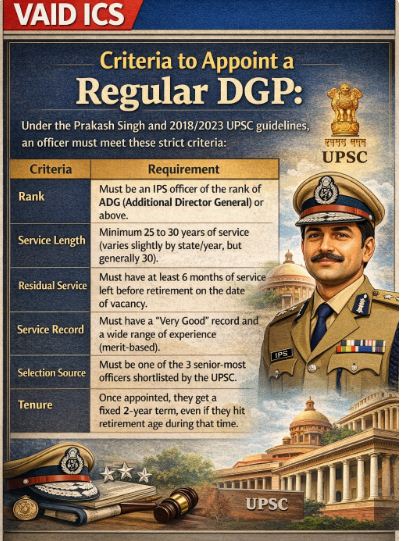
The selection of a DGP is governed by the landmark Prakash Singh vs. Union of India case, intended to insulate the police from political pressure.
The Selection Process
- Empanelment: The State Government sends a list of eligible IPS officers to the UPSC.
- The Shortlist: The UPSC narrows this down to the three senior-most officers based on:
- Length of service.
- “Very Good” service record.
- Range of experience.
- Final Choice: The State Government must appoint one of these three recommended candidates “immediately.”
Tenure and Security:
- Minimum Tenure: Once appointed, a DGP must have a minimum tenure of two years, regardless of their actual date of retirement (superannuation).
- Removal Grounds: A DGP can only be removed before two years under specific conditions:
- Conviction in a criminal or corruption case.
- Disciplinary action under All-India Services Rules.
- Physical or mental incapacity.
- Consultation with the State Security Commission.
The “Three-Month” Rule (2018 Amendment):
To prevent “Acting DGP” appointments, the SC refined the process in July 2018:
- Proactive Submission: States must send proposals to the UPSC at least three months before the incumbent DGP retires.
- Ban on Acting DGPs: The Court explicitly discouraged the appointment of “Acting DGPs,” insisting on permanent appointments through the UPSC panel.
Who is an Ad-hoc / Acting DGP?
An Acting DGP is an officer appointed to lead the state police force without going through the formal UPSC selection process.
- The Loophole: States sometimes appoint an “Acting” chief just before the regular DGP retires, claiming it’s a “temporary arrangement.”
- The Reality: Often, these “temporary” chiefs stay in the post for years. This allows State Governments to pick an officer of their personal choice rather than the most senior/meritorious one.
- The Court’s View: The Supreme Court (SC) has “thrown out” the concept of Acting DGPs. It says they must only be appointed in extreme emergencies and for very short periods.
Is the DGP a “Constitutional” Post?
Technically, no. The post of DGP is not created by the Constitution (unlike the Governor or the CAG).
- The Legal Basis: It is a statutory post under the Police Act of 1861 (or various State Police Acts).
- The Judicial Mandate: However, because “Police” and “Public Order” are State subjects under the 7th Schedule, the SC used its extraordinary powers under Article 142 to create binding rules. These rules carry the weight of law across India to ensure the police remain independent from political “masters.”
Why States Avoid This (The Conflict)?
States often argue that the UPSC’s involvement interferes with Federalism (the State’s right to manage its own police). They prefer “Acting DGPs” because:
- They can pick an officer who is lower in seniority but “loyal.”
- They can remove an “Acting” DGP much more easily than a “Regular” one who has a protected 2-year tenure.

October 17, 2025
October 16, 2025
October 6, 2025
September 24, 2025

