February 2, 2026
UNION BUDGET 2026-27/IMPORTANT TERMS FOR UPSC PRE & MAINS
OVERALL BUDGET PHILOSOPHY (MAINS READY INTRO)
Theme:
- Fiscal discipline + High public investment + Structural reforms
- Continuity with reform momentum + focus on Viksit Bharat @2047
Key Macro Signals:
- Growth rate ~ 7% (India fastest-growing major economy).
- Fiscal deficit on glide path.
- Emphasis on “crowding-in” private investment.
- Shift from welfare-only to productive capital expenditure.
TAX REFORMS & EASE OF DOING BUSINESS (GS III + ESSAY):
Income Tax Act, 2025
- Replaces Income Tax Act, 1961 from 1 April 2026.
- Sections reduced: ~800 → ~500.
- Objective: Certainty, simplicity, litigation reduction.
- Why it matters (Mains value):
-
- Reduces “tax terrorism.”
- Improves Ease of Doing Business.
- Enhances voluntary compliance.
Individual Taxpayer Relief (Pre + Mains)
- MACT compensation interest → Fully tax exempt.
- LRS TCS reduced to 2% for education, medical, tours.
- Automated lower/nil TDS for small taxpayers.
- Revised return filing extended till 31 March.
FISCAL CONSOLIDATION & DEBT PATH (VERY IMPORTANT)
Deficit & Debt Targets::
| Indicator | Value |
| Fiscal Deficit (BE 2026-27) | 4.3% of GDP |
| Debt-GDP | 55.6% |
| Target Debt-GDP | 50±1% by 2030-31 |
UPSC Angle:
- Counter-cyclical fiscal policy.
- Long-term macroeconomic stability.
- Lower interest burden → more social & infra spending.
PUBLIC CAPEX & INFRASTRUCTURE PUSH (GS III CORE)
Capital Expenditure:
- Rs 12.2 lakh crore public capex (FY 2026-27).
- Focus: Roads, railways, ports, logistics, cities.
New Instruments:
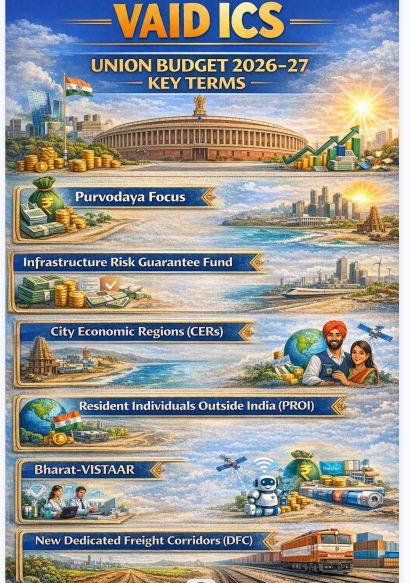
- Infrastructure Risk Guarantee Fund → de-risking private investment.
- City Economic Regions (CERs) for Tier II/III cities.
Logistics Expansion:
- New Freight Corridors.
- 20 new National Waterways.
- Coastal cargo share target: 12% by 2047.
- Inland waterways + ship repair hubs.
MANUFACTURING & INDUSTRIAL POLICY (Make in India 2.0):
7+ Strategic Manufacturing Sectors:
- Semiconductors (ISM 2.0): Equipment + Indian IP.
- Biopharma SHAKTI: Biologics, biosimilars.
- Electronics components: Rs 40,000 cr.
- Rare Earth Corridors: Strategic minerals.
- Chemical Parks: Cluster-based.
- Capital Goods: Container manufacturing, CIE scheme.
- Textiles: National Fibre Scheme, Mega Textile Parks.
- Khadi & Sports Goods: Gram Swaraj + global branding.
Mains Linkages:
- Import substitution.
- Export competitiveness.
- Employment-intensive manufacturing.
MSMEs & LEGACY CLUSTERS (PRE + MAINS)
- Revival of 200 legacy clusters.
- SME Growth Fund: Rs 10,000 cr.
- TReDS mandatory for CPSE-MSME payments.
- Corporate Mitras: Compliance handholding.
Impact:
- Formalisation.
- Credit access.
- Productivity enhancement.
GREEN TRANSITION & ENERGY SECURITY :
Panchamrit in Action:
- Green Hydrogen Mission.
- Small Modular Reactors (SMRs) funding.
- CCUS (Carbon Capture, Utilization, and Storage): Rs 20,000 cr for steel, cement, power.
Why UPSC loves this:
- Net Zero 2070.
- Climate finance + energy transition.
- Balancing growth & sustainability.
FINANCIAL SECTOR & CAPITAL MARKETS
- Banking reforms committee for Viksit Bharat.
- Corporate bond market market-making framework.
- Municipal bonds incentive.
- MAT reduced to 14%, becomes final tax.
- Buyback tax rationalised.
- Prelims keywords: MAT, STT, Safe Harbour, Municipal Bonds.
SOCIAL SECTOR: EDUCATION, HEALTH & TOURISM
Education & Skills:
- Education → Employment linkage.
- AVGC labs in schools & colleges.
- Girls’ STEM hostels (1 per district).
Health:
- Allied Health Professionals (100,000).
- Geriatric caregivers.
- Medical tourism hubs.
- NIMHANS-2 (mental health).
Tourism:
- National Digital Knowledge Grid.
- Adventure + heritage tourism circuits.
- Experiential archaeology.
AGRICULTURE & INCLUSION (GS III)
- High-value crops focus.
- Fisheries & reservoirs.
- AI-based Bharat-VISTAAR advisory.
- Women: SHE-Marts.
- Divyangjan: Skill & assistive devices.
- Purvodaya focus: East India development.
PRELIMS-ORIENTED ONE-LINERS
- Fiscal deficit BE 2026-27: 4.3%.
- Public capex: Rs12.2 lakh crore.
- Income Tax Act, 2025 effective: 1 April 2026.
- CCUS outlay: Rs 20,000 crore.
- Debt-GDP target: 50±1% by 2030-31.
- Courier export value cap: Removed.
- MAT reduced to: 14%.
MAINS ANSWER VALUE ADD (USE THESE PHRASES)
- “Crowding-in effect of public capex”
- “Transition from consumption-led to investment-led growth”
- “Fiscal prudence with developmental orientation”
- “Structural transformation of Indian economy”
- “Green growth pathway aligned with Panchamrit”
UPSC/PCS –PRE & MAINS
IMPORTANT TERMS :
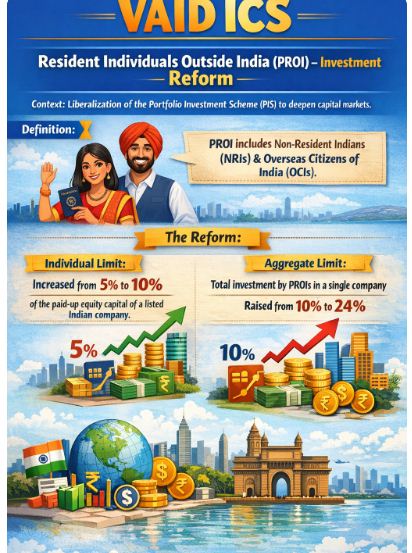
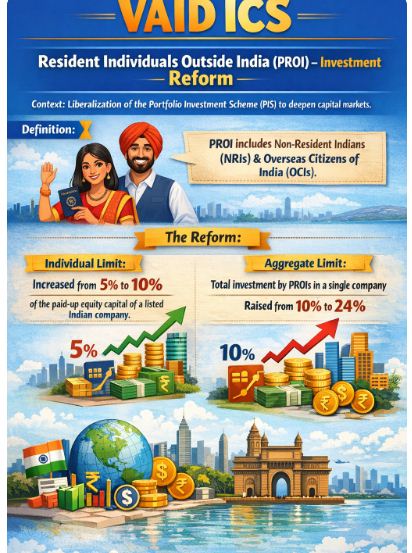
Resident Individuals Outside India (PROI) – Investment Reform:
Context: Liberalization of the Portfolio Investment Scheme (PIS) to deepen capital markets.
Definition: PROI includes Non-Resident Indians (NRIs) and Overseas Citizens of India (OCIs).
The Reform: * Individual Limit: Increased from 5% to 10% of the paid-up equity capital of a listed Indian company.Aggregate Limit: The total investment by all PROIs in a single company increased from 10% to 24%.
- Significance: Encourages stable, long-term capital inflows from the Indian diaspora and improves price discovery in the stock market.
Bharat-VISTAAR (Virtually Integrated System to Access Agricultural Resources):
Context: A flagship AI-driven digital public infrastructure for “Precision Farming.”
Mechanism: A multilingual AI tool that integrates AgriStack (digital farmer records) with ICAR’s (Indian Council of Agricultural Research) scientific “package of practices.”
Key Features:
Customized Advisory: Soil health-based crop selection, real-time weather alerts, and pest management.
Last-Mile Connectivity: Available in Hindi, English, and regional languages to bridge the information gap.Risk Reduction: Helps farmers mitigate climate-related risks through predictive analytics.
Liberalized Remittance Scheme (LRS) & TCS Rationalization:
Context: Easing the liquidity burden on middle-class families for global mobility.
- LRS Overview: Allows residents to remit up to USD 250,000 per year for travel, education, medical, or investment.
- Budget 2026 Change: * Overseas Tours: TCS slashed from a complex 5%/20% structure to a flat 2% (with no threshold).
- Education & Medical: TCS reduced from 5% to 2% for remittances exceeding Rs 10 lakh.
- Mains Value: This moves away from using high TCS as a “tax tracking” tool toward “Ease of Living,” preventing the locking up of family capital for months.
Biopharma SHAKTI:
Context: Strategy to transform India from a “Generics Hub” to a “Global Biopharma Manufacturing Hub.”
- Outlay:Rs 10,000 crore over 5 years.
- Components:
- NIPER Expansion: 3 new National Institutes of Pharmaceutical Education and Research and 7 upgrades.
Clinical Trials: A network of 1,000+ accredited sites to facilitate domestic biologics and biosimilars.
- Regulator Strengthening: Specialized scientific review cadre for CDSCO to meet global approval timelines.
Industrial & Chemical Clusters (Strategic Geography):
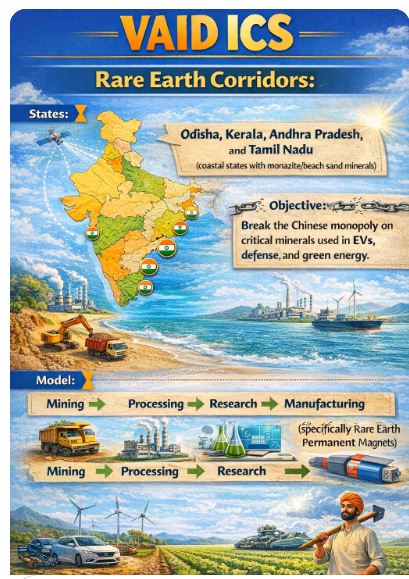
A. Rare Earth Corridors:
- States: Odisha, Kerala, Andhra Pradesh, and Tamil Nadu (coastal states with monazite/beach sand minerals).
- Objective: Break the Chinese monopoly on critical minerals used in EVs, defense, and green energy.
- Model: Integrated hubs for Mining → Processing → Research → Manufacturing (specifically Rare Earth Permanent Magnets).
B. Chemical Parks:
- Mechanism: Established via the “Challenge Route” (States compete based on ease of doing business).
- Plug-and-Play Model: Ready-to-use infrastructure (effluent plants, logistics) to reduce “Time to Market” and import dependency.
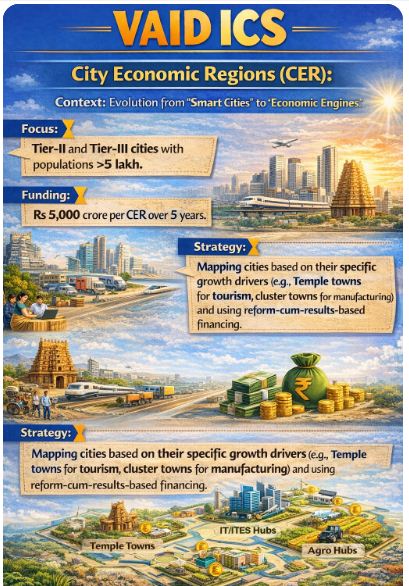
City Economic Regions (CER):
Context: Evolution from “Smart Cities” to “Economic Engines.”
- Focus: Tier-II and Tier-III cities with populations >5 lakh.
- Funding: Rs 5,000 crore per CER over 5 years.
- Strategy: Mapping cities based on their specific growth drivers (e.g., Temple towns for tourism, cluster towns for manufacturing) and using reform-cum-results-based financing.Tourism: Trails & Digital Infrastructure:
A. National Destination Digital Knowledge Grid:
- A unified digital repository to document cultural, spiritual, and historic
- Utility: Improves discoverability for tourists and provides data for evidence-based planning for local bodies.B. Specialized Trails (Experiential Tourism):
- Mountain Trails: In HP, Uttarakhand, and J&K.
- Turtle Trails: Coastal Odisha, Karnataka, and Kerala (focusing on nesting sites like Gahirmatha).
- Bird-Watching Trails: Pulicat Lake (Andhra/Tamil Nadu) and other wetlands.Infrastructure & Logistics:
A. Infrastructure Risk Guarantee Fund:
- Objective: To provide partial credit guarantees to lenders.
- Impact: De-risks the “construction phase” for private developers, encouraging private banks to lend more freely to long-gestation infra projects.B. New Dedicated Freight Corridors (DFC)
- Route: Dankuni (West Bengal) to Surat (Gujarat).
- Connectivity: Connects 6 states; links the Eastern DFC to the Western DFC.
- Significance: Enables high-speed, high-axle-load cargo movement from eastern mineral belts to western ports.

October 17, 2025
October 16, 2025
October 6, 2025
September 24, 2025

