January 23, 2026
Daily Current Affairs for UPSC : 23 Jan 2026/Delhi Food Security Rules, 2025
In January 2026, the Delhi Food Security Rules, 2025 gained significant media attention after being approved by the Delhi Cabinet and sent to the Lieutenant Governor for final notification. The rules aim to overhaul the city’s Public Distribution System (PDS) to prioritize the “poorest of the poor” and clear a decade-long backlog of over 11 lakh people waiting for food security benefits.
Why in the News?
- Approval of New Policy: Chief Minister Rekha Gupta’s cabinet approved the “Delhi Food Security Rules, 2025,” the first major update to the city’s food security framework since 2013.
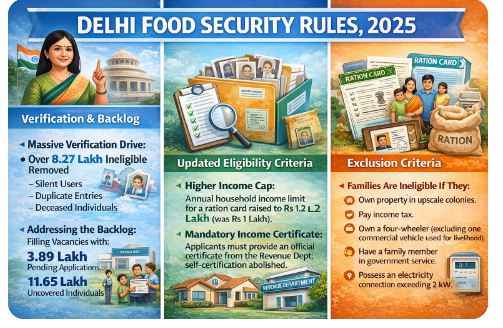
- Massive Verification Drive: A recent data review uncovered significant irregularities, leading to the removal of over 27 lakh ineligible beneficiaries, including “silent” users (those not claiming rations), duplicate entries, and deceased individuals.
- Addressing the Backlog: The new rules are designed to fill these newly created vacancies with the 89 lakh pending applications and 11.65 lakh individuals currently without coverage.
Key Points of the 2025 Rules:
1. Revised Eligibility Criteria
- Higher Income Cap: The annual household income limit for a ration card has been raised to Rs 1.2 lakh, up from the previous Rs1 lakh.
- Mandatory Income Certificate: Applicants must now provide an official income certificate from the Revenue Department; the previous self-certification system has been abolished to prevent misuse.
- Exclusion Criteria: Families are ineligible if they:
- Own property in A to E category (upscale) colonies.
- Pay income tax.
- Own a four-wheeler (excluding one commercial vehicle used for livelihood).
- Have a family member in government service.
- Possess an electricity connection exceeding 2 kW.
2. Structural Reforms:
- End of “First-Come, First-Served”: This model is replaced by a need-based prioritization
- District-Level Committees: Applications will be scrutinized and prioritized by committees led by District Magistrates (DM) or Additional District Magistrates (ADM), including local MLAs.
- District Population Quotas: Ration card allocation will now be based on each district’s population to ensure more equitable distribution.
- 20% Waiting List: A permanent waiting list will be maintained to fill vacancies immediately as they arise.
3. Accountability and Technology:
- Multi-Tiered Grievance Redressal: A new system for complaints will be established at circle, district, and state levels.
- Technology-Driven System: The framework emphasizes a digital approach to prevent fraud and ensure transparency in grain distribution.

Gist of daily Article /The Hindu 17oct 2025
October 17, 2025
Daily Gist of the Hindu/Indian Express : 16 Oct 2025
October 16, 2025
Daily Gist of The Hindu/Indian Express: 6 Oct 2025
October 6, 2025
Daily Gist of Article /The Hindu /Indian Express: 24 Sep 2025
September 24, 2025

