January 21, 2026
Prime Minister Dhan-Dhaanya Krishi Yojana (PMDDKY):
Why in the News? The scheme is currently in the news because the Union Cabinet, chaired by Prime Minister Narendra Modi, formally approved its implementation details on January 21, 2026.
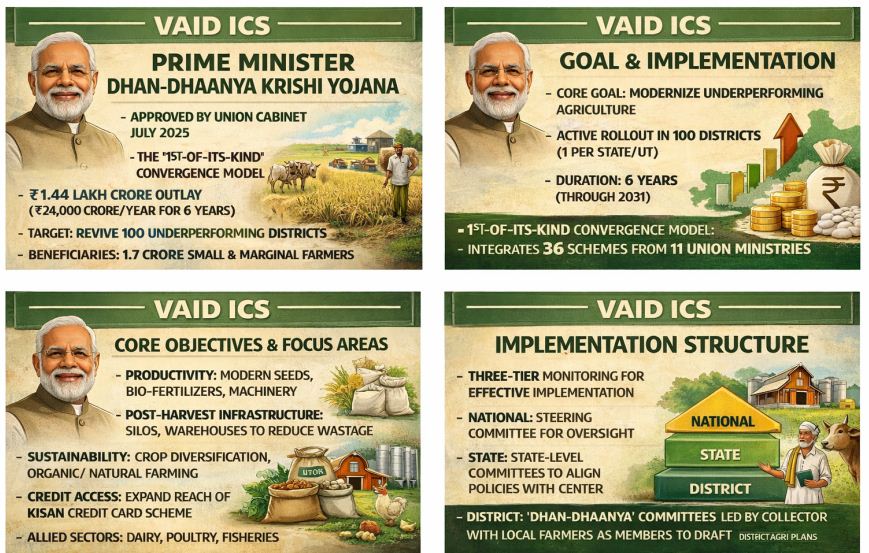
The Prime Minister Dhan-Dhaanya Krishi Yojana (PMDDKY) is a flagship agricultural transformation initiative approved by the Union Cabinet in July 2025 (and officially launched in October 2025) to modernize farming in India’s underperforming regions
- Budgetary Commitment: It follows through on the promise made in the Union Budget 2025-26.
- Massive Outlay: The government has committed Rs 24,000 crore annually for a period of six years (totaling Rs 1.44 lakh crore through 2031).
- Operational Launch: The news highlights the transition from a “proposal” to an “active rollout” phase across 100 identified districts.
Key Points of PMDDKY:
This scheme is described as a “first-of-its-kind” convergence model for the agriculture sector.
- Target Audience: It aims to directly benefit 1.7 crore farmers, specifically small and marginal landholders.
- Geographic Focus: It targets 100 underperforming districts across India. To ensure regional balance, at least one district is selected from every State and Union Territory.
- The Convergence Model: Instead of creating a new administrative silo, it merges 36 existing schemes from 11 different Union Ministries (including Rural Development, Jal Shakti, and Finance) into one unified framework.
- Strategic Inspiration: It is modeled after the Aspirational Districts Programme (ADP), utilizing the same “3Cs” approach: Convergence, Collaboration, and Competition.
Core Objectives & Pillars:
The scheme focuses on a “saturation approach” to fix the gaps in the agricultural value chain:
- Productivity: Providing high-yielding seeds, bio-fertilizers, and modern machinery.
- Post-Harvest Infrastructure: Building storage units (silos, warehouses) at the Panchayat and Block levels to reduce wastage.
- Sustainable Practices: Shifting away from monoculture toward crop diversification and promoting natural/organic farming.
- Credit Access: Expanding the reach of the Kisan Credit Card (KCC) and facilitating both short-term (input) and long-term (asset building) loans.
- Allied Sectors: Integrating dairy, poultry, and fisheries to ensure farmers have multiple income streams.
Implementation Structure (Three-Tier):
To ensure the scheme doesn’t fail due to poor local management, a strict monitoring hierarchy has been established:
- National Level: A National Steering Committee for oversight.
- State Level: State-level committees to align local policies with the center.
- District Level: Led by the District Dhan Dhaanya Samiti (chaired by the District Collector), which includes progressive farmers as members to draft “District Agriculture and Allied Activities Plans.”
Selection Criteria for Districts:
Districts are not chosen randomly; they are identified based on three specific data-driven indicators:
- Low Agricultural Productivity: Output per hectare is significantly below the national average.
- Low Cropping Intensity: Land is left fallow for large parts of the year.
- Low Credit Disbursement: Farmers have limited access to institutional banking.

October 17, 2025
October 16, 2025
October 6, 2025
September 24, 2025

