December 29, 2025
Daily Current Affairs UPSC : 29 Dec 2025/ Somali Land/ History of Somali Land
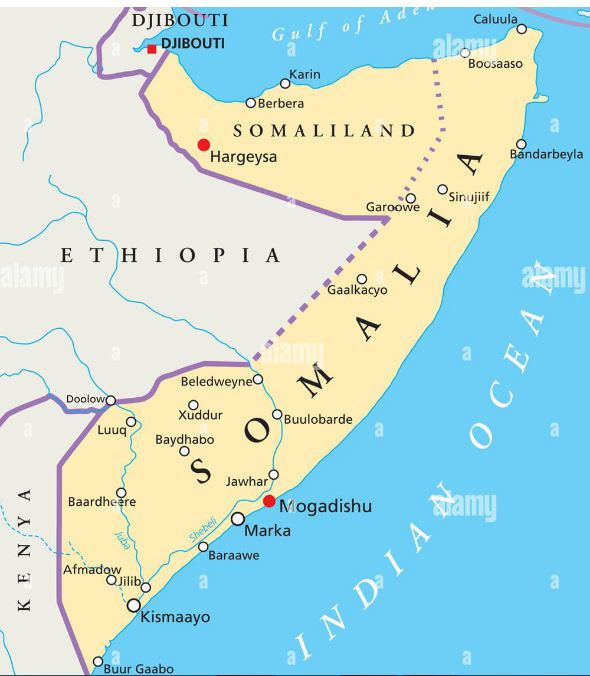
Why in the news? On December 26, 2025, Israel became the first country in the world to formally recognize the Republic of Somaliland as an independent and sovereign state. This is a historic breakthrough for Somaliland, which has operated as a de facto independent state since 1991 but had never received official recognition from a UN member state until now.
Strategic and Geopolitical Aspects :
1. The “Abraham Accords” Expansion:
-
The Framework: Prime Minister Netanyahu framed the recognition as being “in the spirit of the Abraham Accords.“
-
Regional Strategy: By recognizing Somaliland, Israel aims to expand its network of allies in the Horn of Africa and the Muslim world, even as it faces diplomatic tension elsewhere.
-
Somaliland’s Role: President Abdirahman Mohamed Abdullahi has expressed readiness for Somaliland to officially join the Accords.
2. Maritime and Security Interests (The Red Sea):
-
Berbera Port: Somaliland controls a critical coastline along the Gulf of Aden. The Port of Berbera is a vital gateway to the Red Sea.
-
Countering Houthis: Proximity to Yemen makes Somaliland a “forward base” for monitoring and conducting operations against Houthi militants, who have frequently targeted Red Sea shipping.
-
UAE Influence: The United Arab Emirates already has a military presence in Berbera, and Israel’s recognition aligns with the UAE’s regional security goals.
3. Monitoring China:
-
Djibouti Alternative: China has a major military base in neighboring Djibouti. Israel and its allies (like the US) view Somaliland as a strategic “hedge” to monitor and counter growing Chinese influence in the Horn of Africa.
-
The Taiwan Factor: Somaliland is one of the few places that recognizes Taiwan. By supporting Somaliland, Israel aligns with a territory that already challenges China’s “One China” policy.
4. Domestic Autonomy vs. International Law:
-
Functioning State: The news highlights that Somaliland already has its own currency, police, and democratic elections, making it a more stable partner than the rest of Somalia.
-
Legal Successor: Somaliland claims to be the successor of the 1960 “State of Somaliland” (the former British protectorate), which was independent for five days before joining Somalia.
Regional and Global Reactions:
-
Somalia’s Condemnation: Somalia views this as a “deliberate attack” on its sovereignty and territorial integrity.
-
African Union (AU): The AU has “firmly rejected” the move, fearing it sets a dangerous precedent for other secessionist movements across the continent.
-
International Backlash: Nations like Turkey, Egypt, and Djibouti have condemned the recognition, viewing it as interference in Somalia’s internal affairs.
-
US Uncertainty: While some US politicians (like Senator Ted Cruz) support the move, President Trump has reportedly expressed skepticism, famously asking, “Does anyone know what Somaliland is, really?”
History of Somali Land:
The Colonial Split (1884–1960):
The roots of the current situation lie in the “Scramble for Africa.” Unlike most of the Somali-inhabited territories, the region was divided between two different European powers:
- British Somaliland (North): The British established a protectorate in 1884. They governed it with a “light touch,” primarily using it to supply meat for their naval base in Aden.
- Italian Somaliland (South): Italy colonized the southern region, establishing a much more direct and invasive administrative system.
Five Days of Independence (June 1960):
This is the legal “smoking gun” for Somaliland’s current claim to sovereignty:
- On June 26, 1960, British Somaliland gained independence and became the State of Somaliland.
- It was a sovereign nation for five days, during which it was recognized by 35 countries (including the US, UK, and Israel).
- On July 1, 1960, driven by a romanticized vision of “Pan-Somalism,” the State of Somaliland voluntarily entered a union with the newly independent Italian Somaliland to form the Somali Republic.
The Failed Union and “Somalisation” (1969–1991):
The union was troubled from the start. Northerners felt marginalized by the southern-dominated government in Mogadishu.
- Siad Barre’s Rise: In 1969, General Siad Barre took power in a coup. He attempted to eliminate clan identities through a process of “Somalisation.”
- The Rebellion: By the 1980s, the Somali National Movement (SNM) was formed in the north to fight against Barre’s increasingly oppressive regime.
- The Genocide: Between 1987 and 1989, Barre responded with extreme brutality. He ordered the aerial bombardment of Hargeisa (the capital of Somaliland), killing between 50,000 and 200,000 people. This is often referred to as the Isaaq Genocide.
Re-Declaration of Independence (1991–Present):
As the central government in Mogadishu collapsed into total civil war in 1991, the SNM and northern clan elders decided to dissolve the union.
- May 18, 1991: At the Grand Conference in Burao, Somaliland re-asserted its independence based on its 1960 colonial borders.
- State Building: While the rest of Somalia struggled with warlords and Al-Shabaab, Somaliland spent 30 years building a stable democracy with its own:
- Currency: The Somaliland Shilling.
- Democratic Elections: They have held multiple peaceful, one-man-one-vote elections.
- Security: A disciplined army and police force that have kept the region largely free of terrorism.

October 17, 2025
October 16, 2025
October 6, 2025
September 24, 2025

