December 24, 2025
Government of National Unity (GNU): Libya
Why in News ? Pakistan has secured one of its biggest arms deals in history and will sell $4-billion-worth of military hardware to Libya. The deal, apart from land and naval equipment, also includes fourth-generation JF-17 fighter jets, jointly developed by Pakistan and China. This is how Beijing will also gain from the deal amid its bid to expand its footprint in the global arms market.
Pakistan has secured one of the largest arms deals in its history and will be selling an estimated $4-billion-worth of military equipment to Libya. The agreement was finalised following a meeting between Pakistan’s military chief, Field Marshal Asim Munir, and Libyan National Army Deputy Commander-in-Chief Saddam Khalifa Haftar in Benghazi, last week, according to news agency Reuters.
While Islamabad has yet to formally confirm the full scope of the agreement, Reuters reported that the package includes 16 JF-17 multi-role fighter jets and 12 Super Mushshak trainer aircraft, which are used for basic pilot training.
- Pakistani officials told Reuters that the deal covers a broad range of land, sea, and air equipment, with deliveries scheduled over a period of two-and-a-half years.
- A cash-strapped Pakistan, whose economy has been in shambles, directly depends on IMF bailouts, and has been trying to increase its defence exports. Most of its defence equipment is based on Chinese technology transferred to it. For example, the JF-17 fighter jet, which is co-developed by the Pakistan Aeronautical Complex (PAC) in partnership with China’s Chengdu Aircraft Industry Group.
- Today, with assistance from China, Pakistan’s defence industry manufactures armoured vehicles, munitions, and some naval construction too.
- Pakistan has previously sold the JF-17 to Nigeria, Azerbaijan, and Myanmar. The deals indirectly benefited China as it positioned itself as a major arms hub while competing with the West and Russia.
HOW IS CHINA INVOLVED WITH THE PRODUCTION AND SALE OF THE JF-17?
- Though Pakistan has sold the JF-17 fighter jet to a few countries and with several other countries reportedly exploring potential acquisitions, Islamabad remains the main operator of the warbird. It has been in service in the Pakistan Air Force since 2010.
- The JF-17 is a 4th-generation, single-engine powered, light-weight, multi-role fighter jet. It is capable of a variety of roles, including intercepting enemy jets, striking ground targets, attacking naval targets and conducting aerial reconnaissance.
- The JF-17’s production remains heavily dependent on imported Chinese components, with Pakistan mainly responsible for building the airframe and assembly. Many of the jet’s most important parts, such as its Active Electronic Scanned Array (AESA) radars, electronic warfare suite, cockpit avionics and most of its munitions, are imported from China.
Libyan National Army (LNA):
the country remains deeply divided between two primary political and military power centers. the Libyan National Army (LNA) and the Government of National Unity (GNU)
The Libyan National Army (LNA):
The LNA is the military force controlling Eastern and Southern Libya, including the critical “Oil Crescent” where most of Libya’s energy wealth is located.
- Leader: Field Marshal Khalifa Haftar.
- Headquarters: Benghazi and Tobruk.
- Political Affiliation: It is the military arm of the House of Representatives (HoR), Libya’s elected parliament that relocated to the east after conflict broke out in Tripoli.
- Military Characteristics: The LNA is structured more like a conventional army than its rivals. It consists of professional soldiers, former Gaddafi-era officers, and various tribal militias.
- Strategic Goal: Haftar’s primary goal has been to unify Libya under a strong centralized military leadership, often positioning himself as a bulwark against Islamic extremism.
- Foreign Support: Traditionally supported by Egypt, the UAE, and Russia (including the Wagner Group/Africa Corps). The recent deal with Pakistan signifies an effort to modernize its air force and ground tech to gain a decisive edge over Tripoli.
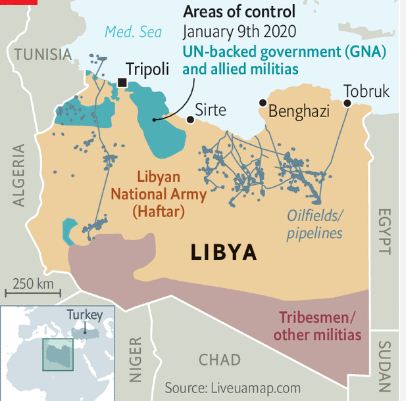
The Government of National Unity (GNU):
The GNU is the internationally recognized interim government based in Western Libya.
- Leader: Prime Minister Abdulhamid al-Dbeibah.
- Headquarters: Tripoli.
- Political Affiliation: It was established in 2021 through a UN-led political process (the Libyan Political Dialogue Forum) intended to lead the country to national elections.
- Military Characteristics: Unlike the LNA, the GNU does not have a single unified army. Instead, it relies on a coalition of powerful, semi-autonomous militias and armed groups based in Tripoli, Misrata, and Zintan.
- Strategic Goal: The GNU seeks to maintain international legitimacy, control the Central Bank of Libya (to manage oil revenues), and eventually hold national elections—though these have been repeatedly delayed.
- Foreign Support: Primarily supported by Turkey (which provides significant drone technology and military advisors) and Qatar, with varying degrees of diplomatic backing from the UN and Western nations like Italy and the US.

October 17, 2025
October 16, 2025
October 6, 2025
September 24, 2025

